
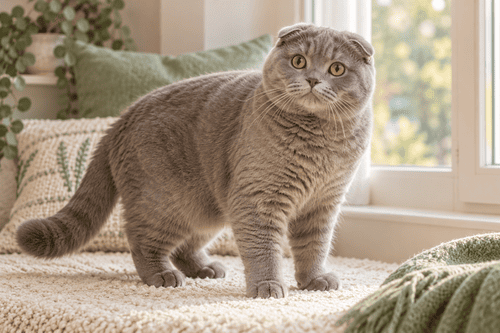
Scottish Fold
Owl-faced and irresistibly round — the cat the internet loves.
The Scottish Fold is instantly recognisable by its unique folded ears, which give it an owl-like expression. Round-faced, round-eyed and compact, Scottish Folds are calm, adaptable and devoted to their families. However, the gene responsible for their ear fold also causes a serious skeletal condition — making health-aware ownership and responsible breeding critically important.
At a glance
- Origin
- Scotland, UK
- Size
- Medium
- Weight
- 6–13 lb (2.7–6 kg)
- Lifespan
- 11–15 years
- Coat
- Short and dense or semi-long (Highland Fold)
- Colours
- Almost all colours and patterns
Breed ratings
Rated 1–5 on the same scale as every other entry, so scores are comparable between breeds. Amber stars mark things that cost you effort rather than things that benefit you.
Diet & Feeding
Scottish Folds are moderately active and can gain weight easily in middle age. Feed a high-protein wet food twice daily with limited dry food. Joint health supplements containing glucosamine and omega-3 fatty acids are worth discussing with your vet, given the breed's predisposition to skeletal issues. Fresh water should always be available — a fountain encourages hydration.
Exercise & Play
Scottish Folds enjoy moderate play — two sessions of 10–15 minutes daily with wand toys or puzzle feeders is sufficient. They are not highly active cats. Watch for reluctance to jump or play, which can indicate the joint pain associated with osteochondrodysplasia — this is a medical signal, not laziness.
Grooming
Short-coated Folds need brushing once a week; semi-long Highland Folds need 2–3 times a week. Their folded ears require particular attention — the fold reduces airflow, making ear infections more likely. Clean ears weekly with a vet-approved cleaner. Wipe the face daily if there is any eye discharge. Trim nails every 2–3 weeks.
Health & Vet Care
This breed has a serious inherited condition: osteochondrodysplasia (OCD) — a painful degenerative joint disease caused by the same gene mutation that folds the ears. ALL Scottish Folds carry some degree of this condition; homozygous (Fold x Fold) breeding dramatically worsens it. Signs include stiff gait, reluctance to move and tail rigidity. Choose only reputable breeders who cross Folds with straight-eared cats. Regular vet monitoring is essential.
Living with a Scottish Fold
Scottish Folds are quiet, calm and highly adaptable — they suit apartments and busy family homes equally well. They enjoy being near their people but are not demanding. They get along well with children and other pets. Due to their health concerns, it is vital to monitor mobility throughout life and seek veterinary advice at the first sign of stiffness or discomfort. Regular check-ups every 6 months are recommended.
Read next
 How to Help a Shy or Fearful Cat Gain ConfidenceA cat that hides when anyone comes in is not unfriendly — it is frightened. Here is how to build a shy cat's confidence with safe spaces, predictable routines and letting the cat set the pace.
 How Lost Pets Actually Get Home — and How to Make Yours Easier to ReturnMost lost pets are found close to home by an ordinary person with a phone. What happens in the next few minutes decides how fast they get back. Here is how reunions really happen, and how to prepare.
 Pet Chores for Kids by Age: A Family Guide That Actually WorksChildren can genuinely help look after a family pet — with the right jobs for their age and adult supervision. Here are age-appropriate pet chores, safety rules and a simple chart to keep it on track.