
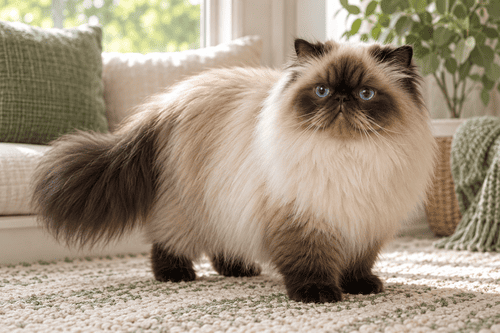
Himalayan
Also known as: Himmy, Colourpoint Persian
A Persian in Siamese colours — placid, beautiful and a genuine daily grooming commitment.
- Placid
- Gentle
- Affectionate
- Quiet
- Undemanding
The Himalayan was created by crossing Persians with Siamese to produce a long-coated cat with colourpoint markings and blue eyes. In temperament it is essentially a Persian: quiet, gentle, undemanding and content indoors. It also inherits the Persian coat and the Persian flat face in full, which means daily grooming and daily face care are not optional extras but the core of ownership.
At a glance
- Origin
- United States / United Kingdom
- Size
- Large
- Weight
- 7–13 lb (3.2–5.9 kg)
- Lifespan
- 12–15 years
- Coat
- Long, dense, silky double coat
- Colours
- Seal, Blue, Chocolate, Lilac, Red, Cream, Tortie and Lynx points
- Average cost
- $75–$85 / month
Breed ratings
Rated 1–5 on the same scale as every other entry, so scores are comparable between breeds. Amber stars mark things that cost you effort rather than things that benefit you.
Temperament
Himalayans are calm to the point of stillness — happy to sit near their people for hours, rarely destructive and rarely vocal. They are affectionate without being demanding and cope well with routine household life.
Care & upkeep
Exercise
Two gentle 10-minute sessions daily. They will not exercise themselves, so movement has to be encouraged actively for weight management.
Grooming
Daily combing to the skin is non-negotiable — this coat mats within days. Wipe the face and eye folds daily and dry thoroughly.
Training
Placid and easy to handle. They accept grooming, nail trims and carriers with minimal fuss, which is fortunate given how much handling this coat requires.
Feeding & diet
- Typical diet
- High-protein wet-led diet
- Daily amount
- 180–260 g wet food, or equivalent
- Meals per day
- 2 meals a day
Use a shallow wide bowl — a flat face makes deep dishes genuinely difficult. Himalayans are sedentary and gain weight readily, which directly worsens the breathing problems inherent to the face shape.
Foods to avoid
- Onion and garlic
- Chocolate
- Grapes and raisins
- Raw dough
- Free-fed dry food
Who this breed suits
A good match for
- Apartments
- Quiet households
- Owners who enjoy grooming
- Families with older children
Probably not for
- Hot climates without climate control
- Owners unwilling to groom daily
- Households wanting an active cat
Common health problems
This section describes conditions the breed is known to be predisposed to, so you know what to ask about. It is not veterinary advice and is not a diagnosis — always speak to a vet about your own animal.
- Brachycephalic airway syndromeThe flat face restricts airflow. Noisy breathing at rest warrants veterinary assessment.
- Polycystic kidney diseaseInherited from Persian lines and DNA-testable. Insist on a negative certificate.
- Eye conditionsProminent eyes and blocked tear ducts cause chronic weeping, staining and ulcer risk.
- Dental crowdingA shortened jaw with full dentition leads to early dental disease.
- Heat intoleranceFlat-faced cats cool poorly and need a temperature-controlled home in summer.
Face shape determines quality of life. Choose breeders producing cats with visible nostrils and a less extreme profile, and treat noisy breathing as a veterinary matter rather than a breed trait.
Interesting facts
- Created by crossing Persians with Siamese to bring colourpoint markings into a longhaired cat.
- Registered as a separate breed in some associations and as a Persian variety in others.
- All colourpoint kittens are born pale and darken over the following weeks.
Diet & Feeding
Use a shallow, wide bowl — a flat-faced cat cannot eat comfortably from a deep dish and will either eat less than it should or make a considerable mess. Feed a measured 180–260 g of quality wet food daily across two meals and avoid leaving dry food out. Himalayans are sedentary and gain weight easily, and in a brachycephalic breed excess weight worsens breathing directly. A fountain encourages the drinking that supports kidney health.
Exercise & Play
Himalayans will not exercise themselves. Two gentle 10-minute sessions daily with a wand toy or a rolling ball is realistic, and the aim is weight management as much as entertainment. They enjoy short bursts of play and then long rest. Puzzle feeders that make them work slightly for food are among the more effective tools. They are strictly indoor cats and should never be given unsupervised outdoor access.
Grooming
Daily grooming is non-negotiable. The long dense coat with a full undercoat mats within days if neglected, and a badly matted cat needs sedation and clipping. Comb right down to the skin with a wide-tooth comb, paying attention to the ruff, armpits, trousers and behind the ears. Bathe every 4–6 weeks. Wipe the face and eye folds daily — blocked tear ducts are near-universal and the resulting damp causes staining and skin infection.
Health & Vet Care
Himalayans carry the Persian health burden in full: brachycephalic airway syndrome, polycystic kidney disease (DNA-testable — insist on negative results), chronic eye conditions including entropion and ulcers, dental crowding and heat intolerance. Noisy breathing at rest is not breed charm but restricted airflow. The most consequential decision you make is the breeder: choose lines with visible nostrils and a less extreme profile, which are meaningfully healthier.
Living with a Himalayan
This is a calm, quiet, affectionate cat that will sit near you for hours and rarely causes trouble. They suit apartments, families with older children and first-time owners who understand the workload. The honest trade-off is time: daily combing, daily face care, weight management and a cool home in summer are the ongoing requirements. Accept those and the Himalayan is one of the most restful cats to share a house with.
Read next
 How to Help a Shy or Fearful Cat Gain ConfidenceBuild trust through accessible retreats, quiet company and voluntary play or touch. Includes room checks, response decisions, visitor wording and an example.
 How Lost Pets Actually Get Home — and How to Make Yours Easier to ReturnFollow four reunion routes from finder to owner. Includes contact steps, scanning and service decisions, ownership checks, safe handover and a worked example.
 Pet Chores for Kids by Age: A Family Guide That Actually WorksChoose manageable tasks by ability, supervision and pet comfort. Includes age-band ideas, higher-risk exclusions, a sample family chart and an adult backup plan.