
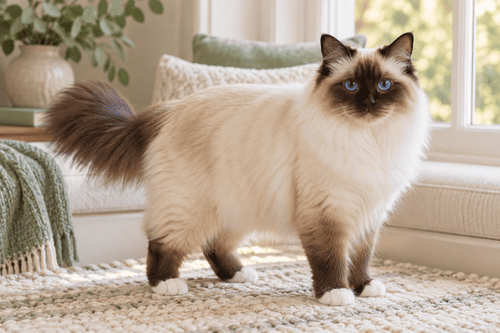
Birman
Also known as: Sacred Cat of Burma, Sacré de Birmanie
Silk gloves and sapphire eyes — the gentlest of the pointed breeds.
- Gentle
- Sociable
- Even-tempered
- Affectionate
- Quiet
The Birman, or Sacred Cat of Burma, is a semi-longhaired pointed cat distinguished by pure white "gloves" on all four paws. Calm, sociable and notably easy-going, Birmans sit temperamentally between the demanding Siamese and the placid Persian. They are among the best pedigree cats for families and for multi-pet households, and their coat is far less work than it looks.
At a glance
- Origin
- Burma / France
- Size
- Large
- Weight
- 7–12 lb (3–5.4 kg)
- Lifespan
- 13–16 years
- Coat
- Semi-long, silky, with minimal undercoat
- Colours
- Seal Point, Blue Point, Chocolate Point, Lilac Point, Red Point, Tortie Point
- Average cost
- $75–$85 / month
Breed ratings
Rated 1–5 on the same scale as every other entry, so scores are comparable between breeds. Amber stars mark things that cost you effort rather than things that benefit you.
Temperament
Birmans are consistently described as the easiest of the pointed breeds — sociable without the Siamese's volume, affectionate without the Persian's fragility. They greet visitors rather than hiding and adapt well to children and dogs.
Care & upkeep
Exercise
Two 10–15 minute play sessions daily. Birmans are moderately active and will play enthusiastically but rarely demand it, so the initiative has to come from you.
Grooming
The silky coat has almost no undercoat and mats far less than other longhairs. Twice-weekly combing is usually enough, increasing during seasonal shedding.
Training
Cooperative and easy to handle. Birmans accept nail trims, brushing and carriers more readily than most breeds, which makes vet visits considerably less stressful.
Feeding & diet
- Typical diet
- High-protein wet-led diet
- Daily amount
- 200–280 g wet food, or equivalent
- Meals per day
- 2 meals a day
Birmans mature slowly, reaching full size at around three years, and benefit from a growth-supporting diet through that period. Adults gain weight easily in a quiet home.
Foods to avoid
- Onion and garlic
- Chocolate
- Grapes and raisins
- Raw dough
- Milk — most adult cats are lactose intolerant
Who this breed suits
A good match for
- Families with children
- Multi-pet households
- First-time pedigree cat owners
- Apartments
Probably not for
- Households wanting a low-contact cat
- Owners away for long stretches
- People wanting a zero-grooming breed
Common health problems
This section describes conditions the breed is known to be predisposed to, so you know what to ask about. It is not veterinary advice and is not a diagnosis — always speak to a vet about your own animal.
- Hypertrophic cardiomyopathy (HCM)Present in the breed — ask for cardiac screening certificates and rescreen from age 2.
- Polycystic kidney disease (PKD)DNA-testable. Reputable breeders provide negative results.
- Corneal dermoidA congenital eye abnormality seen occasionally in the breed; surgically correctable.
- Feline infectious peritonitis susceptibilitySome lines show higher susceptibility. Ask breeders about their history.
Birman kittens are born pure white and develop their points and gloves over the first weeks. Colour continues deepening for two years, so a young adult will look noticeably different from the kitten you brought home.
Interesting facts
- Legend ties the breed to temple cats in Burma, though the modern breed was developed in France in the 1920s.
- The white gloves are required by the breed standard and are notoriously hard to breed evenly.
- All Birman kittens are born completely white.
Diet & Feeding
Birmans are slow developers, reaching full size at around three years, and benefit from a growth-supporting high-protein diet through that stretch. Adults do well on 200–280 g of quality wet food daily across two meals, with dry food measured rather than free-fed. They are large, placid cats and gain weight easily once mature — a monthly body-condition check catches the drift before it becomes a problem. A water fountain supports kidney health in a breed carrying some PKD risk.
Exercise & Play
Two 10–15 minute interactive sessions daily keeps a Birman in condition. They play with real enthusiasm once started, but they rarely demand it — which means a Birman in a busy household can quietly become sedentary. Wand toys, feather teasers and puzzle feeders work well. Provide a tall perch: they enjoy height without being the acrobats a Bengal or Devon is. Keep them indoors; their trusting nature makes them poor at self-preservation.
Grooming
The coat looks like far more work than it is. Birmans have a silky texture with almost no undercoat, which is exactly what makes Persian coats mat — so twice-weekly combing with a wide-tooth comb is usually enough, rising to daily during seasonal shedding. Focus on the ruff and the trousers. Bathe every 6–8 weeks if needed. Clean ears monthly and trim nails every 2–3 weeks; most Birmans tolerate all of it calmly.
Health & Vet Care
Two inherited conditions matter: hypertrophic cardiomyopathy (HCM), which needs cardiac screening from breeders and rescreening from age two, and polycystic kidney disease (PKD), which is DNA-testable — insist on negative results. Corneal dermoid occurs occasionally and is surgically correctable. Some lines show elevated FIP susceptibility, so ask breeders directly about their history. Annual vet checks and a lean body condition cover the rest.
Living with a Birman
Birmans are the pedigree cat most often recommended to people who are nervous about pedigree cats. They greet visitors rather than hiding, tolerate children well, settle with dogs and other cats, and are notably quiet — a soft chirp rather than the Siamese's carrying voice. They are affectionate without being clingy, though they do prefer company to long solitary days. One charming quirk: kittens are born pure white, and the points and gloves develop over the following weeks and deepen for two years.
Read next
 How to Help a Shy or Fearful Cat Gain ConfidenceBuild trust through accessible retreats, quiet company and voluntary play or touch. Includes room checks, response decisions, visitor wording and an example.
 How Lost Pets Actually Get Home — and How to Make Yours Easier to ReturnFollow four reunion routes from finder to owner. Includes contact steps, scanning and service decisions, ownership checks, safe handover and a worked example.
 Pet Chores for Kids by Age: A Family Guide That Actually WorksChoose manageable tasks by ability, supervision and pet comfort. Includes age-band ideas, higher-risk exclusions, a sample family chart and an adult backup plan.