
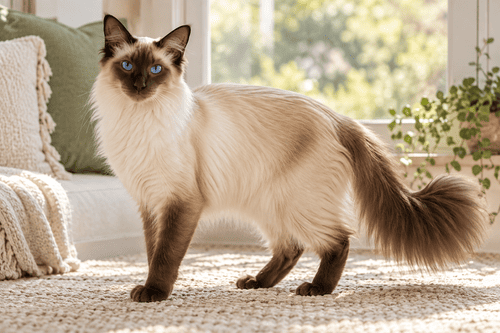
Balinese
Also known as: Longhaired Siamese, Bali
A longhaired Siamese with the same brain, the same voice and a plume of a tail.
- Vocal
- Intelligent
- Affectionate
- Athletic
- Demanding
The Balinese arose as a natural longhaired variant in Siamese litters and was developed into a breed in its own right. Everything about the Siamese came with it — the intelligence, the athleticism, the volume and the intense attachment — wrapped in a silky single coat and a spectacular tail. They are demanding, engaging cats for owners who genuinely want a full-time companion.
At a glance
- Origin
- United States
- Size
- Medium
- Weight
- 6–11 lb (2.5–5 kg)
- Lifespan
- 12–20 years
- Coat
- Semi-long, silky single coat with no undercoat
- Colours
- Seal, Blue, Chocolate, Lilac and other point colours
- Average cost
- $70–$85 / month
Breed ratings
Rated 1–5 on the same scale as every other entry, so scores are comparable between breeds. Amber stars mark things that cost you effort rather than things that benefit you.
Temperament
Balinese are Siamese in every respect but coat — talkative, intensely attached and entirely uninterested in closed doors. They bond strongly, often to one person, and become genuinely unhappy without daily interaction.
Care & upkeep
Exercise
40–60 minutes of interactive play daily. Climbers and fetchers that need a tall tree and shelving, or they will route across your furniture instead.
Grooming
The single silky coat has no undercoat and mats far less than expected — twice-weekly combing is usually enough, concentrating on the ruff and tail plume.
Training
Among the most trainable cats. Fetch, recall, harness walking and clicker tricks all come readily, and they learn household routines and door mechanisms with equal enthusiasm.
Feeding & diet
- Typical diet
- High-protein wet-led diet
- Daily amount
- 160–220 g wet food, or equivalent
- Meals per day
- 2 meals a day
Fine-boned, lean and active, so obesity is uncommon and underweight is the more realistic risk. Weigh monthly and increase portions if the spine or hips become prominent.
Foods to avoid
- Onion and garlic
- Chocolate
- Grapes and raisins
- Raw dough
- Dog food as a substitute
Who this breed suits
A good match for
- People home much of the day
- Multi-cat households
- Owners wanting an interactive cat
- Families with children
Probably not for
- Owners out all day
- Households wanting a quiet cat
- People who dislike being followed
Common health problems
This section describes conditions the breed is known to be predisposed to, so you know what to ask about. It is not veterinary advice and is not a diagnosis — always speak to a vet about your own animal.
- Progressive retinal atrophyA hereditary cause of blindness in Siamese-type lines, with a DNA test available.
- AmyloidosisAbnormal protein deposits affecting the liver, reported in Siamese-derived breeds.
- Dilated cardiomyopathyReported in the breed; ask breeders about cardiac screening.
- Feline asthmaOccurs at elevated rates in Siamese-type cats. Coughing warrants investigation.
- Dental diseaseA genuine long-term concern. Home brushing from kittenhood is worth establishing.
Long-lived, frequently reaching the late teens. Dental care established in kittenhood pays compound returns across that span.
Interesting facts
- Arose as a natural longhaired variation within Siamese litters rather than through outcrossing.
- Named after Balinese dancers for the elegance of the tail and movement.
- The single coat has no undercoat, which is why it mats far less than most longhaired breeds.
Diet & Feeding
Balinese are fine-boned, lean and genuinely active. Feed a high-protein wet-led diet, around 160–220 g daily across two meals. Obesity is uncommon in an active Balinese; underweight is the more realistic risk, so weigh monthly and increase portions if the spine or hips become prominent. They can be distractible eaters in a busy household, so a quiet feeding spot helps more than changing food repeatedly.
Exercise & Play
Plan on 40–60 minutes of interactive play daily, split into sessions. Balinese climb, leap and fetch, and will use your furniture as a route if you do not provide a proper one — a tall tree and wall shelving are worth the investment. They harness-train readily and enjoy puzzle feeders. They are poor at being alone, and a second cat of similar energy is close to a requirement in a household that is out all day.
Grooming
Far easier than the tail suggests. The single silky coat has no undercoat, which is what causes matting in most longhairs, so twice-weekly combing with a wide-tooth comb is usually sufficient, increasing during seasonal shedding. Focus on the ruff and the tail plume. Shedding is light. Nails every 2–3 weeks, ears monthly, and teeth several times a week — dental disease is a genuine long-term concern in Siamese-type cats.
Health & Vet Care
Reported conditions include progressive retinal atrophy (DNA-testable), amyloidosis affecting the liver, dilated cardiomyopathy, asthma and dental disease. Ask breeders for PRA test results and about amyloidosis history in the line. Balinese are long-lived — reaching the late teens is common — so budget for senior care and keep on top of dental health, which pays compound returns across that span.
Living with a Balinese
Expect a cat that talks, supervises and inserts itself into every activity. Balinese are affectionate on a lap-and-shoulder basis, follow their person from room to room and object loudly to closed doors. They are excellent with children and cat-friendly dogs. They are not a low-input cat: without daily interaction and stimulation they become vocal, destructive and genuinely unhappy. In an engaged household they are outstanding.
Read next
 How to Help a Shy or Fearful Cat Gain ConfidenceBuild trust through accessible retreats, quiet company and voluntary play or touch. Includes room checks, response decisions, visitor wording and an example.
 How Lost Pets Actually Get Home — and How to Make Yours Easier to ReturnFollow four reunion routes from finder to owner. Includes contact steps, scanning and service decisions, ownership checks, safe handover and a worked example.
 Pet Chores for Kids by Age: A Family Guide That Actually WorksChoose manageable tasks by ability, supervision and pet comfort. Includes age-band ideas, higher-risk exclusions, a sample family chart and an adult backup plan.