
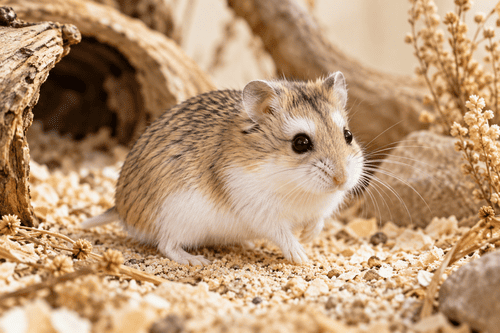
Roborovski Hamster
Also known as: Robo, Desert hamster, Phodopus roborovskii
The smallest and fastest hamster — fascinating to watch, almost impossible to hold.
- Fast
- Curious
- Skittish
- Active
- Nocturnal
The Roborovski is the smallest domesticated hamster, an adult fitting comfortably in a tablespoon. They are fast, curious and remarkably long-lived for a dwarf hamster, and they are the least handleable of the commonly kept species. Bought as a children's pet on the strength of their appearance, they are far better suited to owners who want an animal to observe rather than hold.
At a glance
- Origin
- Mongolia, northern China
- Size
- Small
- Weight
- 0.7–0.9 oz (20–25 g)
- Lifespan
- 3–4 years
- Coat
- Short, dense, sandy with a white belly and distinctive white eyebrows
- Colours
- Agouti (wild type), White-faced, Husky, Platinum
- Average cost
- $20–$40 / month
Breed ratings
Rated 1–5 on the same scale as every other entry, so scores are comparable between breeds. Amber stars mark things that cost you effort rather than things that benefit you.
Temperament
Roborovskis are the least handleable hamster species — extremely fast, rarely tame and easily stressed by restraint. They are absorbing to watch and best appreciated as an observation animal rather than a companion to hold.
Care & upkeep
Exercise
A minimum of 100 x 50 cm floor area with 25–30 cm substrate depth for burrowing, plus a solid-surface wheel of at least 20 cm. Enclosure size is the biggest welfare factor.
Grooming
No grooming needed and never bathe. Provide a sand bath with chinchilla sand several times a week or permanently, which they use enthusiastically.
Training
Not meaningfully trainable. They habituate to a keeper presence and will take food from a hand with patience, but handling tolerance rarely develops in this species.
Feeding & diet
- Typical diet
- Low-sugar seed and grain mix
- Daily amount
- 5–7 g of low-sugar dwarf hamster mix
- Meals per day
- Once daily, scattered
Dwarf hamsters are prone to diabetes, so a low-sugar mix without dried fruit or yoghurt drops matters. Scatter food in the substrate rather than using a bowl — foraging is a core behaviour.
Foods to avoid
- Dried fruit and sugary treats
- Citrus
- Onion and garlic
- Chocolate
- Sticky foods that impact cheek pouches
Who this breed suits
A good match for
- Adults wanting an observation pet
- Apartments
- Evening-active households
- Experienced small pet keepers
Probably not for
- Young children
- Owners wanting a handleable pet
- Small pet-shop cages
- Daytime-only households
Common health problems
This section describes conditions the breed is known to be predisposed to, so you know what to ask about. It is not veterinary advice and is not a diagnosis — always speak to a vet about your own animal.
- DiabetesDwarf hamsters are prone. Choose a low-sugar mix and avoid dried fruit and yoghurt drops entirely.
- Wet tail-type diarrhoeaA rapid and often fatal condition. A wet, soiled rear needs emergency veterinary care within hours.
- Dental overgrowthTeeth grow continuously and need constant gnawing material to wear down.
- TumoursCommon in older animals, as in all small rodents.
- Eye problemsRoborovskis are somewhat prone to eye infections and injuries.
Their size makes veterinary examination and treatment genuinely difficult, which means correct housing and low-sugar feeding carry more weight than in larger species.
Interesting facts
- The smallest domesticated hamster — an adult fits comfortably in a tablespoon.
- Wild Roborovskis run several kilometres a night across Mongolian desert.
- The white eyebrow markings are the easiest way to distinguish them from other dwarf species.
Diet & Feeding
Feed a species-appropriate dwarf hamster mix — around 5–7 g daily — chosen for a low sugar content, because dwarf hamsters including Roborovskis are prone to diabetes. Avoid mixes containing dried fruit, molasses or yoghurt drops. Supplement with small amounts of fresh vegetables, mealworms and occasional egg for protein. Scatter the food in the substrate rather than using a bowl: foraging is a core natural behaviour and takes up much of the active night.
Exercise & Enrichment
Roborovskis are the most active hamster species and need genuine space: a minimum of 100 x 50 cm floor area with 25–30 cm of substrate depth for burrowing, which is a critical natural behaviour rather than a nicety. A wheel of at least 20 cm with a solid running surface is essential — smaller wheels force an unnatural spinal curve. Add a sand bath, multiple hides, wooden chews and cork tunnels. Enclosure size is the single biggest welfare factor.
Grooming
No grooming required, and never bathe a hamster — water strips natural oils and causes serious stress. Provide a sand bath (chinchilla sand, not dust) permanently or several times a week; they roll in it enthusiastically and it keeps the coat in condition. Nails rarely need attention if the substrate and surfaces are appropriate. Check the cheek pouches occasionally, since impaction can occur with sticky or sharp foods.
Health & Vet Care
Find an exotics vet with rodent experience. The main concerns are diabetes, which is why low-sugar feeding matters, wet tail-type diarrhoea, which is a rapid emergency, dental overgrowth, tumours in older animals and eye problems, to which Roborovskis are somewhat prone. Their size makes examination and treatment genuinely difficult, so prevention through correct housing and diet carries more weight here than in larger species.
Living with a Roborovski
Set expectations honestly: they are extremely fast and rarely tame, and most never become comfortable being held. They are, however, fascinating to watch — burrowing, foraging, sand bathing and running enormous distances at night. They are nocturnal, becoming active late in the evening. They can sometimes be kept in same-sex pairs from a young age, but fighting is common and separate housing is often necessary. Better suited to adults than to young children.