
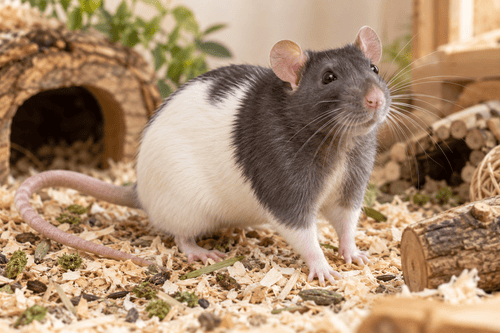
Fancy Rat
Also known as: Pet rat, Rattus norvegicus domestica
The most underrated pet in the world — clever, affectionate and heartbreakingly short-lived.
- Intelligent
- Affectionate
- Sociable
- Curious
- Trainable
The fancy rat is the domesticated brown rat, kept as a companion for nearly two centuries. They are genuinely intelligent, form real bonds with their owners, learn their names, come when called and enjoy being handled — a combination almost no other small mammal offers. The single hard truth about them is lifespan: two to three years, and a very high rate of tumours in later life.
At a glance
- Origin
- Domesticated worldwide
- Size
- Small
- Weight
- 1 lb (0.3–0.6 kg)
- Lifespan
- 2–3 years
- Coat
- Short and smooth, or rex, satin, hairless and dumbo-eared varieties
- Colours
- Agouti, Black, Hooded, Berkshire, Himalayan, Blue, Champagne and many more
- Average cost
- $30–$60 / month
Breed ratings
Rated 1–5 on the same scale as every other entry, so scores are comparable between breeds. Amber stars mark things that cost you effort rather than things that benefit you.
Temperament
Rats form genuine bonds with their owners — they recognise individuals, seek contact and are content to sit on a shoulder for long periods. They must be kept in same-sex pairs or groups, because human company does not substitute for rat company.
Care & upkeep
Exercise
At least an hour of out-of-cage time daily plus a large multi-level cage with solid shelves. Wheels must be solid-surfaced and at least 28 cm to avoid spinal strain.
Grooming
Fastidious self-groomers needing only a weekly check. Do not bathe routinely. Regular handling is what lets you find lumps early, which matters enormously in this species.
Training
The most trainable small mammal commonly kept. Rats learn names, recall, litter training, agility courses and complex trick chains using clicker training and food reward.
Feeding & diet
- Typical diet
- Pellet-based omnivore diet
- Daily amount
- 15–20 g lab blocks or pellets per rat, plus fresh food
- Meals per day
- Once daily, plus fresh supplements
Lab blocks or a rat-specific pellet should form the base — muesli mixes let rats selectively eat the fatty components. Supplement with vegetables, fruit and occasional cooked protein.
Foods to avoid
- Muesli-style mixes as a staple
- Citrus for males (linked to kidney issues)
- Blue cheese
- Raw sweet potato
- Sticky foods that can choke
Who this breed suits
A good match for
- Older children and adults
- Apartments
- People wanting an interactive small pet
- Owners able to keep a pair
Probably not for
- Anyone wanting a long-lived pet
- Owners intending to keep a single rat
- Homes with cats given cage access
- Dusty or poorly ventilated rooms
Common health problems
This section describes conditions the breed is known to be predisposed to, so you know what to ask about. It is not veterinary advice and is not a diagnosis — always speak to a vet about your own animal.
- Respiratory diseaseUsually mycoplasma-related and close to universal in older rats. Ammonia, dust and poor ventilation make it worse.
- Mammary tumoursExtremely common, particularly in females. Spaying substantially reduces the risk.
- Pituitary tumoursPresent with head tilt, difficulty eating and loss of coordination. Common in older females.
- BumblefootPressure sores on the feet caused by wire flooring. Use solid shelves throughout.
- ObesityCommon in later life on muesli-style diets. Use lab blocks and measure portions.
The hardest part of keeping rats is the lifespan. Two to three years is normal, and tumours are common in the final year. Anyone unprepared for that should consider a longer-lived species.
Interesting facts
- Rats laugh when tickled, producing ultrasonic chirps humans cannot hear unaided.
- They can be litter trained and taught to come when called by name.
- Rats will free trapped cage mates and share food, behaviours studied as evidence of empathy.
Diet & Feeding
Feed a quality lab-block or rat-specific pellet as the base — around 15–20 g per rat daily — rather than a muesli mix, which allows selective eating of the fatty components. Supplement with small amounts of fresh vegetables, fruit and occasional cooked protein: peas, broccoli, banana, cooked chicken and egg are all suitable. Rats are prone to obesity in later life, so measure rather than free-feed. Scatter feeding and foraging toys provide enrichment as well as slowing intake.
Exercise & Enrichment
Rats need at least an hour of out-of-cage time daily in a rat-proofed space, plus a large multi-level cage — a minimum of around 80 x 50 x 70 cm for two rats, with solid shelves rather than bare wire. They are exceptional climbers who use vertical space properly. Provide hammocks, ropes, tunnels, cardboard to destroy and puzzle feeders. Wheels must be solid-surfaced and at least 28 cm in diameter to avoid spinal strain.
Grooming
Rats are fastidious self-groomers and need very little help — a weekly check rather than active grooming. Do not bathe routinely; it strips natural oils and causes stress. Intact males produce an oily orange substance called buck grease, which can be wiped off with a damp cloth. Check nails monthly, and inspect the skin during handling — regular contact is what allows you to find lumps early, which matters enormously in this species.
Health & Vet Care
Two conditions dominate. Respiratory disease, usually involving mycoplasma, is close to universal in older rats and is aggravated by ammonia from dirty bedding, dusty substrate and poor ventilation. Mammary and pituitary tumours are extremely common, particularly in females, and spaying substantially reduces mammary tumour risk. Add bumblefoot from wire flooring. Find a small-mammal vet in advance — rats decline quickly once unwell.
Living with Fancy Rats
Rats must be kept in same-sex pairs or groups; a solitary rat is a genuinely depressed animal, and a second rat is company you cannot provide by hand. They learn names, come when called, take to litter training and enjoy sitting on a shoulder for hours. They suit older children and adults who understand the trade: an exceptional companion animal in exchange for a two to three year relationship that almost always ends too soon.