
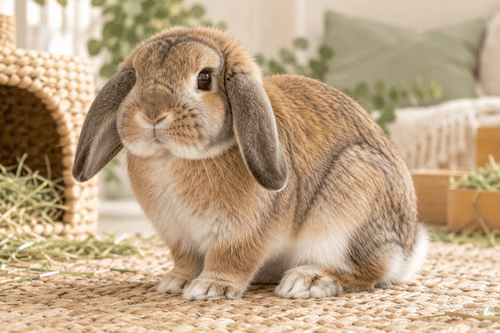
Mini Lop
Also known as: Mini Lop, Klein Widder
Compact, floppy-eared and outgoing — one of the most popular pet rabbits for good reason.
- Friendly
- Sociable
- Curious
- Relaxed
- Gentle
The Mini Lop is a small lop-eared rabbit developed in Germany, sitting between the Holland Lop and the French Lop in size. They are sturdy, sociable and generally more relaxed about handling than the dwarf breeds, which is a large part of their popularity as family rabbits. The lop ears bring a specific care requirement that upright-eared breeds do not have.
At a glance
- Origin
- Germany
- Size
- Small
- Weight
- 3–6 lb (1.5–2.7 kg)
- Lifespan
- 7–12 years
- Coat
- Short to medium, dense rollback fur
- Colours
- Agouti, Broken, Solid, Shaded, Ticked — extensive variety
- Average cost
- $50–$90 / month
Breed ratings
Rated 1–5 on the same scale as every other entry, so scores are comparable between breeds. Amber stars mark things that cost you effort rather than things that benefit you.
Temperament
Mini Lops are among the more outgoing rabbit breeds and settle into handling faster than most dwarfs. They still dislike being picked up, however friendly — interaction at floor level is what builds a good relationship.
Care & upkeep
Exercise
3–4 hours minimum outside the enclosure daily in a rabbit-proofed space. Mini Lops explore and forage rather than sprint, so tunnels and dig boxes suit them well.
Grooming
Brush weekly and daily during the moult. Never bathe. The lop-specific job is weekly ear checks, since folded ears trap wax and drain poorly.
Training
Litter train readily and can learn to come when called. Handle daily from a young age to build tolerance for the ear checks and grooming they will need for life.
Feeding & diet
- Typical diet
- Hay-based herbivore diet
- Daily amount
- Unlimited hay, 1.5 cups greens, 1–2 tbsp pellets
- Meals per day
- Hay always available; greens and pellets once daily
Hay must be 80–85% of intake — it wears continuously growing teeth and keeps the gut moving. Avoid muesli mixes, which let rabbits selectively eat the sugary parts and skip the fibre.
Foods to avoid
- Iceberg lettuce
- Muesli-style rabbit mixes
- Excess fruit
- Bread and cereal
- Onion family vegetables
Who this breed suits
A good match for
- Families with older children
- House-rabbit keepers
- Apartments
- Owners wanting a bonded pair
Probably not for
- Hutch-only housing
- Young children expecting a cuddly pet
- Households without a rabbit-savvy vet
Common health problems
This section describes conditions the breed is known to be predisposed to, so you know what to ask about. It is not veterinary advice and is not a diagnosis — always speak to a vet about your own animal.
- Ear infectionsFolded lop ears drain poorly and trap wax and debris. Weekly checks are important.
- Dental malocclusionThe shortened lop skull frequently misaligns teeth. A hay-heavy diet is the main prevention.
- GI stasisA life-threatening gut slowdown. No eating or droppings for 12 hours needs a vet immediately.
- E. cuniculiA parasite causing head tilt and hind-limb weakness; testable and treatable.
- Uterine cancerVery high risk in unspayed females. Spaying essentially removes it.
Rabbits live far longer than most buyers expect — 7 to 12 years is normal, which puts them on a par with a small dog as a commitment.
Interesting facts
- Developed in Germany from the Klein Widder, and distinct from the Holland Lop despite the similar name.
- Lop ears do not develop at birth — kits are born with upright ears that drop over the first weeks.
- One of the most popular pet rabbit breeds in both the UK and the US.
Diet & Feeding
Unlimited high-quality timothy hay as 80–85% of intake is the foundation, and it matters twice over in a lop: it wears continuously growing teeth and it keeps the gut moving. Add around one and a half packed cups of fresh leafy greens daily and one to two tablespoons of quality pellets. Avoid muesli-style mixes, which allow selective eating of the sugary components. Fresh water must always be available, ideally in a heavy bowl rather than a bottle.
Exercise & Enrichment
Mini Lops need 3–4 hours minimum outside the enclosure daily in a rabbit-proofed space. They are moderately active and lean toward exploring and foraging rather than sprinting. Provide tunnels, cardboard boxes to chew, dig boxes and platforms at low height. They are crepuscular, most active at dawn and dusk, so a Mini Lop that seems dull at midday is simply asleep at the correct time for a rabbit.
Grooming
Brush weekly, rising to daily during the moult — rabbits cannot vomit, so swallowed fur contributes directly to gut blockages. Never bathe a rabbit: immersion causes severe stress and can trigger shock. The lop-specific task is the ears: folded ears have poorer airflow and trap wax and debris, so check them weekly. Nails every 6–8 weeks, and check the rear daily in warm weather for soiling.
Health & Vet Care
Two issues are shaped by the lop conformation: ear infections, because folded ears drain poorly, and dental malocclusion, because the shortened skull frequently misaligns the teeth. Add the standard list: GI stasis (no eating or droppings for 12 hours is an emergency), E. cuniculi, flystrike and uterine cancer in unspayed females, which spaying essentially removes. Vaccinate against myxomatosis and RHD, and register with a rabbit-experienced vet in advance.
Living with a Mini Lop
Mini Lops are among the more outgoing and handleable rabbit breeds, which is why they are so often chosen for families — but they are still rabbits, and almost none enjoy being picked up. Interact at floor level. Keep them in bonded pairs where possible; a lone rabbit is a lonely one. They litter train readily and make excellent house rabbits. Expect 7–12 years, which is a genuine long-term commitment.