
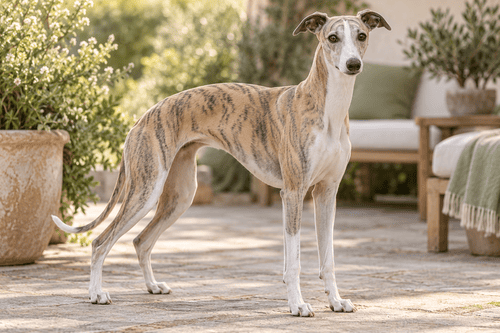
Whippet
Also known as: Snap dog, Poor man's racehorse
Explosive on the field, horizontal at home — the most apartment-friendly sighthound there is.
- Gentle
- Quiet
- Affectionate
- Sensitive
- Sprinter
The Whippet was developed in northern England as a working-class coursing and racing dog, and the result is an animal of contradictions: capable of 55 km/h in a few strides, then asleep on the sofa for eighteen hours. They are quiet, gentle, minimally shedding and remarkably easy to live with, provided their two hard requirements are met — a daily sprint and reliable containment.
At a glance
- Origin
- England, UK
- Breed group
- Hound
- Size
- Medium
- Weight
- 20–42 lb (9–19 kg)
- Height
- 17.3–22 in (44–56 cm)
- Lifespan
- 12–15 years
- Coat
- Very short, fine, close-lying
- Colours
- Any colour or marking — fawn, brindle, blue, black, white, parti
- Average cost
- $75–$90 / month
Breed ratings
Rated 1–5 on the same scale as every other entry, so scores are comparable between breeds. Amber stars mark things that cost you effort rather than things that benefit you.
Temperament
Whippets are among the quietest and most placid dogs indoors — they rarely bark, rarely destroy and sleep enormously. Outdoors they are a different animal entirely, and that switch between states is the breed in a sentence.
Care & upkeep
Exercise
Two or three flat-out sprints a week in a secure field, plus 45–60 minutes of daily walking. Prey drive makes open-space recall unreliable; use long lines and enclosed areas.
Grooming
A weekly rubber mitt handles the coat entirely. Provide soft bedding — bony joints on hard floors cause pressure sores — and a coat for winter walks.
Training
Sensitive and food-motivated but not driven to obey. Short cheerful sessions work; repetition does not. Manage prey drive with secure spaces rather than trying to train it out.
Feeding & diet
- Typical diet
- Quality medium-breed diet
- Daily amount
- 200–350 g of dry food
- Meals per day
- 2 meals a day
A correct Whippet looks thin to eyes used to other breeds — visible last ribs, a deep tuck and prominent hips are right. Feeding a Whippet to look rounded means it is overweight.
Foods to avoid
- Chocolate
- Grapes and raisins
- Onion and garlic
- Xylitol
- Cooked bones
Who this breed suits
A good match for
- Apartments
- Quiet households
- Owners wanting a low-shedding dog
- People who can access secure fields
Probably not for
- Homes without access to secure running space
- Households with free-roaming small pets
- Cold outdoor kennelling
Common health problems
This section describes conditions the breed is known to be predisposed to, so you know what to ask about. It is not veterinary advice and is not a diagnosis — always speak to a vet about your own animal.
- Anaesthetic sensitivitySighthounds metabolise some anaesthetic drugs differently because of low body fat. Always tell your vet the breed.
- Skin lacerationsThin skin tears easily on brambles, wire and fences. Check the coat after runs in rough ground.
- Cold intoleranceAlmost no body fat and a very thin coat. A winter coat is a practical necessity, not an indulgence.
- Myostatin mutationA DNA-testable variant; two copies produce heavily overmuscled bully whippets with health problems.
- Dental diseaseCommon in the breed. Regular home brushing pays off across a long lifespan.
Tell every vet you meet that this is a sighthound. Low body fat changes how some anaesthetics and sedatives behave, and it belongs on the front of the clinical record.
Interesting facts
- Bred by northern English working families for rabbit coursing and weekend racing.
- Capable of around 55 km/h, the fastest domestic animal for its weight.
- They famously burrow under blankets and duvets to stay warm.
Diet & Feeding
Whippets need 200–350 g of a quality food daily across two meals, adjusted to activity. The thing new owners must understand is that a healthy Whippet looks thin by ordinary dog standards: the last two or three ribs visible, a deep tuck and prominent hip points are correct, and a Whippet fed to look like a Labrador is overweight. They have very little body fat and can be sensitive to anaesthesia — always tell your vet the breed.
Exercise Needs
The pattern matters more than the quantity: two or three sprint opportunities a week in a securely fenced area, plus 45–60 minutes of ordinary daily walking. A Whippet needs to run flat out to be content, and then genuinely does nothing for the rest of the day. Prey drive is the safety issue — a Whippet that sights a rabbit is doing 50 km/h before recall registers, and recall in an open space should never be assumed. Secure fields and long lines are the practical answer.
Grooming
As easy as it gets: a weekly wipe with a rubber mitt and that is the coat handled. The genuine care needs are elsewhere. The coat is so thin that Whippets feel the cold badly — a coat in winter is necessary rather than decorative, and they will burrow under blankets year-round. The thin skin tears easily on brambles and fences, so check after runs. Provide soft bedding: bony joints on hard floors cause pressure sores.
Health & Vet Care
Whippets are one of the healthier pedigree breeds with no widespread crippling inherited disease. The practical concerns are anaesthetic sensitivity (sighthounds metabolise some drugs differently — always flag the breed), skin lacerations, dental disease and cold intolerance. A DNA-testable myostatin mutation produces overmuscled bully whippets when doubled. Occasional cardiac and eye conditions occur; ask breeders what they screen for.
Training Tips
Whippets are gentle, sensitive and rather more biddable than sighthound reputation suggests — but they are not driven to obey, and repetition bores them quickly. Short, cheerful, food-led sessions work. Do not expect to train away the prey drive; manage it instead with secure spaces and long lines. House-training is straightforward, and the breed is naturally quiet, which is a large part of why they suit apartments so well.
Read next
 How to Set Up a Dog-Friendly GardenCheck fences, gates, plants and products before adding water, shade and activities. Includes inspection lists, layout choices and a worked small-garden plan.
 Resource Guarding in Dogs: Signs, Safety and What HelpsRecognise guarding and manage bowls, chews, beds and visitors without provoking the dog. Includes barriers, collection steps and questions for professional help.
 How Lost Pets Actually Get Home — and How to Make Yours Easier to ReturnFollow four reunion routes from finder to owner. Includes contact steps, scanning and service decisions, ownership checks, safe handover and a worked example.