
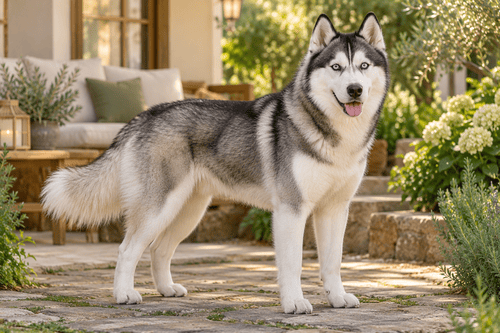
Siberian Husky
Wild-eyed and wolf-like — built for adventure, not the sofa.
The Siberian Husky is a working sled dog bred to cover vast distances in sub-zero temperatures. Striking, athletic and extraordinarily social, Huskies are not for the faint-hearted. They require immense physical exercise, strong containment and an owner who finds humour in their dramatic, talkative personalities — because a bored Husky will redecorate your house.
At a glance
- Origin
- Siberia, Russia
- Size
- Large
- Weight
- 35–60 lb (16–27 kg)
- Lifespan
- 12–14 years
- Coat
- Thick double coat — undercoat and longer guard hairs
- Colours
- Black & White, Grey & White, Red & White, Sable, Pure White, Agouti
Breed ratings
Rated 1–5 on the same scale as every other entry, so scores are comparable between breeds. Amber stars mark things that cost you effort rather than things that benefit you.
Diet & Feeding
Huskies are surprisingly efficient eaters and need less food than their size suggests — overfeeding is common. Feed a high-protein diet twice daily, around 280–400 g dry kibble depending on activity level. They can be picky eaters and may skip meals, which is normal. Avoid free-feeding. Omega-3 supplementation helps maintain their thick double coat.
Exercise Needs
Huskies need 2+ hours of vigorous exercise every single day — not optional. Running, hiking, bikejoring and skijoring are ideal. Without adequate exercise they become destructive, vocal and may escape. Their recall is extremely unreliable — never exercise off-lead in an unsecured area. A securely fenced garden (6ft minimum, dig-proof base) is essential.
Grooming
The double coat 'blows' twice a year — expect weeks of heavy shedding in spring and autumn. Brush daily during blowout with an undercoat rake and slicker brush. During the rest of the year, weekly brushing suffices. Huskies are fastidiously clean and rarely need bathing (every 3–4 months). Never shave a Husky — the coat regulates both warmth and cooling.
Health & Vet Care
Huskies are generally a healthy breed. Known issues include hereditary eye conditions (juvenile cataracts, progressive retinal atrophy, corneal dystrophy), hip dysplasia and hypothyroidism. Choose breeders who provide CERF eye and OFA hip certifications. Annual eye checks are recommended. They have high pain tolerance — watch for subtle signs of discomfort.
Training Tips
Huskies are intelligent but notoriously independent — they will assess whether following a command benefits them. Training requires patience, consistency and high-value rewards. They respond very poorly to harsh methods and will simply disengage. Focus on management: secure fencing, reliable crate training and recall practice in enclosed areas. Socialise extensively from puppyhood.
Read next
 How to Set Up a Dog-Friendly GardenA garden can be a safe, interesting space for your dog — or a source of escapes, toxic plants and dug-up borders. Here is how to set one up for safety, comfort and enrichment.
 Resource Guarding in Dogs: Signs, Safety and What HelpsA dog that stiffens over the food bowl or growls when you approach a chew is guarding something it values. Here is how to recognise it early, keep everyone safe and what helps.
 How Lost Pets Actually Get Home — and How to Make Yours Easier to ReturnMost lost pets are found close to home by an ordinary person with a phone. What happens in the next few minutes decides how fast they get back. Here is how reunions really happen, and how to prepare.