
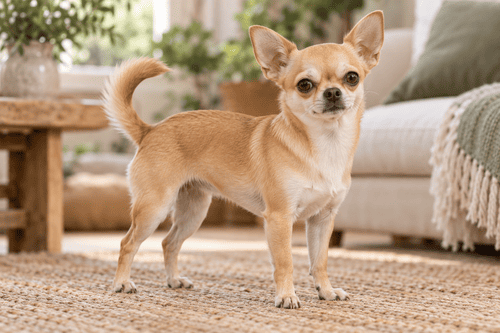
Chihuahua
Also known as: Chi
The smallest dog in the world, with easily the largest opinion of itself.
- Alert
- Devoted
- Bold
- Suspicious of strangers
- Sensitive
The Chihuahua is the smallest recognised dog breed and one of the oldest in the Americas. Fiercely loyal to their chosen person, alert to everything and utterly convinced of their own significance, Chihuahuas are far more dog than their size suggests. They are excellent companions for people who treat them as real dogs rather than accessories — which means training, socialisation and boundaries like any other breed.
At a glance
- Origin
- Mexico
- Breed group
- Toy
- Size
- Toy
- Weight
- 3–7 lb (1.5–3 kg)
- Height
- 5.9–9.1 in (15–23 cm)
- Lifespan
- 14–16 years
- Coat
- Smooth or long, single coat
- Colours
- Fawn, Cream, Black, Chocolate, Blue, Merle, Parti-colour
- Average cost
- $70 / month
Breed ratings
Rated 1–5 on the same scale as every other entry, so scores are comparable between breeds. Amber stars mark things that cost you effort rather than things that benefit you.
Temperament
Chihuahuas bond intensely, usually to one person, and can become genuinely reactive toward everyone else if under-socialised. Most "aggressive Chihuahua" reputations are the result of behaviour that would never be tolerated in a large dog being tolerated because the dog is small.
Care & upkeep
Exercise
Two short walks of 15–20 minutes plus indoor play is plenty. Use a harness rather than a collar — Chihuahuas are prone to tracheal collapse and lead pressure on the throat makes it worse.
Grooming
Smooth coats need a weekly wipe; long coats need brushing 2–3 times a week. Dental care is the real grooming task — brush teeth several times a week from puppyhood.
Training
Train them exactly as you would a large dog. House-training is often the slow part and needs a strict schedule. Socialise hard and early to strangers, children and other dogs, because a fearful Chihuahua is a snappy one.
Feeding & diet
- Typical diet
- Calorie-dense toy-breed diet
- Daily amount
- 40–90 g of dry food
- Meals per day
- 3 small meals a day
Toy breeds have very small energy reserves. Puppies and small adults can develop hypoglycaemia if a meal is missed — feed little and often, and never leave a Chihuahua puppy unfed for long stretches.
Foods to avoid
- Chocolate
- Grapes and raisins
- Xylitol
- Onion and garlic
- Bones that can splinter
Who this breed suits
A good match for
- Apartment living
- Adults and older children
- Owners at home much of the day
- People wanting a long-lived companion
Probably not for
- Homes with toddlers
- Owners wanting a quiet dog
- People who will not train a small dog properly
Common health problems
This section describes conditions the breed is known to be predisposed to, so you know what to ask about. It is not veterinary advice and is not a diagnosis — always speak to a vet about your own animal.
- Patellar luxationSlipping kneecaps are very common. Watch for a skipping gait on one hind leg.
- Tracheal collapseA honking cough, often triggered by lead pressure. Always walk on a harness.
- Dental diseaseCrowded teeth in a tiny jaw. Without home brushing, most Chihuahuas need extractions by middle age.
- HydrocephalusFluid on the brain, associated with the domed "apple head" skull. Seen mainly in puppies.
- HypoglycaemiaLow blood sugar, especially in puppies. Signs are wobbliness, glazed eyes and collapse — an emergency.
Chihuahuas are long-lived, frequently reaching 16 years or more, but they are fragile. Falls from sofas and arms cause a large share of the injuries this breed presents with.
Interesting facts
- Named after the Mexican state of Chihuahua, where the modern breed was identified in the 1850s.
- Likely descended from the Techichi, a companion dog of the Toltec civilisation.
- Frequently the longest-lived of all dog breeds.
Diet & Feeding
A Chihuahua eats very little — around 40–90 g of quality dry food daily — but how often matters more than how much. Toy breeds have minimal glycogen reserves and can slide into hypoglycaemia if meals are skipped, which is why three small meals suit them better than two. Choose a small-kibble toy-breed formula their jaws can manage. Treats add up terrifyingly fast in a 2 kg dog: a single biscuit can be a meaningful share of the daily calories.
Exercise Needs
Two walks of 15–20 minutes plus indoor play meets a Chihuahua's needs. They enjoy far more than that if offered, but they do not require it. Always walk on a harness, never a collar — the breed is prone to tracheal collapse and pressure on the throat aggravates it. Be realistic about cold: a short-coated 2 kg dog loses heat fast, and a coat in winter is practical rather than indulgent.
Grooming
Smooth-coated Chihuahuas need little more than a weekly wipe with a rubber mitt. Long-coated ones need brushing 2–3 times a week, with attention behind the ears and on the tail feathering. The grooming task that actually matters is dental care: brush their teeth several times a week from puppyhood. Chihuahuas have full-size dentition crowded into a miniature jaw, and dental disease is close to universal without it. Trim nails every 3 weeks.
Health & Vet Care
Key concerns are patellar luxation, tracheal collapse, dental disease, hydrocephalus (in domed-skull puppies) and hypoglycaemia. Most are manageable with an aware owner. The other risk is simply physical fragility — jumping from a sofa or slipping out of someone's arms causes a disproportionate share of Chihuahua injuries. On the upside, this is one of the longest-lived breeds, routinely reaching 16 years or more.
Training Tips
The most important rule: train a Chihuahua exactly as you would a Rottweiler. Almost every behavioural problem in the breed comes from behaviour being permitted because the dog is small — growling at guests, snapping when picked up, barking at everything. Socialise intensively before 16 weeks. House-training is often slow and needs a strict schedule and patience; small bladders and bad weather work against you. Positive reinforcement only — they shut down under harsh handling.
Read next
 How to Set Up a Dog-Friendly GardenCheck fences, gates, plants and products before adding water, shade and activities. Includes inspection lists, layout choices and a worked small-garden plan.
 Resource Guarding in Dogs: Signs, Safety and What HelpsRecognise guarding and manage bowls, chews, beds and visitors without provoking the dog. Includes barriers, collection steps and questions for professional help.
 How Lost Pets Actually Get Home — and How to Make Yours Easier to ReturnFollow four reunion routes from finder to owner. Includes contact steps, scanning and service decisions, ownership checks, safe handover and a worked example.