
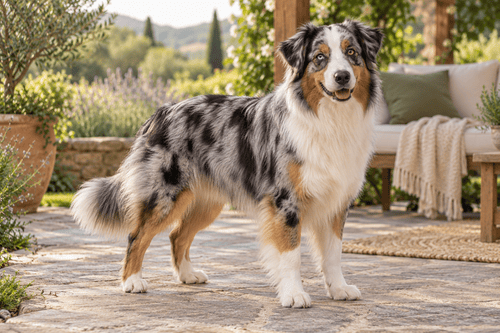
Australian Shepherd
Also known as: Aussie, Australian Shepherd Dog
A working brain that never switches off — brilliant, tireless and not for the casual owner.
- Intelligent
- Energetic
- Devoted
- Alert
- Reserved with strangers
Despite the name, the Australian Shepherd was developed in the western United States as a ranch herding dog. Aussies are athletic, strikingly marked and among the most trainable breeds in existence — which is exactly the problem for unprepared owners. An Aussie without a job will find one, and the job it picks is rarely one you would have chosen.
At a glance
- Origin
- United States
- Breed group
- Herding
- Size
- Large
- Weight
- 35–71 lb (16–32 kg)
- Height
- 18.1–22.8 in (46–58 cm)
- Lifespan
- 12–15 years
- Coat
- Medium-length weather-resistant double coat
- Colours
- Blue Merle, Red Merle, Black, Red, with white and copper markings
- Average cost
- $85–$140 / month
Breed ratings
Rated 1–5 on the same scale as every other entry, so scores are comparable between breeds. Amber stars mark things that cost you effort rather than things that benefit you.
Temperament
Aussies bond intensely with their household and are often aloof with strangers — that is breed-typical, not a fault, but it does mean early socialisation matters. The herding instinct shows up as circling and nipping at running children and needs redirecting rather than suppressing.
Care & upkeep
Exercise
Two hours a day minimum, and physical exercise alone is not enough. Aussies need to think — herding, agility, obedience, scent work or trick training every day.
Grooming
Brush 2–3 times weekly, daily during the twice-yearly coat blow. Check feathering behind ears and on the trousers for mats. Never shave the double coat.
Training
One of the fastest-learning breeds on earth, which cuts both ways — an Aussie learns your mistakes just as fast. Constant novelty keeps them engaged. Without an outlet they develop obsessive behaviours: shadow chasing, light fixation, compulsive circling.
Feeding & diet
- Typical diet
- High-protein active-dog diet
- Daily amount
- 400–700 g of dry food, by workload
- Meals per day
- 2 meals a day
Feed to body condition rather than to a chart — a working Aussie and a pet Aussie have very different requirements. You should feel ribs easily under a thin covering.
Foods to avoid
- Chocolate
- Grapes and raisins
- Onion and garlic
- Xylitol
- Macadamia nuts
Who this breed suits
A good match for
- Very active owners
- Dog sports competitors
- Rural or large-garden homes
- People who want to train daily
Probably not for
- Apartments
- First-time owners
- Households out all day
- Anyone wanting a calm indoor dog
Common health problems
This section describes conditions the breed is known to be predisposed to, so you know what to ask about. It is not veterinary advice and is not a diagnosis — always speak to a vet about your own animal.
- MDR1 drug sensitivityA genetic mutation affecting how common drugs, including some wormers and sedatives, are processed. Always tell your vet the breed, and DNA test.
- Hip and elbow dysplasiaScreened by responsible breeders.
- Collie eye anomaly and cataractsHereditary eye conditions — ask for eye certification.
- EpilepsyOccurs at higher rates than in the general dog population.
- Double merle blindness and deafnessBreeding two merles together produces puppies with severe eye and ear defects. Never buy from a merle-to-merle litter.
The MDR1 mutation is the one every Aussie owner should know about by name — it changes which drugs are safe and it is a simple cheek-swab test.
Interesting facts
- Developed in California, not Australia — the name comes from the Australian sheep the dogs worked with.
- A fixture of American rodeo culture in the mid-20th century.
- Many Aussies are born with naturally bobbed tails.
Diet & Feeding
Feed 400–700 g of a high-protein active-dog food daily, split into two meals — but treat the number as a starting point. The gap between a ranch-working Aussie and a suburban pet Aussie is enormous, so feed to body condition: ribs easily felt under a thin covering, a visible waist from above. Use part of the daily ration as training rewards rather than adding treats on top; this breed trains several times a day and the calories add up fast.
Exercise Needs
Two hours daily is the floor, and physical exercise alone will not produce a settled Aussie. A dog that runs for two hours and thinks for none is a fitter version of the same problem. Combine running with work that requires decisions: herding, agility, obedience, tracking, advanced trick training, scent work. Aussies deprived of an outlet develop compulsive behaviours — shadow chasing, light fixation, spinning — that are genuinely difficult to reverse.
Grooming
The weather-resistant double coat needs brushing 2–3 times a week, rising to daily during the two annual coat blows, when the undercoat comes out in sheets. Pay particular attention to the feathering behind the ears, on the trousers and under the tail, where mats form first. Bathe every 6–8 weeks. Never shave the coat — it insulates against heat as well as cold and regrowth can be permanently damaged.
Health & Vet Care
Every Aussie owner should know about MDR1 — a genetic mutation, common in the breed, that changes how safely certain drugs (including some wormers, sedatives and anti-diarrhoeals) are metabolised. It is a simple cheek swab, and it is information your vet needs. Also screen for hip and elbow dysplasia, Collie eye anomaly, cataracts and epilepsy. Critically: never buy from a merle-to-merle mating — double merle puppies are frequently born deaf, blind or both.
Training Tips
Aussies are among the fastest learners in the dog world, which is a mixed blessing — they learn your accidental patterns as quickly as your deliberate ones. Keep training novel and frequent; boredom is the enemy, not difficulty. Socialise early and broadly, because reserve toward strangers is breed-typical and tips into suspicion without exposure. Redirect the herding instinct — circling and heel-nipping at running children — onto toys and structured work from the first week.
Read next
 How to Set Up a Dog-Friendly GardenCheck fences, gates, plants and products before adding water, shade and activities. Includes inspection lists, layout choices and a worked small-garden plan.
 Resource Guarding in Dogs: Signs, Safety and What HelpsRecognise guarding and manage bowls, chews, beds and visitors without provoking the dog. Includes barriers, collection steps and questions for professional help.
 How Lost Pets Actually Get Home — and How to Make Yours Easier to ReturnFollow four reunion routes from finder to owner. Includes contact steps, scanning and service decisions, ownership checks, safe handover and a worked example.