
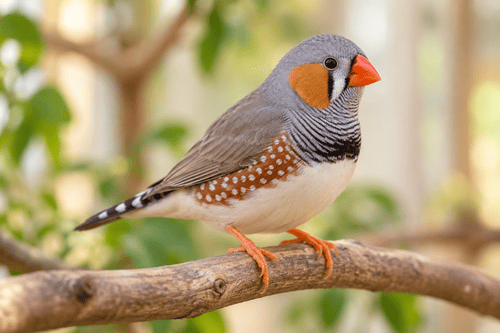
Zebra Finch
Also known as: Taeniopygia guttata, Zebbie
Busy, chattering and best kept in company — a flock bird, never a solo pet.
- Social
- Busy
- Chattering
- Timid
- Flock-oriented
The zebra finch is a small Australian grassland bird and one of the most commonly kept aviary species in the world. They are active, endlessly social and constantly vocal in a soft chattering way. The single most important fact about them is that they are **flock animals** — a zebra finch kept alone is a welfare problem, no matter how much human attention it receives.
At a glance
- Origin
- Australia
- Size
- Small
- Weight
- 0.4–0.6 oz (10–16 g)
- Lifespan
- 5–9 years
- Coat
- Plumage
- Colours
- Grey (wild type), Fawn, Pied, White, Chestnut-flanked White
- Average cost
- $12–$30 / month
Breed ratings
Rated 1–5 on the same scale as every other entry, so scores are comparable between breeds. Amber stars mark things that cost you effort rather than things that benefit you.
Temperament
Zebra finches are flock animals whose whole behavioural repertoire is social. They are absorbing to watch and entirely uninterested in human contact — not tame, not handleable and not wanting to be.
Care & upkeep
Exercise
Zebra finches fly rather than climb, so cage length is what matters — 80 cm minimum for a pair. Tall narrow cages are unsuitable regardless of volume.
Grooming
Self-grooming, with a bath dish offered two or three times a week. Use perches of varied natural diameter to keep nails and feet in good condition.
Training
Not trainable. They habituate to routine and to the presence of their keeper, and will become calm around normal household activity, but they do not learn cues or accept handling.
Feeding & diet
- Typical diet
- Seed base with fresh greens
- Daily amount
- 1–2 tsp seed plus fresh greens per bird
- Meals per day
- Fresh food daily
Seed forms the base but daily fresh greens, sprouted seed and cuttlefish bone are what make the difference. Blow husks off the dish daily — a dish that looks full is frequently empty underneath.
Foods to avoid
- Avocado
- Chocolate
- Caffeine
- Alcohol
- Salt
- Apple seeds
Who this breed suits
A good match for
- Apartments
- First-time bird keepers
- People wanting an observation pet
- Aviary keepers
Probably not for
- Owners wanting a tame handleable bird
- Anyone intending to keep a single bird
- Homes using non-stick cookware
Common health problems
This section describes conditions the breed is known to be predisposed to, so you know what to ask about. It is not veterinary advice and is not a diagnosis — always speak to a vet about your own animal.
- Chronic egg layingDepletes calcium and shortens lives. Remove nests and nesting material unless deliberately breeding.
- Egg bindingA straining, hunched female is an emergency requiring immediate veterinary care.
- Air sac mitesCause clicking and wheezing. Treatable with prompt veterinary attention.
- Scaly face and leg mitesProduce crusty growths around the beak and legs. Treatable.
- AspergillosisA fungal respiratory infection linked to damp bedding and poor ventilation.
Keeping a zebra finch alone is a genuine welfare failure regardless of how much human attention it receives. They must be kept at least in pairs.
Interesting facts
- One of the most studied birds in science, particularly for research into how song is learned.
- Males learn their song from an adult tutor during a limited window in youth.
- Adapted to arid Australian grassland, they can survive on remarkably little water.
Diet & Feeding
A quality finch seed mix forms the base, supplemented daily with fresh greens — spinach, kale, broccoli, chickweed and grated carrot — plus egg food during moult and breeding. Sprouted seed is excellent and closer to the wild diet. Provide cuttlefish bone for calcium, which matters particularly for laying females. Change water daily and blow the husks off the seed dish, because a dish that looks full is often empty underneath — a common cause of birds starving in plain sight.
Exercise & Housing
Zebra finches fly rather than climb, so cage width is what counts: a minimum of 80 cm long for a pair, and larger is meaningfully better. Avoid tall narrow cages entirely. Provide perches of varying diameter and natural branch, plus a swing and some cover planting or artificial foliage. Keep at least two, ideally a same-sex pair or a small group if you do not want breeding — this is not a bird that can be kept singly.
Grooming
Self-grooming. Provide a shallow bath dish two or three times a week; zebra finches bathe enthusiastically and daily in warm weather. Nails occasionally overgrow and need trimming, especially if all perches are the same diameter — use varied natural wood to reduce the problem. Handle only when necessary: these are not handling birds and restraint is genuinely stressful for them, so catch with care and keep it brief.
Health & Vet Care
Register with an avian vet. Common issues are air sac mites, scaly face and leg mites, egg binding in females, which is an emergency, and chronic egg laying, which depletes calcium and shortens lives — remove nests and nesting material if you are not deliberately breeding. Also watch for aspergillosis from damp bedding. A fluffed, floor-sitting bird is a same-day matter; finches decline very quickly once visibly unwell.
Living with Zebra Finches
They are absorbing to watch — constantly busy, chattering softly and interacting with each other all day. They are not tame, do not step up and do not want handling, and expectations should be set accordingly. They are quiet enough for a flat, cheap to feed and relatively straightforward to keep well. Their main requirements are company, flight space and a clean environment, and given those they are among the easiest birds to look after.