
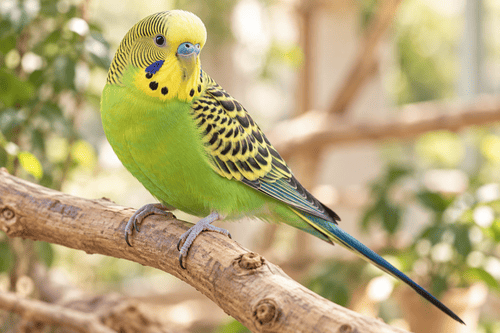
Budgerigar (Budgie)
Small, bright and full of personality — the perfect introduction to bird ownership.
The budgerigar is the world's most popular pet bird, and for good reason. Small, colourful, sociable and capable of mimicking speech, budgies pack an enormous amount of personality into a tiny frame. They are one of the more manageable pet birds to keep well, though "manageable" should not be confused with "low-effort" — budgies need social interaction, space and mental stimulation every single day.
At a glance
- Origin
- Australia
- Size
- Small
- Weight
- 0.9–1.4 oz (25–40 g)
- Lifespan
- 5–15 years
- Coat
- Plumage
- Colours
- Green, Blue, Yellow, White, Violet, Grey, Albino and many mutations
Breed ratings
Rated 1–5 on the same scale as every other entry, so scores are comparable between breeds. Amber stars mark things that cost you effort rather than things that benefit you.
Diet & Feeding
The biggest mistake budgie owners make is feeding seed-only diets. Seeds are the budgerigar equivalent of junk food — high in fat, low in vitamins. Offer a high-quality small parrot pellet as the dietary base, supplemented daily with fresh vegetables (leafy greens, broccoli, carrot, corn) and limited fruit. Keep seed as a treat. Grit (mineralised) can be offered in very small amounts. Fresh water daily — budgies are prone to Vitamin A and iodine deficiency on poor diets.
Exercise & Social Time
Budgies need daily out-of-cage time to fly freely in a safe, bird-proofed room. Flight is essential for physical and psychological health. A large cage is the minimum — a flight cage allowing full wingspan movement is ideal. Budgies are flock animals: a single budgie needs hours of daily human interaction. Two budgies are easier to keep well than one, as they provide company during the hours you are unavailable.
Grooming
Budgies groom themselves. Provide a shallow dish of water 2–3 times a week for bathing — most love it. Never use soap. Check nails monthly (overgrown nails can curl and catch on cage bars). Beak overgrowth is a sign of nutritional deficiency or health problems and should be assessed by an avian vet. Moulting occurs once or twice a year — normal light feather loss; heavy or patchy loss warrants a vet visit.
Health & Vet Care
Budgies hide illness until critically unwell. Watch for: fluffed-up posture (a sick bird's classic sign), tail bobbing when breathing, nasal discharge, changes in droppings, sitting on the floor of the cage. These all require prompt avian vet attention. Common conditions include psittacosis (chlamydiosis), air sac mites, tumours (particularly in females — ovarian/testicular), thyroid enlargement and scaly face mite (Cnemidocoptes). Annual wellness checks are worthwhile.
Living with a Budgie
Budgies are not cage ornaments. A well-kept budgie is an active, curious, vocal presence in your home. They can learn to mimic speech (males more readily than females), will respond to their name and will interact with toys, puzzles and their owners. They are relatively quiet compared to larger parrots — appropriate for flat/apartment living. Their relatively short lifespan means they are sometimes a first bird for children, but adult supervision and commitment remain essential.