
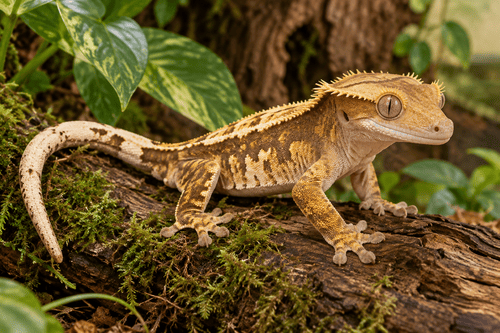
Crested Gecko
Also known as: Crestie, Eyelash gecko, Correlophus ciliatus
No special heating, no live-food obligation — arguably the easiest reptile to keep well.
- Docile
- Nocturnal
- Jumpy
- Curious
- Solitary
The crested gecko was believed extinct until its rediscovery in New Caledonia in 1994, and has since become one of the most popular pet reptiles in the world. The reason is practical: they thrive at ordinary room temperature, eat a complete powdered diet that needs only water, and stay small. For a first reptile that is genuinely straightforward to get right, this is the strongest candidate available.
At a glance
- Origin
- New Caledonia
- Size
- Small
- Weight
- 1.2–1.9 oz (35–55 g)
- Lifespan
- 15–20 years
- Coat
- Soft granular scales with eyelash-like crests above the eyes
- Colours
- Buckskin, Harlequin, Pinstripe, Dalmatian, Flame, Tiger
- Average cost
- $15–$35 / month
Breed ratings
Rated 1–5 on the same scale as every other entry, so scores are comparable between breeds. Amber stars mark things that cost you effort rather than things that benefit you.
Temperament
Crested geckos tolerate gentle handling but are genuinely jumpy — they leap without warning, so handle low over a soft surface or inside a contained space. They do not seek interaction and are best appreciated as an animal to observe.
Care & upkeep
Exercise
A tall, planted vivarium provides all the exercise they need — cresties are arboreal and climb constantly at night. Minimum adult enclosure 45 x 45 x 60 cm, taller rather than wider.
Grooming
None required. Maintain humidity at 60–80% with evening misting so sheds come away cleanly, and check toes and tail tip afterwards for retained skin.
Training
Not trainable in any meaningful sense. They will learn feeding routines and may come out at the sound of the food dish. Allow two weeks of settling before handling a new animal.
Feeding & diet
- Typical diet
- Complete powdered fruit diet (CGD)
- Daily amount
- CGD mixed with water, offered every other day
- Meals per day
- 3–4 times per week
Commercially formulated crested gecko diet is nutritionally complete and is the single biggest reason this species is easy to keep. Live insects 1–2 times a week are optional enrichment rather than a requirement.
Foods to avoid
- Insects larger than the space between the eyes
- Avocado
- Citrus
- Wild-caught insects
- Any temperature above 28°C
Who this breed suits
A good match for
- First-time reptile keepers
- Apartments and small spaces
- Owners who dislike handling live insects
- People wanting a low-heat setup
Probably not for
- Owners wanting a handleable, interactive pet
- Warm rooms that cannot be kept below 28°C
- Anyone wanting a diurnal animal
Common health problems
This section describes conditions the breed is known to be predisposed to, so you know what to ask about. It is not veterinary advice and is not a diagnosis — always speak to a vet about your own animal.
- Metabolic bone diseaseCaused by calcium or vitamin D3 deficiency. Largely prevented by a complete diet; signs are a wavy jaw, tremors and weak limbs.
- Retained shedStuck skin on toes constricts blood supply and causes toe loss. Maintain humidity and check after every shed.
- Floppy tail syndromeThe tail base weakens from prolonged head-down resting; linked to calcium status and enclosure design.
- Tail lossCresties drop their tails readily and, unlike leopard geckos, never regrow them. Harmless but permanent.
- OverheatingSustained temperatures above 28°C are dangerous. This species needs cool, not warm.
Almost every crested gecko in captivity is tailless by adulthood — the tail drops easily and does not regenerate. It affects appearance only and has no bearing on the animal's health or quality of life.
Interesting facts
- Declared extinct for most of the 20th century and rediscovered in 1994 after a tropical storm.
- Their toe pads and tail tip both grip, allowing them to hang from glass.
- Unlike most geckos, they have no eyelids and clean their eyes with their tongue.
Diet & Feeding
This is what makes the species so beginner-friendly. Commercial crested gecko diet (CGD) is a nutritionally complete powder — mix with water to a ketchup consistency and offer in a shallow dish three to four times a week, removing it after 24–36 hours. That is the entire dietary obligation. Live insects are optional enrichment, not a requirement: offer appropriately sized dubia roaches or crickets once or twice a week if you like, dusted with calcium. Never feed insects wider than the gap between the gecko's eyes.
Temperature & Humidity
Crested geckos are the rare reptile that needs no supplemental heat in most homes. They thrive at 22–26°C — ordinary room temperature — with a night drop. Critically, they run the opposite risk to most reptiles: sustained temperatures above 28°C are dangerous and above 30°C can be fatal. Humidity should cycle between roughly 60% and 80%, achieved by misting in the evening and allowing partial drying during the day. A low-output UVB bulb is not essential but is increasingly recommended.
Enclosure & Setup
Cresties are arboreal, so height matters more than floor space: a minimum of 45 x 45 x 60 cm for a single adult, oriented vertically. Furnish densely with cork bark, branches, vines and plants (live or artificial) — a bare enclosure leaves a nocturnal, climbing animal with nowhere to feel secure. Use a substrate that holds humidity, such as coconut fibre or a bioactive soil mix. House alone: males fight, and mixed pairs lead to unwanted breeding that is hard on the female.
Health & Vet Care
Register with a reptile-experienced vet. The main issues are metabolic bone disease (largely prevented by the complete diet — watch for a wavy jaw or tremors), retained shed on the toes, which constricts blood supply and causes toe loss if not caught, and floppy tail syndrome. Weigh your gecko monthly; steady weight is the best early indicator of health. Note that dropped tails never regrow in this species — most adult cresties are tailless, and it affects nothing but appearance.
Living with a Crested Gecko
Expect an animal to observe rather than interact with. Cresties are nocturnal, becoming active after dark, and while they tolerate gentle handling they are genuinely jumpy — handle low over a soft surface or inside a contained space, because they leap without warning. Allow a new gecko two weeks to settle before handling at all, then build up in short sessions. They live 15–20 years, are quiet, odourless and need no special heating, which makes them one of the most apartment-compatible pets of any kind.