
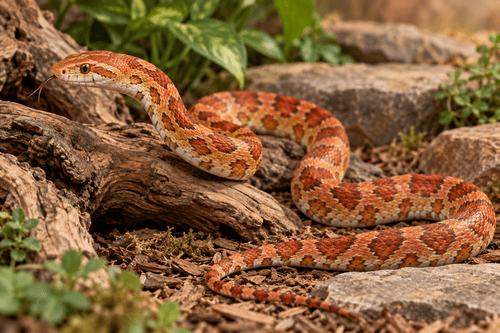
Corn Snake
Also known as: Red rat snake, Pantherophis guttatus
Docile, hardy and forgiving — the snake most keepers should start with.
- Docile
- Curious
- Active
- Hardy
- Solitary
The corn snake is a North American rat snake and the most widely recommended beginner snake in the world. They are docile, rarely bite, stay a manageable size and are unusually forgiving of minor husbandry variation. They are also active and visible during the day and evening, unlike many snakes, which makes them more engaging to keep than their reputation for simplicity suggests.
At a glance
- Origin
- South-eastern United States
- Size
- Medium
- Weight
- 1–2 lb (0.5–0.9 kg)
- Lifespan
- 15–20 years
- Coat
- Smooth scales
- Colours
- Wild type (orange with red saddles), Amelanistic, Snow, Anerythristic, Lavender, Scaleless and hundreds of morphs
- Average cost
- $18–$40 / month
Breed ratings
Rated 1–5 on the same scale as every other entry, so scores are comparable between breeds. Amber stars mark things that cost you effort rather than things that benefit you.
Temperament
Corn snakes are calm and rarely bite, and most tolerate regular handling well once settled. They are more active and visible than many snakes, which makes them engaging to keep as well as easy.
Care & upkeep
Exercise
An appropriately sized secure enclosure with climbing branches and two hides. Corn snakes climb more than expected and escape more readily than any other beginner species.
Grooming
None required. Maintain humidity around 40–50%, raised to 60% during a shed, so the skin comes away in one piece. Check eye caps and tail tip afterwards.
Training
Not trainable. They habituate to routine handling — short, calm, regular sessions build tolerance. Allow two weeks to settle after arrival, and never handle during a shed.
Feeding & diet
- Typical diet
- Whole prey — appropriately sized rodents
- Daily amount
- One mouse roughly the width of the snake, every 5–10 days
- Meals per day
- Every 5–10 days depending on age
Feed frozen-thawed rather than live — a live rodent can injure a snake that is not immediately interested. Corn snakes are reliable feeders, so prolonged refusal signals a husbandry or health problem.
Foods to avoid
- Live prey left unattended
- Prey larger than the snake widest point
- Handling within 48 hours of feeding
- Unregulated heat sources
Who this breed suits
A good match for
- First-time snake keepers
- Apartments
- Owners wanting a visible, active reptile
- People able to commit for two decades
Probably not for
- Anyone squeamish about feeding rodents
- Households unwilling to store frozen prey
- Owners wanting a handleable pet immediately
Common health problems
This section describes conditions the breed is known to be predisposed to, so you know what to ask about. It is not veterinary advice and is not a diagnosis — always speak to a vet about your own animal.
- Respiratory infectionUsually caused by incorrect temperature or humidity. Open-mouth breathing and wheezing need prompt veterinary care.
- Scale rotDiscoloured, blistered belly scales caused by wet or soiled substrate.
- MitesTiny black specks around the eyes and in the water bowl. Highly contagious — quarantine new animals.
- Retained eye capsIncomplete shedding around the eyes from low humidity. Never pull them off.
- RegurgitationUsually caused by handling too soon after feeding or by prey that is too large.
The most common husbandry failure with corn snakes is escape. Check every gap, vent and latch before the snake goes in — they are considerably stronger and more persistent than they look.
Interesting facts
- Named for the maize-like pattern on the belly, or for being found in grain stores hunting rodents.
- Hundreds of colour morphs exist, second only to the ball python.
- Widely used as a beginner species because they tolerate minor husbandry errors better than most snakes.
Diet & Feeding
Corn snakes eat whole prey — a mouse roughly as wide as the snake at its thickest point — every 5–10 days depending on age and size. Feed frozen-thawed, never live: an unattended live rodent can seriously injure a snake. Thaw fully to slightly above room temperature. Avoid handling for 48 hours after feeding to prevent regurgitation. Unlike ball pythons, corn snakes are reliable feeders and prolonged refusal is more likely to signal a husbandry or health issue.
Temperature & Humidity
Provide a clear gradient: warm side 28–30°C, cool side 21–24°C, with a modest night drop. Use a thermostat-controlled heat mat or radiant panel — never an unregulated heat source, which causes serious burns. Humidity should sit around 40–50%, raised to 60% during a shed. Digital thermometers with probes and a hygrometer are essential; guessing at these numbers is how respiratory infections begin. Low-level UVB is optional but increasingly recommended.
Enclosure & Setup
An adult needs at least 120 x 60 x 60 cm. Corn snakes are excellent escape artists — the single most common husbandry failure with this species is an enclosure that is not genuinely secure, so check every gap and latch. Provide at least two hides, one on each side of the gradient, snug enough that the snake touches the sides. Add climbing branches, since they climb more than expected, a water bowl large enough to soak in, and aspen or cypress substrate.
Health & Vet Care
Find a reptile vet in advance. Common problems are respiratory infection (open-mouth breathing, wheezing — usually caused by incorrect temperature or humidity), scale rot from wet substrate, mites, retained eye caps from low humidity and regurgitation from handling too soon after feeding. Quarantine new animals for 60 days. Weigh monthly: steady weight is the most reliable indicator of health in any snake.
Living with a Corn Snake
They are calm, curious and among the easiest snakes to handle — most tolerate regular short sessions well once settled. Allow two weeks after arrival before handling, and never handle during a shed, when vision is impaired. They are active and often visible, which makes them more rewarding to watch than many species. Expect 15 to 20 years, and keep them alone: cohabitation offers no benefit and carries genuine risk.