
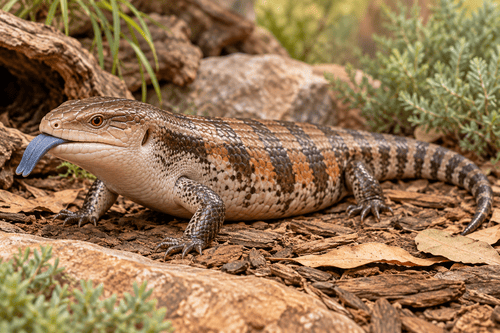
Blue-Tongued Skink
Also known as: Blue-tongue, Bluey, Tiliqua
A handleable, food-motivated lizard with real personality — and an omnivore diet to match.
- Docile
- Curious
- Food-motivated
- Slow-moving
- Solitary
The blue-tongued skink is a large Australasian lizard named for its startling cobalt tongue, used as a bluff display against predators. They are among the most handleable reptiles available, genuinely responsive to their keepers, and long-lived. Their omnivorous diet is more involved than an insectivore's, and their size means the enclosure requirement is larger than most people expect.
At a glance
- Origin
- Australia, Indonesia, New Guinea
- Size
- Large
- Weight
- 1–2 lb (0.3–1 kg)
- Lifespan
- 15–20 years
- Coat
- Smooth overlapping scales
- Colours
- Banded brown, grey and orange depending on species
- Average cost
- $25–$55 / month
Breed ratings
Rated 1–5 on the same scale as every other entry, so scores are comparable between breeds. Amber stars mark things that cost you effort rather than things that benefit you.
Temperament
Blue-tongues are among the most interactive reptiles available — diurnal, tolerant of handling and quick to recognise their keeper and the feeding routine. They move slowly, rarely bite and are genuinely responsive animals.
Care & upkeep
Exercise
Terrestrial and needing floor space rather than height — 120 x 60 cm minimum for an adult, with 10–15 cm of substrate for burrowing and foraging.
Grooming
None required. Maintain species-appropriate humidity so sheds come away cleanly, and check toes and tail tip afterwards for retained skin.
Training
Target training and hand-feeding work well and are useful for stress-free handling. They learn routines quickly and will approach when the enclosure is opened.
Feeding & diet
- Typical diet
- Omnivorous — vegetables, protein and limited fruit
- Daily amount
- Roughly 50% vegetables, 40% protein, 10% fruit
- Meals per day
- Adults 2–3 times weekly; juveniles daily
An omnivore rather than an insectivore, which makes the diet more involved than for most pet lizards. Dust with calcium at most feeds and use a multivitamin weekly.
Foods to avoid
- Onion and garlic in any wet food
- Avocado
- Rhubarb
- Insects larger than the space between the eyes
- Loose substrate at feeding time
Who this breed suits
A good match for
- First-time lizard keepers wanting interaction
- Families with older children
- Owners able to commit for two decades
- People wanting a diurnal reptile
Probably not for
- Owners wanting a small enclosure
- Homes without UVB provision
- Anyone unwilling to prepare a varied omnivore diet
Common health problems
This section describes conditions the breed is known to be predisposed to, so you know what to ask about. It is not veterinary advice and is not a diagnosis — always speak to a vet about your own animal.
- Metabolic bone diseaseCaused by insufficient UVB or calcium. Signs include tremors, a soft jaw and weakness. Preventable with correct lighting.
- ObesityVery common — blue-tongues will eat as much as offered. Feed adults two or three times a week, not daily.
- ImpactionCaused by ingesting loose substrate during feeding. Feed from a dish or flat surface.
- Retained shedStuck skin on toes and tail tip constricts circulation. Check after every shed.
- Respiratory infectionLinked to cold or damp conditions. Wheezing or open-mouth breathing needs prompt veterinary care.
Confirm the species before buying. Australian and Indonesian blue-tongues have meaningfully different humidity requirements, and setups suited to one can cause problems for the other.
Interesting facts
- The blue tongue is a bluff display, flashed at predators alongside a hiss and a flattened body.
- They give birth to live young rather than laying eggs.
- Among the most handleable reptiles kept as pets, and often recommended for people who want interaction.
Diet & Feeding
Blue-tongues are omnivores, and the usual target is roughly 50% vegetables, 40% protein and 10% fruit. Vegetables: collard greens, dandelion, squash, green beans. Protein: high-quality wet dog or cat food with no onion or garlic, cooked egg, insects, or commercial blue-tongue diets. Fruit sparingly. Dust with calcium at most feeds and a multivitamin weekly. Adults eat two or three times a week; juveniles daily. They are food-motivated to the point of pushiness.
Heating & Lighting
Provide a proper gradient: basking surface of 35–38°C, ambient warm side around 29°C, cool side 22–24°C, with a night drop. UVB is required — a T5 HO tube across a good portion of the enclosure — because without it a skink cannot metabolise calcium and will develop metabolic bone disease. Replace the UVB bulb every 6–12 months regardless of visible output. Humidity varies by species: Australian types around 40%, Indonesian types considerably higher.
Enclosure & Setup
Blue-tongues are terrestrial and need floor space, not height. An adult requires a minimum of 120 x 60 cm, and larger is genuinely better for an animal that patrols and forages. Provide deep substrate for burrowing — 10–15 cm of a soil and cypress mix — plus multiple hides, cork bark, a flat basking stone and a water bowl large enough to soak in. House alone: blue-tongues are solitary and cohabitation causes stress and injury.
Health & Vet Care
Register with a reptile vet. The main problems are metabolic bone disease from insufficient UVB or calcium, obesity, which is very common because they will eat as much as offered, retained shed on the toes and tail, respiratory infection from cold or damp conditions and impaction from loose substrate ingested during feeding. Feed on a flat surface or a shallow dish rather than directly off loose substrate.
Living with a Blue-Tongued Skink
They are among the most rewarding reptiles to keep for anyone who wants interaction: diurnal, curious, tolerant of regular handling and quick to recognise their keeper and the food routine. They move slowly and rarely bite. Allow two weeks to settle after arrival before handling, then build up in short sessions. Expect 15 to 20 years and confirm species before buying, since Australian and Indonesian types have meaningfully different humidity needs.