
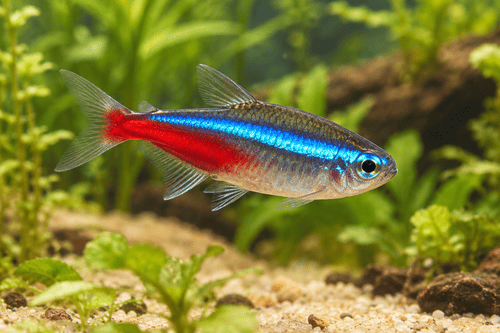
Neon Tetra
Also known as: Paracheirodon innesi, Neon
A shoaling fish that only makes sense in numbers — and looks extraordinary when kept properly.
- Peaceful
- Shoaling
- Active
- Shy in small groups
- Colourful
The neon tetra is one of the most recognisable aquarium fish in the world, a small Amazonian characin with an iridescent blue stripe and red flank. They are sold everywhere, frequently in groups far too small, into tanks far too new. Kept as they should be — a proper shoal in a mature, planted, soft-water tank — they are spectacular and genuinely easy.
At a glance
- Origin
- Amazon basin, South America
- Size
- Small
- Weight
- 0 oz (1 g)
- Lifespan
- 5–8 years
- Coat
- Scales
- Colours
- Iridescent blue stripe with a red posterior, also Diamond and Golden variants
- Average cost
- $10–$30 / month
Breed ratings
Rated 1–5 on the same scale as every other entry, so scores are comparable between breeds. Amber stars mark things that cost you effort rather than things that benefit you.
Temperament
Neon tetras only behave normally in a proper shoal. Kept in small groups they are pale, hiding and short-lived; kept in fifteen or more they school tightly, swim boldly and display full colour.
Care & upkeep
Exercise
A shoal of at least 10 in a minimum 60 litre planted tank. Swimming space and shoal size together determine whether the fish behave naturally or remain permanently stressed.
Grooming
Not applicable — tank maintenance is the equivalent job. Weekly 20–25% water changes and monthly filter media rinsing in old tank water.
Training
Not trainable, though they learn feeding times and will gather at the front of the tank when a keeper approaches.
Feeding & diet
- Typical diet
- Micro-pellet base with frozen and live foods
- Daily amount
- What the shoal eats in about 30 seconds
- Meals per day
- 1–2 times daily
Micropredators that do best on variety — a micro-pellet base with frozen or live daphnia, cyclops and brine shrimp two or three times a week. Overfeeding is the main cause of water quality problems.
Foods to avoid
- Overfeeding
- Uncycled tanks
- Large or aggressive tank mates
- Sudden large water changes
- Hard alkaline water
Who this breed suits
A good match for
- Planted community tanks
- Apartments
- Beginner aquarists with a cycled tank
- Owners wanting a display shoal
Probably not for
- Uncycled or brand new tanks
- Groups smaller than six
- Tanks with angelfish or other large species
- Hard water without adjustment
Common health problems
This section describes conditions the breed is known to be predisposed to, so you know what to ask about. It is not veterinary advice and is not a diagnosis — always speak to a vet about your own animal.
- Neon tetra diseaseA parasitic infection causing fading colour and erratic swimming. No reliable cure — quarantine new fish to prevent it.
- Ich (white spot)A parasite appearing as salt-like grains. Usually follows a temperature swing or stress.
- Fin rotRagged fins caused by poor water quality. Correct the water before medicating.
- ColumnarisA bacterial infection producing white patches, often at the mouth. Linked to poor water and high temperature.
- New tank syndromeNeons are notably sensitive to ammonia and nitrite. Never add them to an uncycled tank.
Almost every neon problem traces back to shoal size, tank maturity or water quality. A large shoal in a mature planted tank is a hardy, long-lived fish; the same fish in a bare new tank is not.
Interesting facts
- Discovered in the Amazon in the 1930s and among the most popular aquarium fish ever since.
- The blue stripe is structural iridescence rather than pigment, which is why it shifts with the light.
- They dim their colours at night and regain them within minutes of the lights coming on.
Diet & Feeding
Neon tetras are micropredators in the wild and do best on variety. Use a quality micro-pellet or crushed flake as the base, supplemented two or three times a week with frozen or live daphnia, cyclops, brine shrimp and microworm. Feed only what the shoal consumes in about 30 seconds, once or twice daily, and remove anything left. Overfeeding is the leading cause of water quality collapse in small community tanks.
Tank & Water Requirements
The two things that matter most are shoal size and tank maturity. Keep a minimum of 10, and preferably 15 or more — small groups produce stressed, pale, short-lived fish. Minimum tank 60 litres. Water should be 22–26°C, soft and slightly acidic (pH 6.0–7.0), gently filtered and heavily planted with dark substrate, which is what brings out the colour. Never add neons to a tank that is not fully cycled — they are notably sensitive to new-tank conditions.
Tank Maintenance
Test weekly with a liquid test kit: ammonia and nitrite at 0 ppm, nitrate under 20 ppm. Change 20–25% of the water weekly with dechlorinated water matched to tank temperature — neons dislike large sudden changes more than most community fish, so little and often beats occasional big changes. Rinse filter media in old tank water rather than under the tap, and never replace all media at once.
Health & Vet Care
The condition to know is neon tetra disease, a parasitic infection causing fading colour, lumpy body shape and erratic swimming. There is no reliable cure, and affected fish should be removed promptly to protect the shoal — quarantining new fish for two to four weeks is the only real defence. Also watch for ich, fin rot and columnaris, nearly all of which trace back to water quality or a sudden temperature swing.
Living with Neon Tetras
In a proper shoal they behave completely differently to the anxious individuals seen in shop tanks — tight schooling, bold movement and full colour. They are peaceful and suit a community with other small, calm species; avoid anything large enough to eat them, including angelfish, which will. They are best appreciated as a display shoal rather than as individuals, and a well-planted tank of twenty neons is one of the most striking sights in the hobby.