
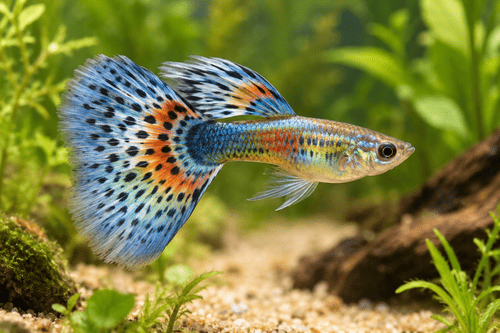
Guppy
Also known as: Poecilia reticulata, Millionfish, Rainbow fish
Colourful, hardy and prolific — the beginner fish that will fill your tank if you let it.
- Peaceful
- Active
- Hardy
- Sociable
- Prolific
The guppy is a small livebearing fish from northern South America and one of the most popular aquarium species in the world, bred into an enormous range of colours and tail shapes. They are hardy, active and genuinely easy for a beginner — with one significant caveat that catches almost everyone: they breed constantly, and an unmanaged tank becomes overcrowded within months.
At a glance
- Origin
- Northern South America
- Size
- Small
- Weight
- 0–0.1 oz (1–2 g)
- Lifespan
- 2–4 years
- Coat
- Scales with elaborate fin development in males
- Colours
- Almost every colour, Cobra, Tuxedo, Snakeskin, Delta, Fantail and many strains
- Average cost
- $10–$25 / month
Breed ratings
Rated 1–5 on the same scale as every other entry, so scores are comparable between breeds. Amber stars mark things that cost you effort rather than things that benefit you.
Temperament
Guppies are peaceful, constantly active and highly visible, which makes them ideal for a first tank. Males display to each other and to females continually, and the breeding is relentless without deliberate management.
Care & upkeep
Exercise
A minimum 40 litre tank with moderate planting and gentle flow. Keep one male to two or three females, or the females are harassed continuously.
Grooming
Not applicable — tank maintenance is the equivalent commitment. Weekly 25% water changes and monthly filter media rinsing in old tank water.
Training
Not trainable, though they learn feeding times quickly and will gather at the surface as soon as a keeper approaches the tank.
Feeding & diet
- Typical diet
- Omnivorous flake and frozen food diet
- Daily amount
- What they eat in about 30 seconds
- Meals per day
- 1–2 times daily
Omnivores that beg constantly and will eat well past sense. A quality flake or micro-pellet base with frozen foods two or three times a week, fed sparingly, is all they need.
Foods to avoid
- Overfeeding
- Uncycled tanks
- Fin-nipping tank mates
- Very soft acidic water
- Strong filter flow
Who this breed suits
A good match for
- Beginner aquarists
- Families with children
- Small community tanks
- Apartments
Probably not for
- Owners unprepared for constant breeding
- Uncycled tanks
- Tanks with fin-nipping species
- Very soft-water setups
Common health problems
This section describes conditions the breed is known to be predisposed to, so you know what to ask about. It is not veterinary advice and is not a diagnosis — always speak to a vet about your own animal.
- Fin rotRagged, receding fins caused by poor water quality or overcrowding. Fix the water before medicating.
- Ich (white spot)A parasite appearing as salt-like grains on fins and body. Treatable if caught early.
- VelvetA gold dust-like coating, highly contagious and often fatal if untreated.
- ColumnarisA bacterial infection producing white patches, often around the mouth.
- Reduced hardiness in fancy strainsIntensive breeding for colour and fin shape has made many modern guppies less robust than older stock.
Population control is the thing to plan before buying, not after. Keeping males only is the simplest approach for anyone who does not want to manage constant fry.
Interesting facts
- Sometimes called the millionfish for how rapidly they reproduce.
- Females can store sperm and produce several broods from a single mating.
- Introduced worldwide for mosquito control, becoming invasive in several regions as a result.
Diet & Feeding
Guppies are omnivores and do well on a quality tropical flake or micro-pellet as the base, supplemented two or three times a week with frozen daphnia, brine shrimp or bloodworm and occasional blanched vegetable matter. Feed only what they finish in about 30 seconds, once or twice daily. They will beg constantly and continue eating past the point of sense, so overfeeding — and the water quality problems that follow — is the classic beginner mistake.
Tank & Water Requirements
A minimum of 40 litres for a small group, with 22–28°C, a gentle filter and moderate planting. Guppies prefer slightly hard, alkaline water (pH 7.0–8.0), which is the opposite of most soft-water tetras — an important consideration when planning a community. Cycle the tank fully before adding fish. Keep males and females in a ratio of about one male to two or three females, or the females are harassed constantly.
Tank Maintenance
Test weekly with a liquid test kit: ammonia and nitrite at 0 ppm, nitrate under 20 ppm. Change 25% of the water weekly with dechlorinated water matched to temperature. Rinse filter media in old tank water rather than under the tap. Guppies are prolific — a female can store sperm and produce broods for months after a single mating — so plan for population control from the start rather than reacting when the tank is full.
Health & Vet Care
Common problems are fin rot, ich, columnaris, velvet and swim bladder issues, most of which trace directly back to water quality or overcrowding. Modern fancy guppy strains are, honestly, less hardy than they used to be because of intensive breeding for colour and fin shape — buy from a reputable source, quarantine new fish for two to four weeks and be sceptical of very cheap mass-bred stock.
Living with Guppies
They are active, colourful and constantly visible, which makes them excellent for a first tank and for children to watch. They are peaceful, though males will display at each other, and they suit a community of similarly sized calm species — avoid fin-nippers, which target the long tails. The population question is unavoidable: keep males only if you do not want fry, and have a plan before you buy rather than after the first brood.