
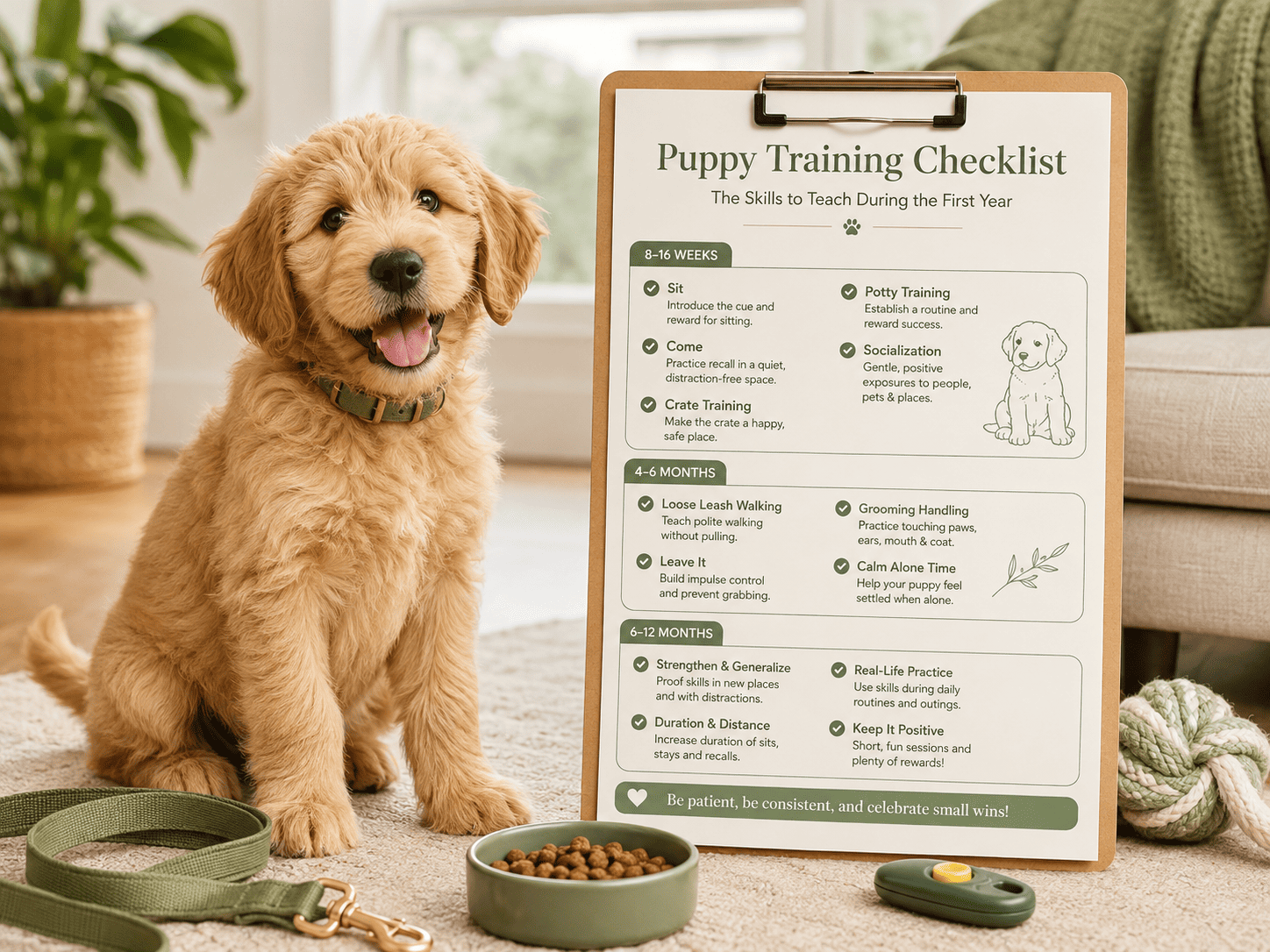
Puppy Training Checklist: The Skills to Teach During the First Year
Choose care, recall, walking, handling and settling skills across the first year. Use age-band checklists, progress criteria and an adolescent walking example.
In short
Choose care, recall, walking, handling and settling skills across the first year. Use age-band checklists, progress criteria and an adolescent walking example.
A puppy training checklist for the first year helps you choose useful skills as life changes: toilet access, handling, recall, walking, settling and safe household habits. Start with the behaviours that make ordinary care easier, then practise them in gradually changing settings.
The age bands below are planning prompts, not pass dates. A puppy's background, health and confidence affect progress; keep care and safety arrangements in place while learning continues.
Puppy training checklist for the first year: start with priorities
Choose a few current jobs rather than teaching every skill at once. Reward the behaviour you want and make the surroundings manageable enough for the puppy to participate.
| Priority | Useful action | Keep in place while learning |
|---|---|---|
| Toileting | Comfortably follow the routine to the toilet area | Frequent opportunities and supervision |
| Handling | Accept brief familiar care without distress | Gentle introductions and professional help when needed |
| Recall | Return towards the handler when called | A secure area or safe lead arrangement |
| Walking | Move with the handler on a loose lead | Fitted equipment and manageable routes |
| Rest | Use a comfortable resting place | Available quiet space and enough sleep |
| Household safety | Cooperate with ordinary door and item exchanges | Barriers, secure storage and supervision |
Ask the vet which early experiences are safe for local infection risks and vaccination status. Positive exposure can include seeing or hearing things at a comfortable distance; it does not require greetings with every animal or person.
Early weeks at home: build the care foundations
For puppies arriving around eight to twelve weeks, focus on familiar routines and manageable learning. Adapt the tasks for a different arrival age or background.
- Name and attention: reward turning towards you in a quiet setting.
- Toilet route: accompany the puppy, offer access around care events and reward toileting in the chosen place.
- Resting area: make a bed, pen or positively introduced crate comfortable and accessible.
- Gentle handling: introduce a brief touch or grooming tool without holding the puppy through discomfort.
- Recall foundation: invite the puppy towards you nearby and reward arrival.
- Everyday experience: allow a calm look at a household sound, surface or familiar person, with room to retreat.
Do not punish toilet accidents or force social contact to complete a checklist. Meet the puppy's care needs and simplify an experience that is too much.
A small starting practice plan
“Current jobs: attention in the kitchen, comfortable brush introduction and following the garden toilet route. Keep rewards ready and rest available. New experiences stay calm and optional; ask the vet about safe outings.”
Around three to four months: add everyday cooperation
As your puppy becomes familiar with home, choose tasks that help meals, outings and household movement. Continue the earlier foundations where needed.
- Practise a simple sit or another comfortable pause before an ordinary activity.
- Introduce walking equipment gradually and check fit as the puppy grows.
- Reward walking near you in a quiet place without pulling.
- Offer an appropriate toy during mouthy play and stop interactions that become overwhelming.
- Introduce “drop” through a calm exchange for something the puppy values.
- Expand positive experiences by changing one manageable feature.
- Continue comfortable grooming and care handling.
Use consistent cue words across the household. Decide whether “off” means leaving furniture or something else before several people use it for different actions.
If the puppy guards items or handling becomes unsafe, seek qualified help rather than repeatedly taking objects away to demonstrate control.
Around four to six months: practise beyond the easiest setting
Choose a modest new setting or distraction while keeping the task familiar. A skill learned beside the food cupboard may need an easier introduction outdoors.
- Practise recall with safe control in a quieter outdoor area.
- Reward a relaxed position near you before adding busier walking routes.
- Practise a comfortable mat or resting-place routine during quiet household activity.
- Introduce “leave” with a manageable item and reward moving attention away.
- Practise a brief everyday separation at a level the puppy tolerates comfortably.
- Continue polite greeting practice without forcing contact.
- Revisit equipment, handling and toilet arrangements as the puppy grows.
Do not turn alone-time practice into leaving until distress stops. Keep care cover available and arrange professional advice when separation is difficult.
Around six to twelve months: support adolescence
Adolescence can bring changing interests and responses. Keep routines predictable, make difficult settings easier and revisit skills where the puppy can succeed.
- Maintain recall practice without removing safe management too soon.
- Rebuild attention at a distance from exciting dogs, wildlife or activity.
- Practise greetings with enough space and a clear option to disengage.
- Continue walking in manageable routes before adding busy environments.
- Keep grooming, transport and veterinary handling introductions positive.
- Review alone-time comfort and care arrangements as household plans change.
- Retain enjoyable sniffing, play and learning rather than making every outing a test.
New pain, fear or a marked behaviour change deserves a veterinary conversation, not a blanket explanation that the dog is “just a teenager”. For the changing stage, see adolescence in dogs.
Decide when a checklist entry is ready for a harder version
Mark the action together with the setting where it works. Use the checklist to choose the next practice task; keep detailed session notes in the puppy training log.
| Skill | Useful progress statement | Next manageable change |
|---|---|---|
| Recall | Returns in the enclosed garden with no barking next door | A quieter outdoor setup with safe control |
| Mat | Uses the mat while a familiar person sits nearby | One calm household movement |
| Grooming | Comfortable with the brush approaching and a brief touch | Another easy touch, stopping before withdrawal |
| Walking | Can move beside the handler in a quiet area | A slightly different quiet route |
Change one condition, watch the response and keep the easier version available. A tick saying “recall finished” cannot tell a new handler whether the skill works around squirrels or traffic.
Worked example: Alba meets a busier walking route
Hugo's young dog, Alba, walks comfortably near him on the quiet lane. At a busier junction she watches passing dogs and pulls towards them.
Hugo keeps the fitted lead equipment, uses more distance and returns to a quieter route for practice. He marks walking as comfortable on the lane, with junction practice still developing.
Checklist update: “Loose-lead walking: quiet lane comfortable. Busy junction too distracting today. Next attempt uses more space from passing dogs; keep the familiar route for ordinary walks.”
He does not remove a useful skill from the checklist or push through the busiest setting to meet an age target. The next task is specific and manageable.
Common first-year mistakes
- Using age as a deadline: choose tasks from the puppy's present needs.
- Forcing socialisation: allow distance and a way to withdraw.
- Testing recall without safe control: keep management while reliability develops.
- Training when rest is needed: provide sleep and simplify the day.
- Calling all changes adolescence: ask the vet about health or significant behaviour concerns.
Frequently Asked Questions
Should every puppy finish these skills by their first birthday?
No. The first year is a planning period, not a pass deadline. Keep developing the skills that help your dog's daily life and seek support for persistent difficulty.
Can I start this checklist with an older puppy?
Yes. Begin with the foundations the puppy needs now, regardless of the age band. Consider their experience, comfort and care arrangements before adding harder tasks.
Does socialisation mean playing with lots of dogs?
No. Calm, positive experiences include sights, sounds, handling and different surroundings. Ask the vet about safe exposure and avoid forcing greetings or crowded situations.
What if a trained behaviour becomes difficult during adolescence?
Use an easier setting and maintain safe management. Review what changed, continue reward-based practice and ask for veterinary or qualified behaviour help where changes are significant.
Resources & Links
These sources help connect first-year skills with positive learning, puppy care and adolescent changes.
- PDSA: Adolescent Dogs — Adapt expectations and practice when responses change during adolescence.
- RSPCA: Puppy Care — Keep rest, early experiences and daily care alongside the skills you practise.
- Blue Cross: Dog and Puppy Training — Use positive learning principles as you revisit skills in different settings.
Track developing skills with the Puppy Training Tracker and prepare early care with the New Puppy Starter Kit. Get the Puppy Training Tracker → Get the New Puppy Starter Kit →
Printable and fillable PDF templates for pet owners — feeding schedules, health records, training trackers and more.