How to Teach a Reliable Recall: The Skill That Matters Most
Recall is the one command that genuinely keeps a dog safe. Here is how to build it properly from scratch, how to proof it against distractions, and the mistakes that break it.
In short
Recall is the one command that genuinely keeps a dog safe. Here is how to build it properly from scratch, how to proof it against distractions, and the mistakes that break it.
If a dog only ever learns one thing reliably, it should be coming back when called. Recall is what allows off-lead freedom, and it is the difference between a manageable moment and a dangerous one near a road or livestock. It is also the command owners most often teach accidentally badly.
The Rule That Underpins Everything
Coming back must always be the best thing that happens. If a dog is called and then told off, put on the lead to go home, or bathed, the word starts to predict something unwelcome. Dogs are not being disobedient when they hesitate; they are responding to what the cue has reliably meant.
Stage 1: Charge the Word
Pick a word you have not already worn out. Say it in the house, at zero distance, and immediately give a genuinely high-value reward — cheese, chicken, whatever your dog rarely gets. Repeat ten to fifteen times a day for several days. At this stage you are not asking for anything; you are building an automatic association between the word and something excellent.
Stage 2: Short Distances at Home
- Call from one metre away, reward, release
- Build to across the room, then between rooms
- Two-person recall: take turns calling the dog between you, rewarding each time
- Keep sessions to two or three minutes
Stage 3: Garden and Long Line
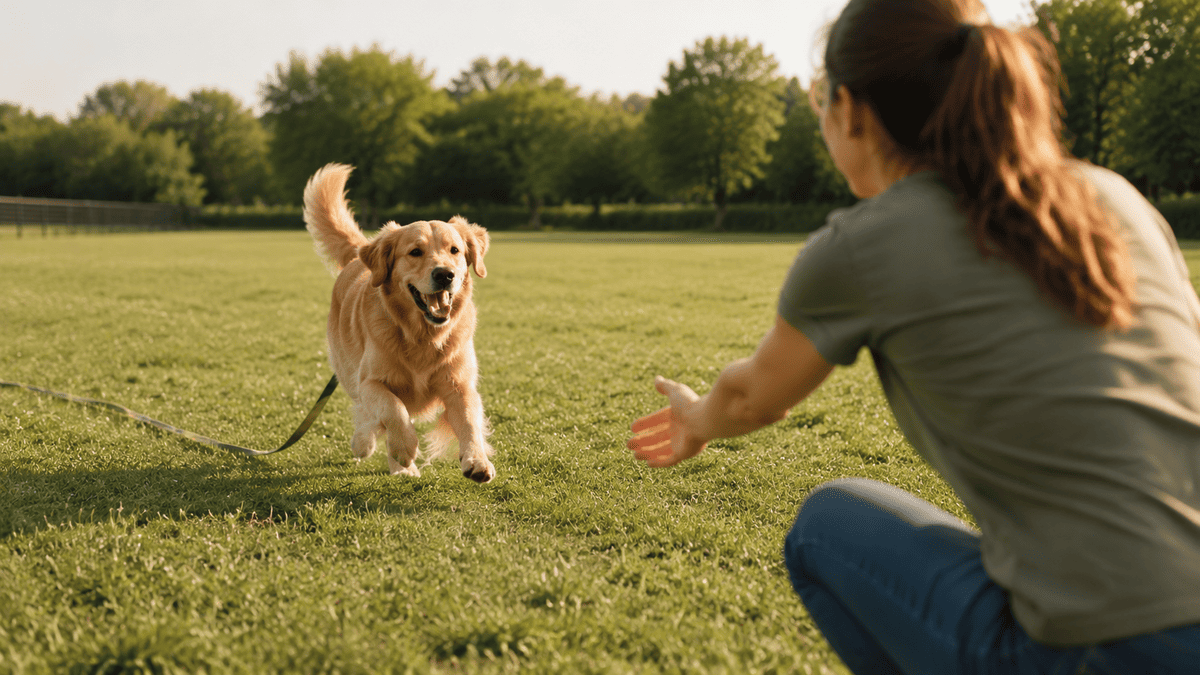
Move outdoors with a long training line attached — five to ten metres, on a harness rather than a collar. The line is not for pulling the dog in; it prevents rehearsal of ignoring you. Call when the dog is mildly distracted, reward heavily, and release them back to what they were doing. That release is itself a reward and teaches the dog that recall does not always mean the fun ends.
Puppy Training Tracker
Record every recall session — environment, distractions, success rate and next step. The Puppy Training Tracker gives you printable session logs and progress sheets so you can see when a skill is genuinely ready for a harder setting.
Get the Puppy Training Tracker →Stage 4: Proofing Against Distractions
A recall that works in the garden is not a recall. Build up distraction gradually and change only one variable at a time:
- Quiet field, no other dogs
- Field with distant dogs
- Busier park at a quiet time
- Near, but not into, high-value distractions
If the dog fails twice at a level, the level is too hard. Go back a step rather than repeating the failure.
Mistakes That Break Recall
- Calling repeatedly when the dog is ignoring you — this teaches the word means nothing
- Calling only to end the fun
- Punishing a slow return
- Testing off lead before the skill is built
- Using a reward the dog does not actually rate highly
The Emergency Recall
Keep a second word in reserve, trained the same way but used perhaps once a month and always paired with an exceptional reward. It stays powerful precisely because it is never diluted, which is what you want in a genuine emergency.
Two ways to track training
Focused on training progress? Choose the Puppy Training Tracker. Want training alongside daily care, health records and sitter notes? Choose the Complete Dog Owner Binder.
Get the Complete Dog Owner Binder →Frequently Asked Questions
How long does it take to train a reliable recall?
Several months of consistent short sessions for most dogs, and longer for adolescents or breeds with strong chase instincts. It is a skill that needs maintaining for life, not one you finish.
Should I use a whistle?
A whistle is consistent, carries further and never sounds annoyed — many owners find it more reliable than a voice cue. Train it exactly as you would a word.
My dog only comes back when I have food. Is that a problem?
Vary the reward so it becomes unpredictable — sometimes food, sometimes a game, sometimes release back to play. Unpredictable rewards produce stronger responses than a guaranteed treat.
Printable and fillable PDF templates for pet owners — feeding schedules, health records, training trackers and more.