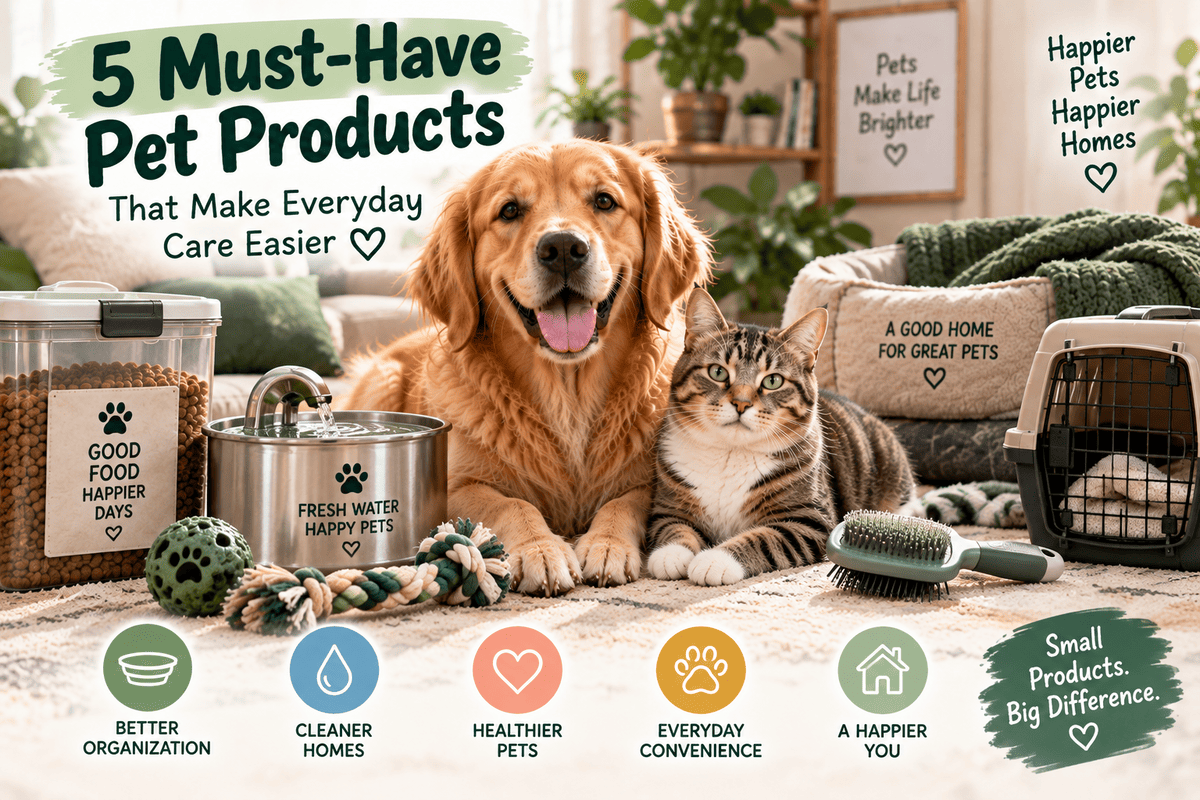
5 Must-Have Pet Products That Make Everyday Care Easier
Not toys — the practical items that quietly remove friction from daily pet care. Here are five that earn their place for both dog and cat owners, and what to buy first on a small budget.
In short
Not toys — the practical items that quietly remove friction from daily pet care. Here are five that earn their place for both dog and cat owners, and what to buy first on a small budget.
Affiliate disclosure: this article contains affiliate links. If you buy through them, Plan for Paw may earn a small commission at no extra cost to you. Products are grouped by the job they do, not by personal testing, and we have not tested them ourselves.
Most pet shopping lists are written for the first week: bowls, bed, lead, litter tray. The items below are different. They are the ones owners tend to buy in year two, after a bag of food has gone stale, a guest has sat down in a coat covered in hair, or a vet has asked a question nobody could answer quickly. They make daily care easier rather than more fun, which is why they are rarely on a new-owner list and almost always worth having.
Necessity or Convenience?
It is worth being honest about which is which. Of the five below, two solve problems with real consequences — food quality and emergency preparation — and three save time and effort. If the budget is tight, buy in that order rather than by price.
1. Airtight Pet Food Storage Container
Best for: anyone buying dry food in large bags.
Dry food degrades once it is open. The fats in kibble oxidise on contact with air, which dulls the smell and taste long before there is anything visibly wrong — a common and easily missed reason for a dog or cat suddenly becoming fussy. An airtight container with a sealing lid slows that down, keeps out humidity and insects, and stops a determined dog helping themselves.
The important detail: keep the food in its original bag and put the whole bag inside the container. The bag is made as a barrier, it carries the batch code and best-before date you would need in a recall, and it stops oils soaking into the plastic and turning rancid.
What we like:
- Keeps food fresher and more palatable between refills
- Keeps out damp, insects and curious pets
- Wheeled versions make large bags manageable
- Retains batch information when used with the original bag
Keep in mind:
- Wash and dry fully between bags, even when using the original packaging
- Choose food-grade plastic or stainless steel
- Buy for the bag size you actually use — a container too large holds more air
2. Reusable Pet Hair Remover
Best for: sofas, car seats and anything a lint roller runs out on.
A reusable remover — a roller with a one-way brush chamber, or a rubber-edged blade — pulls hair out of upholstery fibres rather than lifting it off the surface, and empties into a bin instead of using up sticky sheets. On a shedding dog's favourite chair, the difference is striking.
It is also worth doing the job in the right order: brush the pet first, outside if possible, then clean the furniture. Removing hair at the source is always less work than removing it from fabric.
What we like:
- No refills, so the running cost is nothing
- Works on upholstery and carpet where lint rollers struggle
- Fast enough to use before guests arrive
- Many double as a grooming tool for short-coated pets
Keep in mind:
- Test on delicate fabrics first — stiff rubber edges can pull loose weaves
- Empty the chamber regularly or it stops collecting
- It manages the symptom; regular brushing is what reduces the hair
3. Pet Water Fountain
Best for: cats, and any pet that drinks less than you would like.
Many cats prefer moving water and will drink more from a fountain than from a still bowl. That matters because cats are prone to urinary and kidney problems, and water intake is one of the few things an owner can influence at home. Some dogs, particularly fussy drinkers, respond the same way.
A fountain is a maintenance item, not a set-and-forget one. Filters need changing on schedule and the whole unit needs taking apart and washing regularly, or the bowl that was meant to encourage drinking becomes a biofilm-covered one that discourages it.
What we like:
- Encourages higher water intake, especially in cats
- Keeps water cooler and better aerated than a standing bowl
- Larger reservoirs suit long working days
- Ceramic and stainless versions avoid the scratches that harbour bacteria
Keep in mind:
- Requires regular cleaning and filter changes — factor in the ongoing cost
- Pump noise bothers some cats; quiet models are worth the extra
- Always keep a normal bowl available as well, in case of a power cut or pump failure
- A pet that suddenly drinks far more than usual needs a vet, not a bigger fountain
Pet Emergency and Care Info Kit
Equipment helps day to day; written information is what helps in an emergency. The printable Pet Emergency and Care Info Kit holds vet and out-of-hours contacts, medication details, feeding instructions and a lost pet sheet — ready before you need it.
Get the Pet Emergency and Care Info Kit →4. Pet Grooming Glove
Best for: short-coated pets, and animals that dislike brushes.
A grooming glove has soft silicone tips on the palm, so brushing feels like being stroked. For a cat that walks away from a comb, or a dog that has decided brushes are unpleasant, it is often the way back in — and it is a useful first step before introducing a proper brush.
It is genuinely good at collecting loose hair from short and smooth coats. What it will not do is get through a double coat or prevent mats in a long coat; those need an undercoat rake or a comb that reaches the skin.
What we like:
- Accepted by pets that dislike conventional brushes
- Collects loose hair rather than scattering it
- Doubles as a way to get a nervous animal used to being handled
- Easy to peel the hair off and rinse clean
Keep in mind:
- Not a substitute for an undercoat rake on double-coated breeds
- Will not prevent matting in long coats
- Check the fit; loose gloves lose contact and do very little
5. Pet Emergency Kit Organiser
Best for: keeping first aid supplies, records and essentials in one grab-and-go place.
The problem with emergency supplies is never owning them; it is finding them. A dedicated organiser — a labelled bag or case kept somewhere everyone in the household knows — turns a frantic search into a single decision. It is also the obvious home for the paperwork a vet or a sitter will ask for.
A sensible kit holds: a basic pet first aid kit, a spare lead and collar with ID, a few days of medication in original labelled packaging, a foldable bowl and bottled water, a blanket, poo bags or spare litter, and printed copies of vaccination records, microchip details, vet contacts and feeding instructions. Check it twice a year and replace anything out of date.
What we like:
- Everything in one place when time matters
- Works for vet trips, travel and evacuation alike
- Anyone in the household, or a sitter, can find what they need
- Printed records stay readable when a phone is dead or has no signal
Keep in mind:
- An organiser is only as good as what you put in it — fill it properly on day one
- Diary a six-monthly check of medication and food dates
- Keep it accessible, not at the back of a loft
Quick Comparison
| Product | Problem it solves | Ongoing cost | Priority |
|---|---|---|---|
| Airtight food container | Stale food, pests, spills | None | High |
| Emergency kit organiser | Finding things under pressure | Occasional restock | High |
| Water fountain | Low water intake | Filters, electricity | Medium, higher for cats |
| Reusable hair remover | Hair on furniture | None | Medium |
| Grooming glove | Brushing a reluctant pet | None | Medium |
What to Buy First on a Small Budget
- Airtight food container. Food is the largest recurring cost; protecting it pays for the container quickly.
- Emergency organiser, even a basic box. Costs little and matters most on the worst day.
- Grooming glove. Inexpensive, and brushing reduces both hair and vet-visit grooming costs.
- Hair remover. Quality-of-life for you rather than the pet.
- Water fountain. Worth prioritising for cats, particularly with any history of urinary problems.
Choose for Cleaning, Not Just for Looks
Anything that touches food or water gets cleaned constantly, so the deciding question is how easily it comes apart and whether it is dishwasher safe. Stainless steel and ceramic beat plastic for bowls and fountains: they resist scratching, and scratches are where bacteria take hold. Fewer parts also means fewer places to miss.
Where to Keep It All
One cupboard or a single labelled box for everything — food scoop, grooming tools, spare lead, medication, records — removes a surprising amount of daily friction, and it is what makes a handover to a sitter or a family member take two minutes instead of twenty. Keep the emergency organiser in the same place and tell everyone where it lives.
Two ways to organise the paperwork
Want emergency contacts, medication details and a lost pet sheet ready to go? Choose the Pet Emergency and Care Info Kit. Want the full system — daily care, health records, training and sitter notes in one binder? Choose the Complete Dog Owner Binder or the Complete Cat Owner Binder.
Get the Complete Dog Owner Binder →Frequently Asked Questions
Should I keep dry food in the bag or pour it into a container?
Keep it in the bag and put the bag inside the container. The bag is a better barrier, and it carries the batch code and best-before date you would need if there were ever a recall.
Are pet water fountains worth it?
For many cats, yes — moving water encourages drinking, which supports urinary and kidney health. They need regular cleaning and filter changes, so factor that in before buying.
What should be in a pet emergency kit?
A pet first aid kit, spare lead and ID, a few days of medication in original packaging, water and a foldable bowl, a blanket, waste bags or spare litter, and printed vaccination records, microchip details and vet contacts.
How often should I check the emergency kit?
Every six months. Replace expired medication and food, and update the printed records after any vet visit, house move or change of phone number.
Do these products work for both dogs and cats?
All five do, with sizing and material chosen to suit. Fountains matter most for cats; food containers and hair removers are equally useful for either.
Printable and fillable PDF templates for pet owners — feeding schedules, health records, training trackers and more.