
Crate Training Schedule: A Flexible Printable Plan
Plan open-door practice, brief closure, distance and short absences with a day-by-day table. Includes optional session slots, move-on criteria and a puppy example.
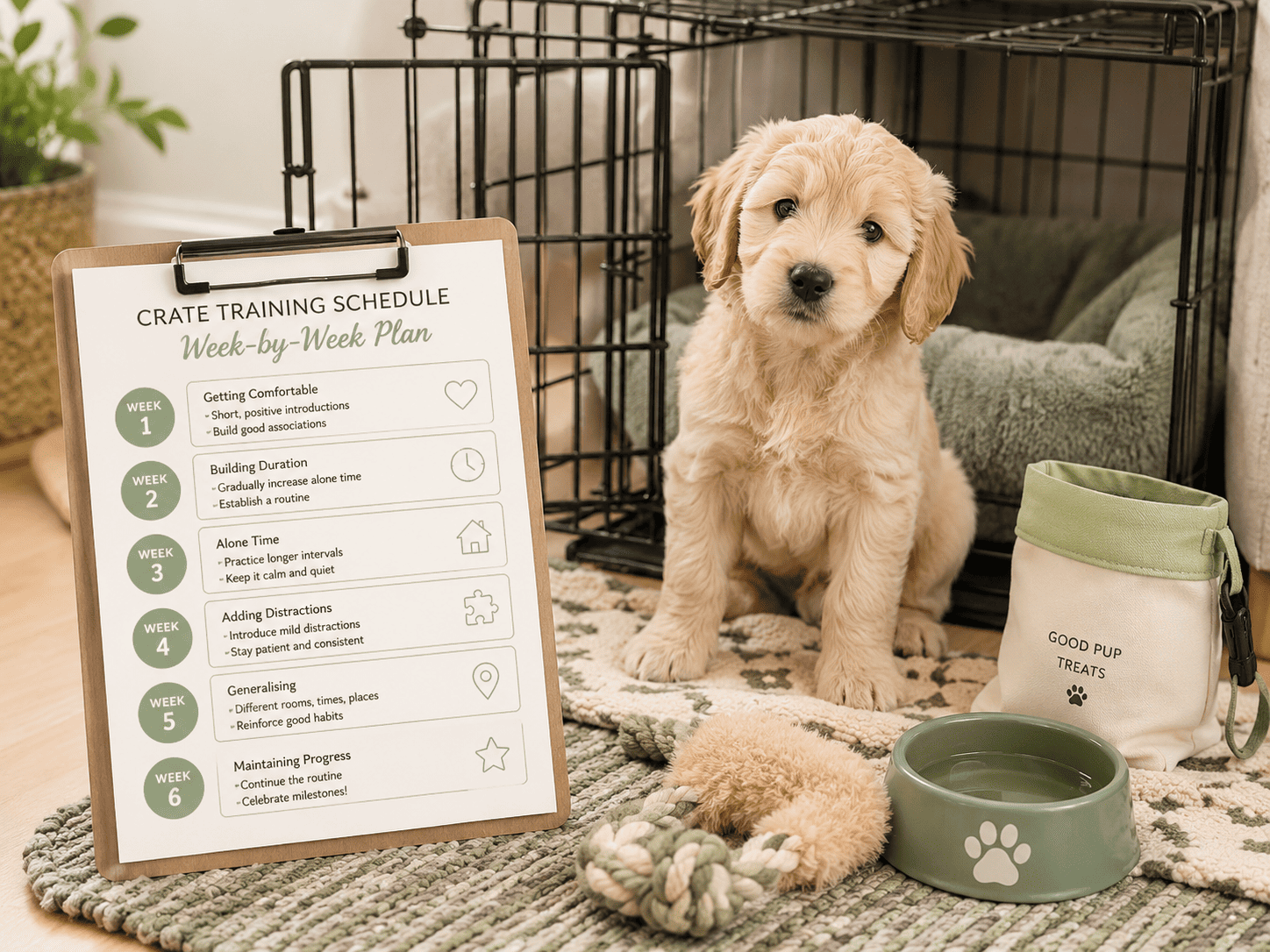
In short
Plan open-door practice, brief closure, distance and short absences with a day-by-day table. Includes optional session slots, move-on criteria and a puppy example.
A crate training schedule should reserve manageable practice opportunities and show when your puppy is ready to progress. Begin with an open door, then introduce closure, your movement away and short absences as separate changes.
Use the calendar to organise your effort, while the puppy's comfort decides the stage. If they are still learning to enter freely, repeat that practice even when the next planned day names a harder task.
Crate training schedule: a flexible first-week progression
The sample plan reserves two brief optional practice opportunities per day, such as after morning care and later in a quiet afternoon. That is a diary choice, not an RSPCA requirement or a minimum every puppy must complete. Skip or simplify practice when the puppy needs sleep, care or a calmer setting.
RSPCA guidance progresses from a positive introduction to comfortable closed-door use and then going out of sight. It advises small steps and returning to an easier stage when distress appears. No calendar date here requires a particular closed-door duration.
| Planning day | Practice slots | Crate-specific task | Move on when |
|---|---|---|---|
| Day 1 | Up to two easy opportunities | Secure the door open; let the puppy approach and investigate voluntarily | They approach without being pushed, pulled or trapped |
| Day 2 | Two optional repeats at the comfortable stage | Reward voluntary entry and let the puppy come back out freely | Entry and exit are relaxed, with no reluctance about returning |
| Day 3 | Two opportunities, or repeat open-door work | Introduce small door movement while you stay close, then restore the easy setup | Door movement does not make the puppy withdraw, freeze or become worried |
| Day 4 | Two opportunities if the earlier stage is comfortable | Try a brief closure while remaining beside the crate; reopen before concern builds | The puppy remains relaxed through closing and reopening |
| Day 5 | Two comfortable closed-door repeats | Repeat closure without adding owner distance; use a familiar pleasant activity where safe | They can remain comfortable without watching anxiously for release |
| Day 6 | Two opportunities at the current easy level | Add a small change in your position while staying in view | Your movement does not change the puppy's relaxed response |
| Day 7 | Two opportunities; earlier work if needed | Consider a moment out of sight only after comfortable in-view practice | The puppy stays comfortable as you leave view and return |
You may spend several days on any row or use another resting arrangement. End a practice opportunity while it remains easy; do not keep repeating an uncomfortable step to complete the day's boxes.
Plan later weeks around one change at a time
A new week does not unlock a harder stage. Review what the puppy already finds comfortable, then choose the next small variation.
| Planning period | Sessions per day in this example | Focus | Ready-to-progress check |
|---|---|---|---|
| Next week | Keep up to two optional slots | Repeat the last comfortable stage and vary only your position or visibility | Relaxed response across ordinary repeats, not one unusually sleepy attempt |
| Following weeks | Reserve two opportunities; use fewer when needed | Introduce short absences that the puppy can tolerate, returning before worry develops | No distressed response during departure, absence or return |
| Different room or handler | Use a familiar slot for an easier version | Rebuild comfort with the changed setting or person | The puppy can manage that change without added confinement demands |
| Ordinary household use | Planned practice as needed, separate from care cover | Maintain comfortable associations and check the wider routine | Crate use fits the puppy's needs and does not replace supervision or toilet access |
Change distance before asking for a longer absence, or practise a familiar absence without also adding a new location. The useful limit is the puppy's comfortable response, not a target copied from another animal's schedule.
Prepare the crate and the easy starting point
- Choose a crate that allows comfortable standing, turning and lying down.
- Follow the manufacturer's setup and safety instructions.
- Use a calm location away from direct heat and draughts.
- Secure the door open during voluntary introduction so it cannot swing shut.
- Provide water access and bedding the puppy can use safely.
- Supervise any chew or food activity and remove unsafe items.
- Keep another safe rest arrangement available outside training.
Do not lure a reluctant puppy inside and immediately shut the door behind them. If eating near the crate is easier, start there and keep entry voluntary.
For the detailed introduction method, see how to crate train a puppy. Use the printable puppy schedule for meals, toilet opportunities, rest and care throughout the day.
Decide whether to repeat, move on or make it easier
Look at the puppy during the change, not just whether they stay inside. Eating a reward can be useful, but also watch posture, movement and their response when you touch the door or step away.
| What you see | Next action |
|---|---|
| Voluntary entry and relaxed posture | Repeat, then consider one small variation |
| Hesitation when the door moves | Return to open-door work and smaller movement |
| Repeated barking, panting unrelated to ordinary heat or activity, cowering or escape attempts | End the confinement calmly and reassess with professional help if needed |
| Sleepiness after a busy day | Provide rest; do not treat that alone as readiness for harder absence practice |
| Toilet need or another unmet care need | Meet that need before considering further practice |
Do not leave a distressed puppy to cry until a planned time has passed. Get them out safely and make the next task easier. Panic, injury risk or persistent distress needs veterinary advice and qualified behaviour support.
Keep a short practice record
Write one line after a slot so every carer knows the current comfortable stage. Record the change you made and the response, rather than a tick saying only “crate done”.
“Stage: [open door/closure/in-view distance/out of sight]. Change tried: [one feature]. Response: [what the puppy did]. Next slot: [repeat/easier version/one small progression]. Rest and care outside practice: [arrangement].”
A completed calendar is not permission to leave the puppy longer than they can manage. Keep ordinary care cover separate from the practice record.
Worked example: Nell needs more open-door practice
Owen plans two quiet opportunities each day for Nell. On the day he intended to try closure, Nell backs away when the door begins moving.
He returns to the voluntary-entry row and leaves the door secured open. Nell rests in her puppy-proofed area during ordinary household activity; Owen does not use the training plan as a way to cover a work meeting.
“Nell entered freely but withdrew at door movement. Next practice: open door, familiar setup, no closure. Household cover: Owen or the agreed carer supervises in the puppy area.”
When Nell later remains relaxed around the moving door, Owen tries one easy closure while staying beside her. He does not combine that first closure with leaving the room.
Common schedule mistakes
- Advancing because the next day arrived: use the move-on criteria.
- Adding distance and absence together: change one feature.
- Practising with an exhausted puppy: meet rest needs first.
- Using the crate to cover a long care gap: arrange capable care separately.
- Turning confinement into punishment: preserve calm, positive associations.
Frequently Asked Questions
Must I complete two sessions every day?
No. Two optional slots is the sample diary arrangement. Keep opportunities brief and comfortable, use fewer when needed and repeat an earlier stage without trying to catch up.
What if my puppy is still on the first stage after a week?
Stay with voluntary comfortable entry and review the setup. The week heading is a planning aid. Seek help if fear or distress persists, and keep another safe resting arrangement.
When can I begin stepping out of sight?
After the puppy is comfortable with closure and your movement nearby. Make the visibility change small, return before concern develops and repeat an easier step if the response changes.
Does crate progress tell me how long I can leave home?
No. Comfortable practice and the puppy's wider care needs both matter. Arrange company, toilet access and other care independently of the calendar's completed rows.
Resources & Links
These sources support positive crate progression and care planning outside the practice slots.
- RSPCA: Crate Training — Check the positive progression from voluntary entry to closure and going out of sight.
- PDSA: Basic Training for Puppies — Keep practice consistent and rewarding while scheduling manageable opportunities.
- RSPCA: Dogs Left Alone — Separate comfortable practice from wider care cover and seek help for separation distress.
Organise training with the Puppy Training Tracker and early household care with the New Puppy Starter Kit. Get the Puppy Training Tracker → Get the New Puppy Starter Kit →
Printable and fillable PDF templates for pet owners — feeding schedules, health records, training trackers and more.