
Rainy Day Dog Enrichment: 12 Indoor Ideas That Genuinely Tire a Dog Out
Try twelve indoor activities with clear first steps, food-allocation checks and safer materials. Includes response-based choices and a simple wet-day plan.
In short
Try twelve indoor activities with clear first steps, food-allocation checks and safer materials. Includes response-based choices and a simple wet-day plan.
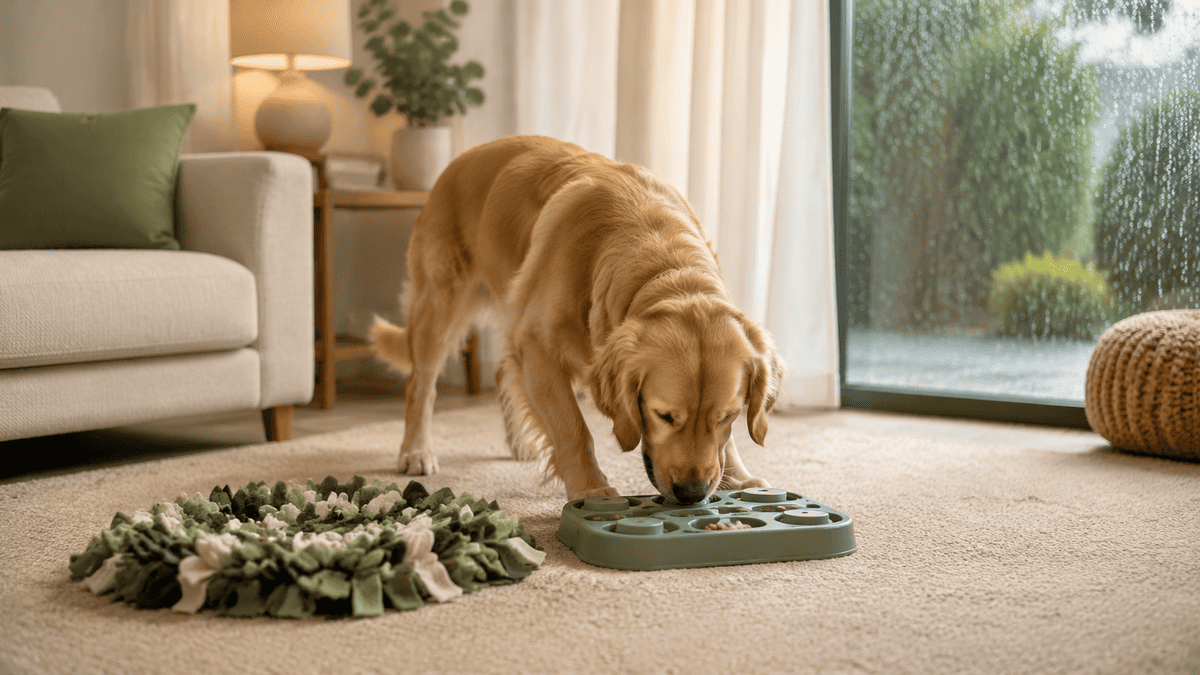
Rainy day dog enrichment can provide sniffing, learning and calm occupation when outdoor plans change. It still sits alongside toilet opportunities and the activity your dog needs and can safely manage.
Choose one easy indoor task, watch how your dog responds and offer rest afterwards. You do not need to fill every wet afternoon with food puzzles or try to exhaust the dog.
Set up rainy day dog enrichment safely
- Use a clear, non-slip area away from stairs and breakable items.
- Choose toys that fit the dog’s size and chewing habits.
- Supervise food tasks and improvised materials; remove anything being swallowed or damaged.
- Use food from the daily plan when possible and account for any extras.
- Separate pets if food or toys create competition.
- Follow veterinary activity or diet restrictions.
Adult dogs usually need daily walking opportunities plus sniffing and play, adjusted to health and conditions. Rain may change the route or outing length, while storms, flooding or dangerous surfaces may require a different plan. Indoor games should not become a reason to miss toileting or necessary care.
Twelve indoor ideas with a clear first step
1. Scatter part of a meal
Place a little of the dog’s dry food on a clean, clear area where pieces are easy to find. Let the dog sniff them out before making the search harder. Use a mat only if the dog will search it without chewing or swallowing it.
2. Fill a familiar food toy
Use a durable food toy already known to the dog, with food from their current plan. Start with an easy fill that can be removed without frustration. Freezing is optional and must suit the dog’s diet and ability; it is not required to make the task useful.
3. Try a loose towel fold
Put a few pieces of food inside a loosely folded towel and show one visible piece at the edge. Use this only with a dog who noses the towel rather than eats fabric. Keep folds easy and remove the towel if chewing starts.
4. Explore an uncovered tray
Place food in a stable, dog-safe puzzle tray or accessible compartments. Begin without covers. If using movable covers later, choose items the dog cannot swallow and observe whether lifting them remains comfortable.
5. Find food in one room
Place a few pieces in visible, reachable spots while the dog waits with another person or behind a safe barrier. Release the dog to search. Avoid furniture climbing, tight gaps or locations near electrical cables.
6. Find a named toy
Start with one favourite toy and say its name when the dog chooses it. Reward interest, then place it a little farther away. Add a choice only when the first version is easy; retrieving is optional.
7. Search a simple cardboard box
Use a clean box with staples, tape and handles removed, and place food where it can be reached. Skip this activity if the dog eats cardboard. You can use an ordinary durable food toy instead.
8. Practise recall on a flat floor
Two people can take turns inviting the dog a short, clear distance between them and rewarding arrival. Keep the pace calm and the surface non-slip. Do not use stairs as an indoor exercise circuit.
9. Use a lick mat the dog already accepts
Spread food from the current diet on a stable mat and supervise use. Stop if the dog starts chewing the mat. Skip foods outside the feeding plan merely because they appear in a recipe online.
10. Investigate a safe new texture
Put a flat, stable mat or folded blanket on the floor and let the dog approach or leave. Reward curiosity without pulling the dog onto it. Keep the surface low and non-slip rather than creating a balancing obstacle.
11. Practise a hand target
Offer a stationary hand near the dog without reaching into their face. Reward voluntary interest or a nose touch if the dog is comfortable. Use the simple version as a calm learning task, not a way to force handling.
12. Make settling comfortable
Put a familiar bed in a quiet place and reward the dog’s voluntary move towards it. Let them relax without repeated commands. Calm company and sleep are useful parts of an indoor day.
Choose by the dog’s response, not difficulty
| What you see | Try next | Avoid |
|---|---|---|
| Easy sniffing and continued interest | Repeat or make one small search change | Adding several obstacles at once |
| Chewing the material | Remove it and use a durable familiar toy | Leaving fabric or cardboard unsupervised |
| Frustration with hidden food | Expose the food and simplify access | Making the puzzle harder to prolong use |
| Moving away or settling elsewhere | Offer quiet rest | Repeatedly calling the dog back to participate |
| Conflict with another pet | Separate resource access | Testing whether they will share under pressure |
For broader household planning, see daily dog care tasks. Keep enrichment as one part of the day rather than a substitute for the whole routine.
Build a wet-day plan with pauses
A manageable pattern is toilet opportunity, the planned meal, a chosen sniffing task, rest and later movement when conditions allow. Repeat the care opportunities your dog needs without assuming each pause needs another activity.
Wet-day choices: morning [care and activity]. Rest place [location]. Later toilet route [safe route]. Indoor task [one choice and food allocation]. Stop or change if [dog response]. Next carer [name and remaining tasks].
Keep one short note about which activity worked. You can then offer a familiar success next time instead of rebuilding an elaborate indoor course.
A simple search suits the dog better than a harder puzzle
In an illustrative example, Milo’s owner Anwen tries a tightly rolled towel on a wet afternoon. Milo grabs the fabric rather than searching. Anwen removes it and places part of his meal openly on a clear floor area.
Milo sniffs, finds the food and then chooses his bed. Anwen leaves him to rest and uses their safer sheltered toilet route later. The successful change is easier access, not more layers or more treats.
- Food added without counting: take the task’s food from the planned allowance.
- Too much indoor excitement: choose sniffing or quiet practice and leave pauses.
- A clever setup the dog cannot use: simplify the first step.
- Repeated chasing or stair games: use calm movement on a clear, flat surface.
Frequently Asked Questions
Can indoor enrichment replace every walk?
Meet your dog’s toilet, movement and sniffing needs according to health and conditions. Indoor tasks help when plans change, but are not a universal replacement for outdoor care.
Do I need special enrichment products?
No. A simple food search, familiar toy or calm learning task can work. Choose materials based on the dog’s behaviour and supervise them.
What if my dog finishes immediately?
Finishing quickly is fine. Repeat an easy task or offer rest; making access difficult purely to extend time can create frustration.
What if my dog guards food toys?
Keep pets and people out of pressured interactions, stop the unsuitable activity and seek qualified behaviour help. Do not provoke guarding to test improvement.
Resources & Links
These sources help choose positive enrichment and recognise when an indoor activity needs simplifying.
- Blue Cross: Enrichment for Dogs — Explore ways to offer choice, sniffing and activity without simply adding excitement.
- Blue Cross: Dog and Puppy Training — Support reward-based indoor practice with manageable learning tasks.
- PDSA: Canine Body Language — Notice when a dog is comfortable, frustrated or ready to disengage.
Organise activity and daily care with the Daily Dog Care Tracker and Complete Dog Owner Binder. Get the Daily Dog Care Tracker → Get the Complete Dog Owner Binder →
Printable and fillable PDF templates for pet owners — feeding schedules, health records, training trackers and more.