Dog Care Binder vs Pet Health Binder: Which One Do You Need?
Compare clinical paperwork with broader dog-care coverage, using filled decision tables, practical content lists and examples of choosing by the job needed.
In short
Compare clinical paperwork with broader dog-care coverage, using filled decision tables, practical content lists and examples of choosing by the job needed.
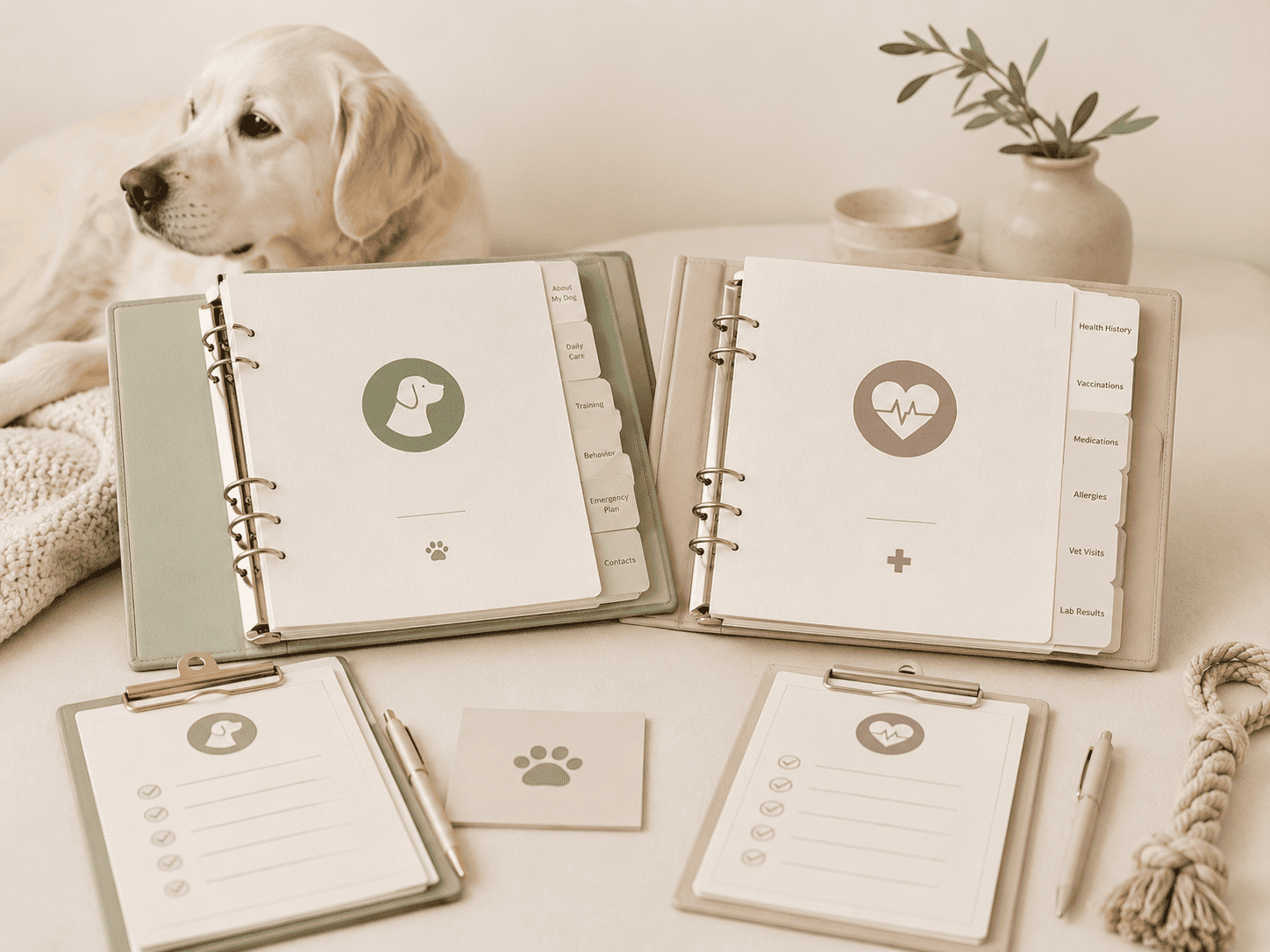
Choosing a dog care binder vs pet health binder depends on which job you need help with. A health-focused file organises clinical paperwork; a broader dog-care system can also cover meals, walks, training, spending and temporary carers.
Use the comparison below to identify your missing coverage before choosing a product. These are category-level differences to check against the current contents of the actual binder, not promises about every product with a similar name.
Compare coverage rather than page counts
A dedicated health binder is useful when clinical information is the main problem. A general dog-care binder is useful when everyday responsibilities and other ownership tasks also need structure. Either can include shared information such as an identity profile or contacts.
| Job | Health-focused binder | Broader dog-care binder |
|---|---|---|
| Vet appointment preparation | A central purpose | A health section within wider coverage |
| Certificates and visit summaries | Organised as clinical evidence | Often included; verify the current contents |
| Prescribed-care completion | Relevant health tracking where supplied | May connect with daily care pages |
| Meals, outings and routine responsibilities | Usually outside its main focus | A reason to choose broader coverage |
| Training and household rules | Not its principal job | Potential sections to check |
| Sitter preparation | Provides relevant health information | May also organise ordinary care and access notes |
| Spending | Related insurance or clinical documents | Potential wider expense coverage |
The decision is about tasks you will actually perform. A large collection that leaves the needed field awkward to use can be less helpful than a small file built around your current problem.
Choose a health binder for clinical paperwork
Look for a layout that gives each pet a clear identity and separates active veterinary directions from dated evidence. It should help you prepare for appointments without searching receipts for the most recent instructions.
- Profile and chip registry information.
- Vaccination certificates and clinic recommendations.
- Visit summaries, discharge letters and results.
- Current prescribed directions and a completion record where relevant.
- Known reactions recorded by the veterinary team.
- Weight history and useful home observations.
- Insurance policy details and claim references.
This category suits an owner whose household routine already works but whose clinic documents are scattered. It can also suit a dog receiving care from several practices, where finding the relevant evidence is the immediate challenge.
Check how the product accommodates existing documents. A blank summary page is useful alongside a clinic letter, but some records need to be retained as issued. Choose enough practical space for the evidence you keep.
Choose broader coverage for everyday ownership tasks
A dog-care binder earns its extra sections when different care jobs need organising. Check whether it addresses the actual household gaps rather than assuming “complete” means it fits every dog.
- Established feeding instructions and daily care pages.
- Suitable walk or activity records.
- Reward-based training notes and agreed household cues.
- Sitter information and care-cover preparation.
- Grooming needs and relevant appointment reminders.
- Expense categories and payment references.
- Health evidence and urgent contacts.
A new owner may need several of these jobs at once. An experienced household using walkers or sitters may mainly need the routine and temporary-care pages. You can choose broader coverage without printing every included section.
Look for cat-free wording in dog-specific action pages where species matters, and for age-appropriate fields. A puppy progress page may be irrelevant to an adult dog even within a useful broader system.
Use this situation table to make the choice
| Your situation | Starting choice | What to verify |
|---|---|---|
| Meals and walks work; clinic letters are lost | Health-focused file | Evidence storage, active directions and appointment preparation |
| Several adults miss or duplicate care | Broader dog-care system | Clear daily tasks and usable completion fields |
| New dog, unfamiliar routine and new records | Broader coverage may help | Actual preparation, routine and health sections |
| Only one missing job, such as tracking spending | A relevant individual sheet may suffice | Whether broader coverage adds anything you need |
| Existing broad binder with a weak health section | Improve that section or add a focused file | How to avoid conflicting active instructions |
If you are undecided, write your missing jobs as verbs: find a certificate, coordinate meals, prepare a sitter. Match each job to a real page. This turns the comparison into a purchasing decision rather than a competition over bundle size.
Check format and current product contents
Inspect a preview where available and check the current listing. Verify printable or fillable format, page sizes, editing requirements and what you receive. Do not assume a PDF supports typing, saving or sharing merely because another product does.
- List the essential pages you need.
- Match them to the published contents.
- Check whether the fields fit your actual entries.
- Confirm how you can print or save completed pages.
- Check the current purchase and access terms.
- Choose the smaller option if it already handles your jobs well.
Compare current prices only after checking coverage. Avoid guessed savings or assumptions about included products. A binder can organise care information, but it cannot determine treatment, insurance cover or legal authority.
Example: a reliable routine, scattered clinic records
Sofia already uses a workable feeding arrangement and a reliable walker. Her difficulty is finding Basil's certificates, visit letters and current veterinary directions. A health-focused file addresses that problem without rebuilding the walking routine.
Another owner, Dev, has a new dog and several relatives helping. He needs written meals, ordinary care responsibilities, a sitter packet and somewhere for clinical evidence. He checks a broader binder's contents against those jobs.
Choice note: “The missing jobs are [list]. The selected option provides [verified pages]. Existing information that already works stays in [location], with current veterinary directions kept in one agreed place.”
Both owners keep the decision specific. Sofia does not buy a broader system just because it has more pages, while Dev does not expect a clinical file alone to solve his routine gaps.
Common mistakes in binder comparisons
- Assuming the largest bundle is automatically better value. Unused pages add no practical coverage. Compare the jobs you need with the pages actually supplied.
- Assuming every broad binder contains every health field. Product contents vary. Read the current list rather than relying on the category name.
- Maintaining two independent active treatment summaries. Changes can leave them conflicting. Use one authoritative current set of veterinary directions and reference it where needed.
Frequently Asked Questions
Can I use both types of binder?
Yes, if each has a distinct purpose. For example, one can hold the working routine while another holds clinical evidence. Keep active veterinary directions clearly identified across the arrangement.
Which is better for a senior dog?
Choose by the tasks needing support, not age alone. A health file may suit clinical paperwork, while broader coverage may help with daily access, care responsibilities and visiting carers.
What if I only need a medication completion page?
A focused sheet may be enough alongside the clinic's current instructions. Check whether you also need other health documents organised before buying a larger system.
Do more printable pages mean more work every day?
Only if you choose to use them all. Print the pages that serve actual jobs and keep occasional records separate from the everyday action list.
Resources & Links
These veterinary guides help identify the healthcare documents and questions a chosen binder should support.
- PDSA: Health checks at home — Helps distinguish useful home observations from questions requiring the practice's assessment.
- Blue Cross: Basic healthcare in dogs — Outlines dog-health topics to consider when checking the healthcare coverage of a binder.
The Complete Dog Owner Binder suits broader dog-care organisation; the Pet Health Record Binder suits a focused place for veterinary records. Get the Complete Dog Owner Binder → Get the Pet Health Record Binder →
Printable and fillable PDF templates for pet owners — feeding schedules, health records, training trackers and more.