
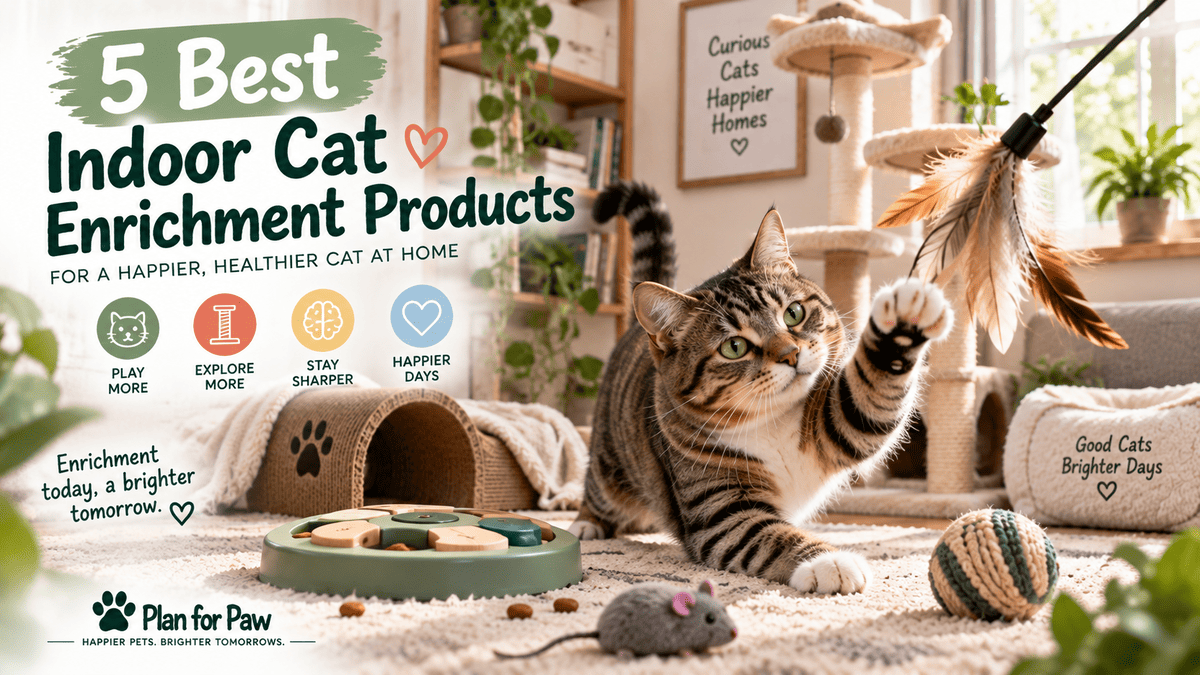
5 Best Indoor Cat Enrichment Products for a Happier Home
An indoor cat needs more than food, water and a bed. They need to climb, scratch, watch, hunt and explore. Here are five products that add those options back into a home.
In short
An indoor cat needs more than food, water and a bed. They need to climb, scratch, watch, hunt and explore. Here are five products that add those options back into a home.
Affiliate disclosure: this article contains affiliate links. If you buy through them, Plan for Paw may earn a small commission at no extra cost to you. Products are grouped by the need they meet, not by personal testing, and we have not tested them ourselves.
Indoor life keeps cats safe from traffic, disease and a long list of other risks. What it does not do on its own is give them anything to do. A cat's day outdoors would involve climbing, watching from height, stalking, catching, scratching and patrolling. Indoors, all of that has to be designed in — and when it is missing, the result is not a relaxed cat but a bored one.
How to Tell a Cat Needs More Enrichment
- Night-time activity: racing around the house at 4am
- Over-attachment to food, or eating out of boredom
- Play that tips into biting and scratching hands
- Scratching furniture despite having a post somewhere in the house
- Sleeping far more than usual for their age
- Overgrooming, particularly on the belly and legs
Overgrooming and sudden changes in behaviour can also be medical or stress-related, so start with a vet check if anything has changed quickly. Boredom tends to build slowly.
1. Cat Tree or Climbing Tower
Best for: giving a cat height, and reducing tension in multi-cat homes.
Height is territory to a cat. A tall tree lets them survey the room, rest somewhere nothing can approach unseen, and share space with another cat without being on the same level — which is often enough to defuse low-level conflict entirely. In a small flat, vertical space is usually the single most valuable change you can make.
Look for a wide, heavy base and sisal-wrapped posts rather than carpet, and at least one enclosed platform or cubby. Position it where the cat already likes to be, by a window if possible, not tucked into an unused corner.
What we like:
- Adds climbing, resting and scratching in one piece of furniture
- Reduces friction between cats sharing a room
- Works well for cats that dislike being approached at floor level
- Sisal posts last far longer than carpeted ones
Keep in mind:
- Stability matters more than height — a wobbly tower will be avoided after one bad experience
- Older or arthritic cats need low, wide steps rather than big jumps
- Large trees take real floor space; wall shelves are an alternative in small rooms
2. Interactive Wand Toy
Best for: daily hunting play, and for cats that play too roughly with hands.
A wand toy is a stick, a string and something at the end that can be made to behave like prey. It is the closest thing to a hunting sequence you can offer indoors, and it is the one piece of enrichment that genuinely needs you: the value is in how you move it.
Move the toy away from the cat and into cover rather than waving it in their face — prey flees and hides, it does not flutter at a predator. Let your cat catch it several times during the session, and finish with a catch followed by a small meal or a few treats. That sequence — hunt, catch, eat, groom, sleep — is why a good wand session often settles a cat for hours.
What we like:
- Ten to fifteen minutes has a visible effect on evening behaviour
- Keeps teeth and claws away from hands
- Cheap to replace attachments as they wear out
- Works for shy cats who will not play with people in other ways
Keep in mind:
- Put it away between sessions — string and feathers are a swallowing risk when unsupervised
- Never let a session end with the cat unable to catch anything; that is frustrating, not enriching
- Laser pointers have the same problem in a stronger form — if you use one, always finish on a physical toy or treat
3. Window Perch
Best for: small flats, and for cats that spend long stretches alone.
A window perch is a padded shelf that fixes to the glass or the sill, giving the cat a warm, elevated place to watch the outside world. Watching birds, weather and movement is real mental stimulation, and for a cat left alone during a working day it is one of the few things that fills the hours without any input from you.
Suction-mounted perches need a clean, smooth window and a periodic check of the fixings. Sill-mounted or bracket versions are more reassuring for heavy cats.
What we like:
- Takes up almost no floor space
- Provides hours of low-effort stimulation
- Warm spot in winter sun, which most cats will choose over a bed
- Easy to move to a better window
Keep in mind:
- Check weight limits and test the mount before trusting it
- Re-seat suction cups regularly, especially in cold weather
- If neighbourhood cats are visible and cause stress, a different window is better than none
- Never pair a perch with a window that opens without a secure screen
Complete Cat Owner Binder
Track play, feeding, litter use and weight in one place, and changes in your cat's routine become visible before they become a problem. The Complete Cat Owner Binder is printable and fillable, with a page per cat.
Get the Complete Cat Owner Binder →4. Cat Puzzle Feeder
Best for: cats that eat too fast, beg constantly, or need to lose weight slowly.
Cats in the wild eat many small meals and work for every one of them. A puzzle feeder — a ball that drops kibble as it rolls, a board with wells and tunnels, or a set of tubes to fish food out of — restores some of that effort. It slows eating, spreads the day's ration across more of the day, and gives a food-focused cat something to do other than shout at you.
Introduce it easy. Start with food visible and barely contained, and make it harder only once your cat is using it confidently. A cat that fails at a feeder will simply not eat from it, and some will rather go hungry than persist.
What we like:
- Uses the food the cat was getting anyway — no extra calories
- Turns feeding into activity, which matters most for indoor cats
- Helpful in a supervised, vet-agreed weight plan
- Reduces the 4am wake-up in cats that are simply under-occupied
Keep in mind:
- Not suitable if your cat is losing weight or eating poorly — check with a vet first
- In multi-cat homes, feed separately so you know who has eaten what
- Wet-food versions need washing after every meal
5. Cat Scratching Lounge
Best for: saving furniture, and for cats that prefer scratching horizontally.
Scratching is not optional behaviour. Cats scratch to maintain their claws, to stretch the whole body and to leave both a visual and a scent mark. A cat scratching the sofa is usually a cat whose scratching options are in the wrong place or the wrong orientation. A lounge-style scratcher is a broad, curved or flat cardboard surface that also works as a bed, which suits cats that scratch on the floor rather than up a post.
Placement does most of the work: put it where the cat already scratches, or beside where they sleep, since the first stretch after waking is a common scratching moment.
What we like:
- Covers the horizontal scratching many posts miss
- Doubles as a resting place, so it earns its floor space
- Inexpensive to replace when worn
- Low profile suits older cats that cannot stretch up a tall post
Keep in mind:
- Cardboard sheds — expect to vacuum around it
- Replace when flattened; a worn-out scratcher stops being used
- One is rarely enough: most homes need several scratching options in different rooms and orientations
Quick Comparison
| Product | Need it meets | Space required | Best suited to |
|---|---|---|---|
| Cat tree | Climbing, height, territory | High | Multi-cat homes, active cats |
| Wand toy | Hunting play with you | None | Every cat; ideal first purchase |
| Window perch | Watching, sunbathing | None | Small flats, cats left alone |
| Puzzle feeder | Working for food | Low | Fast eaters, food-focused cats |
| Scratching lounge | Scratching, stretching, resting | Low | Horizontal scratchers, older cats |
Setting Up a Small Flat for a Cat
Square metres matter less than how the space is arranged. In a one-bedroom flat you can usually add:
- Two or three levels of height — a tree, a shelf, a cleared bookcase top
- One window with a perch and a clear view
- Scratching options in at least two rooms, one vertical and one horizontal
- A hiding place at floor level, such as a covered bed or a box on its side
- Food and water away from the litter tray, and the tray somewhere quiet with an escape route
Those five things cover climbing, watching, scratching, hiding and eating, which is most of what a cat needs from an environment.
Rotate Toys Instead of Buying More
Cats habituate to toys quickly. Keep most of them in a drawer, put two or three out at a time and swap weekly. A toy that has been away for a fortnight is effectively new again, and storing them with a little catnip refreshes them further.
Play at the Right Time of Day
Cats are most naturally active at dawn and dusk. A wand session in the early evening, finished with a meal, works with that rhythm instead of against it — and it is the most reliable fix for a cat that wakes the household before sunrise.
Two ways to stay organised
Want feeding, litter, play and health logs for each cat? Choose the Complete Cat Owner Binder. Want a focused medical record for vet visits and weight tracking? Choose the Pet Health Record Binder.
Get the Pet Health Record Binder →Frequently Asked Questions
How much play does an indoor cat need each day?
Two sessions of ten to fifteen minutes is a reasonable target for most adult cats, ideally morning and early evening. Kittens and young adults usually want more, in shorter bursts.
My cat ignores every toy I buy. What am I doing wrong?
Usually it is the movement rather than the toy. Drag it away from the cat and let it disappear behind furniture instead of dangling it in front of them, and let them catch it regularly.
Is one scratching post enough?
Rarely. Cats scratch in different places and orientations, so several options — one tall and sturdy, one horizontal, placed where the cat already scratches — work far better than a single post in a corner.
Do puzzle feeders work for wet food?
Yes, with feeders designed for it, such as silicone mats and wells. They need washing after each meal, so many owners use wet-food puzzles once a day and dry-food ones the rest of the time.
Will enrichment stop my cat scratching the sofa?
It helps a great deal when combined with placing appropriate scratchers exactly where the cat already scratches. Sudden new scratching, especially with other changes in behaviour, is worth a vet check.
Printable and fillable PDF templates for pet owners — feeding schedules, health records, training trackers and more.