5 Best Dog Enrichment Products to Keep Your Dog Busy at Home
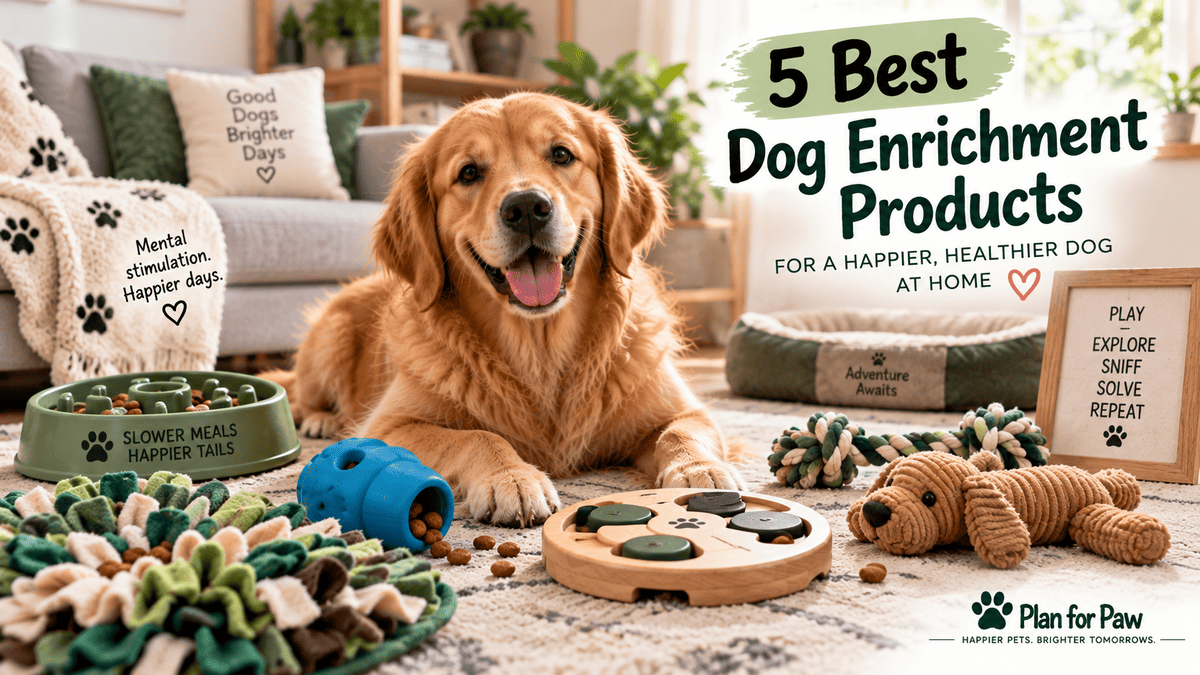
Not every dog needs a longer walk. Many need something to solve, sniff out or work for. Here are five kinds of enrichment product, who each one suits, and how to use them without overfeeding.
In short
Not every dog needs a longer walk. Many need something to solve, sniff out or work for. Here are five kinds of enrichment product, who each one suits, and how to use them without overfeeding.
Affiliate disclosure: this article contains affiliate links. If you buy through them, Plan for Paw may earn a small commission at no extra cost to you. Products are grouped by the job they do, not by personal testing, and we have not tested them ourselves.
A restless dog in the evening is usually read as a dog that needs a longer walk. Sometimes that is true. Often it is not. Walking builds physical stamina, and a dog with more stamina needs more walking to reach the same result — which is why the hour-long walk that settled your dog last year barely registers now.
Mental work behaves differently. Sniffing, searching and problem-solving are demanding in a way that produces genuine rest afterwards. Ten to fifteen minutes of concentrated scent work settles many dogs as effectively as a much longer walk, which is why enrichment is standard advice for dogs on crate rest, for high-energy breeds in small homes, and for the stretch of a rainy week when nobody wants to be outside.
How to Choose Enrichment for Your Dog
Enrichment is not one product category. It is several different jobs, and dogs are rarely equally interested in all of them. Watch what your dog does when nobody is directing them:
- The dog that noses along every hedge wants scent work — snuffle mats and scatter feeding.
- The dog that works at things — shoving a toy under the sofa and getting it back out — wants puzzles.
- The dog that inhales dinner in nine seconds wants the meal itself made slower and more interesting.
- The dog that struggles to settle alone often does best with long-lasting licking and chewing, which are self-soothing rather than stimulating.
Start easy. A puzzle that is too hard produces a dog that gives up and walks away, and dogs that have learned a category of toy is pointless are slow to try again. Begin with something your dog solves in under a minute, then increase difficulty once they are confident.
1. Interactive Dog Puzzle Toy
Best for: dogs that enjoy food-based problem-solving.
A puzzle toy is a board or block with compartments, sliders or flaps that a dog must move to reach food underneath. It turns a handful of kibble into a five to ten minute task that involves deciding, testing and adjusting rather than simply eating. Most come in difficulty levels: the simplest have open compartments with sliding covers, the hardest combine several moves in sequence.
Use it as a task rather than a toy left lying around. Set it up, let your dog work through it, then put it away. That keeps it interesting, and it means you are there to supervise.
What we like:
- Gives structured mental work in a small indoor space
- Levels let you increase difficulty as your dog improves
- Works with part of the normal daily food allowance
- Useful for dogs on restricted exercise after surgery, with vet approval
Keep in mind:
- Always supervise — determined chewers can break pieces off plastic puzzles
- Start with the easiest level, even for a clever dog
- Not a solution for separation anxiety; a dog in distress will not engage with food
2. Snuffle Mat
Best for: dogs that love to sniff, and for turning an ordinary meal into a search.
A snuffle mat is a fabric mat with dense fleece strips that food can be scattered into. The dog works through it nose-first, which is the most natural and most settling form of enrichment there is. Scent work uses a large part of a dog's brain, and it is one of the few activities that reliably calms an over-aroused dog rather than winding them up further.
This is the easiest place to start if your dog has never used enrichment before. There is nothing to learn: food goes in, dog finds food.
What we like:
- Needs no training and suits almost every dog
- Calming rather than exciting, which is useful in the evening
- Slows down fast eaters using the meal they were getting anyway
- Most are machine washable
Keep in mind:
- Supervise dogs that chew fabric — a mat is not a chew toy
- Wash regularly, especially if you use wet or oily treats
- Dogs with very flat faces may find deep piles harder to work
3. Lick Mat
Best for: dogs that need to settle, and for making grooming or nail care easier.
A lick mat is a textured silicone sheet that wet food is spread thinly across. Licking is a repetitive, self-soothing behaviour, which makes this the enrichment of choice for winding a dog down rather than firing them up. Many owners use one during nail trims, brushing or ear cleaning, giving the dog something to concentrate on while a slightly unwelcome job happens.
Spread it thin rather than thick, and freeze it for a version that lasts considerably longer. Frozen lick mats are also one of the more effective ways to get a teething puppy through a difficult evening.
What we like:
- Genuinely calming, which not all enrichment is
- Freezes well, extending a two-minute snack into twenty
- Pairs well with grooming and handling practice
- Easy to clean, and many are dishwasher safe
Keep in mind:
- Watch what you spread on it — avoid xylitol, chocolate, grapes and onion in any form
- Count the topping as part of daily calories
- Supervise; silicone can be chewed and swallowed by determined dogs
Daily Dog Care Tracker
Enrichment is easy to start and easy to forget. Log what you used, how long it lasted and how your dog settled afterwards — and the pattern of what actually works for your dog becomes obvious within a fortnight. Printable and fillable.
Get the Daily Dog Care Tracker →4. Slow Feeder Bowl
Best for: dogs that swallow a meal in seconds.
A slow feeder is a bowl moulded with ridges, spirals or maze walls so food has to be worked out of the gaps. Eating goes from a few seconds to several minutes, which reduces gulped air and gives the dog something to do at mealtimes rather than finishing and immediately looking for the next thing.
For deep-chested breeds, eating very fast is one of several factors associated with bloat — a genuine emergency. A slow feeder is not a preventative measure on its own, and it is worth asking your vet what else is sensible for your particular dog.
What we like:
- Works at every meal without any extra effort from you
- No additional calories involved — it is the same food
- Stainless steel and dishwasher-safe versions are easy to keep clean
- Useful for dogs that finish and then pester a second dog at their bowl
Keep in mind:
- Choose a pattern suited to your dog's muzzle shape — very tight mazes frustrate flat-faced dogs
- Some dogs simply tip the bowl; a heavier or non-slip base solves it
- It slows eating, it does not fix resource guarding or anxiety around food
5. Treat-Dispensing Toy
Best for: dogs that like to move while they work for food.
A treat dispenser is a hollow rubber or hard plastic toy that releases food as it is rolled, nudged or thrown about. It adds movement to the mental work, which suits dogs that do not want to stand still at a puzzle board. Most have adjustable openings so you can make food fall out easily at first and less easily as your dog gets the idea.
The classic hollow rubber toys sit in this category too: stuffed with wet food or soaked kibble and frozen, they become a long, absorbing task and one of the better tools for building up calm time alone.
What we like:
- Combines gentle physical activity with problem-solving
- Adjustable difficulty on many models
- Freezing turns it into a much longer session
- Good for building positive associations with a crate or a quiet room
Keep in mind:
- Hard plastic versions are noisy on wooden and tiled floors
- Check regularly for cracks, and replace damaged toys
- Very hard materials can damage teeth — choose rubber with some give for heavy chewers
Quick Comparison
| Product | Main benefit | Typical session | Best suited to |
|---|---|---|---|
| Puzzle toy | Problem-solving | 5–10 minutes | Dogs that enjoy working things out |
| Snuffle mat | Scent work, calming | 10–15 minutes | Almost any dog; ideal first purchase |
| Lick mat | Settling, handling practice | 5–20 minutes frozen | Anxious dogs, teething puppies |
| Slow feeder | Slower eating | Every meal | Dogs that gulp food |
| Treat dispenser | Movement plus problem-solving | 10–30 minutes frozen | Active dogs, time alone |
Use the Daily Food, Not Extra Treats
Almost all enrichment involves food, and a week of enthusiastic use is how a dog quietly gains weight. Weigh the day's ration in the morning and work from that bowl: breakfast in a slow feeder, part of dinner in a snuffle mat, the remainder in a puzzle or a frozen dispenser. Treats on top should stay within roughly ten percent of daily calories.
Short Sessions, Then Rest
Three or four short sessions across the day beat one long one. Ten minutes of concentrated work followed by a genuine rest period lets a dog consolidate and settle. Continuous stimulation does the opposite and produces a dog who cannot switch off — a common and counterproductive pattern in households trying hard to tire a young dog out.
Rotate Instead of Buying More
Four toys in rotation, one available at a time, stay interesting far longer than eight toys permanently on the floor. Put the current set away at the end of each day and swap weekly. It costs nothing and does more for novelty than any new purchase.
Supervision and Safety
- Watch every new item for the first few sessions before trusting your dog with it
- Check for cracks, loose parts and chewed edges regularly
- Avoid very hard chews — antlers, hooves and hard nylon are a common cause of fractured teeth
- Remove packaging, tags and rope ends before first use
- Feed puzzles and mats away from other pets to avoid competition
Two ways to keep routine on track
Want a daily log of meals, walks and enrichment? Choose the Daily Dog Care Tracker. Want daily care alongside health records, training progress and sitter notes in one system? Choose the Complete Dog Owner Binder.
Get the Complete Dog Owner Binder →Frequently Asked Questions
How much enrichment does a dog need each day?
Two or three short sessions of ten to fifteen minutes suits most dogs, alongside normal walks. Young dogs and working breeds often need more; senior dogs usually prefer scent work to puzzles.
Can enrichment replace walks?
Not permanently — dogs need outdoor time for physical health and for the stimulation of new environments. For an occasional bad-weather day, or for a dog on vet-advised rest, it covers the gap well.
My dog solves every puzzle in seconds. What now?
Make it harder rather than stopping: layer two steps, spread the search over a larger area, or combine a puzzle with a snuffle mat. Speed is a sign to progress.
Is enrichment suitable for puppies?
Yes, in short sessions. Avoid anything involving stairs, jumping or hard impact while joints are developing, and supervise closely — puppies chew everything.
Will enrichment help with separation anxiety?
It helps build positive associations with being alone, but genuine separation anxiety needs a proper behaviour plan. A dog in real distress will not touch food, which is a useful way to tell the difference between boredom and anxiety.
Printable and fillable PDF templates for pet owners — feeding schedules, health records, training trackers and more.