What to Put on a Pet ID Tag (and What to Leave Off)
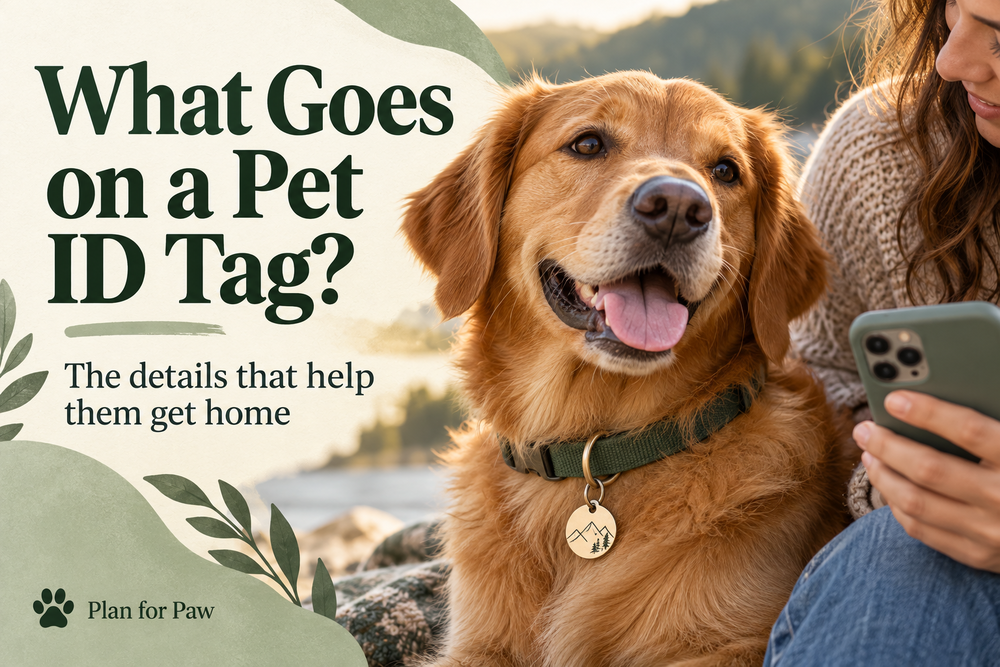
A pet ID tag has very little space and one job: helping a stranger reach you quickly. Here is exactly what to put on it, what to leave off for safety, and how QR tags change what fits.
In short
A pet ID tag has very little space and one job: helping a stranger reach you quickly. Here is exactly what to put on it, what to leave off for safety, and how QR tags change what fits.
An ID tag is the fastest way a lost pet gets home. Whoever finds your dog or cat does not need a scanner, a vet or a shelter — they just need to read the tag and call you. But a tag has room for only a few lines, so what you put on it matters.
What to Put on the Tag
- Your mobile number. This is the most important line. Use your full number with country code if you travel.
- A second number. A partner or family member who will answer if you cannot.
- Your surname or a short identifier. In some countries, such as the UK, the law requires the owner's name and address on a dog's collar tag — check the rules where you live.
- "Microchipped" — tells a finder there is another way to trace you, and may discourage anyone thinking of keeping a found pet.
- A key medical word if it matters: "Needs medication", "Diabetic", "Deaf".
What to Leave Off
- Your pet's name. Many trainers and rescue organisations advise leaving it off. A stranger who knows the name has an easier time calling a friendly dog away. Your finder does not need it to call you.
- Your full home address, unless the law where you live requires it. A postcode or town is usually enough alongside a phone number.
- "Reward" engraved permanently — offer one when it is needed, not in advance.
- Long sentences. Small text wears off and is hard to read on a moving animal.
The Problem With Engraved Tags
Engraved tags work, but they have two weaknesses. There is no room for anything beyond a number or two, and the information is fixed. Change your phone number or move house and the tag is wrong until you remember to buy a new one — and out-of-date tags are one of the most common reasons found pets take longer to get home.
Where a QR Code Tag Helps
A QR code tag works differently. The code holds only a web link, and the details live on the page it opens. Anyone who finds your pet points their normal phone camera at the tag and sees your pet's photo, a button to call you and the care notes you chose to share — allergies, medication, "nervous with other dogs". Because the details are online, you can update your number any time and the printed tag keeps working.
We built the Plan for Paw Smart Pet ID around exactly this: a permanent QR code and printable pet ID card, a "Call Owner" button, an "I Found This Pet" message form, and a Lost Mode that turns the same code into a lost pet alert. There is no app and no subscription, and you choose what is public. If you are new to them, our guide to QR code pet tags explains how they compare with engraved tags, microchips and GPS trackers.
Smart Pet ID
A permanent QR code for your pet's collar or carrier. Update your details any time, switch on Lost Mode if your pet goes missing, and get "I found your pet" messages straight to your inbox. See your finished tag before you pay — one-time payment, no subscription.
Create My Pet's QR Tag →Tag, Chip or QR? Use More Than One
- Microchip: permanent, cannot fall off, but only readable by a vet or shelter with a scanner. Keep the registration current.
- Engraved tag: anyone can read it, nothing to charge, but limited space and fixed details.
- QR tag: anyone with a phone can read it, room for care notes, and details you can update.
Many owners use all three. They solve different parts of the same problem.
Check the Tag Regularly
- Can you still read every line? Worn engraving is common on active dogs.
- Is the split ring secure and the tag still on the collar?
- Are the phone numbers current? Test-call them if you are unsure.
- Does the collar still fit? Two fingers should slide underneath.
A paper backup too
Keep the same details for your sitter, your wallet and the fridge. The printable Pet Emergency Card holds contacts, vet details, medications and the microchip number on one card.
Get the Pet Emergency Card →Frequently Asked Questions
Should I put my dog's name on the tag?
Many trainers advise against it, as it makes it easier for a stranger to call your dog. A finder only needs your number.
Does my cat need an ID tag if it is microchipped?
A tag on a breakaway collar means a neighbour can contact you directly, without taking your cat to a vet to be scanned. Keep the microchip as the permanent backup.
Can I change the details on a QR pet tag?
With a Smart Pet ID, yes. The QR code never changes; you edit the profile it opens and every printed tag shows the new details straight away.
Printable and fillable PDF templates for pet owners — feeding schedules, health records, training trackers and more.