
What Information Should You Leave for a Dog Sitter? Complete Checklist
Pack food, walking equipment, rest supplies and prescribed-care information. Use task stations, a practice visit, a departure note and a backup-care checklist.
In short
Pack food, walking equipment, rest supplies and prescribed-care information. Use task stations, a practice visit, a departure note and a backup-care checklist.
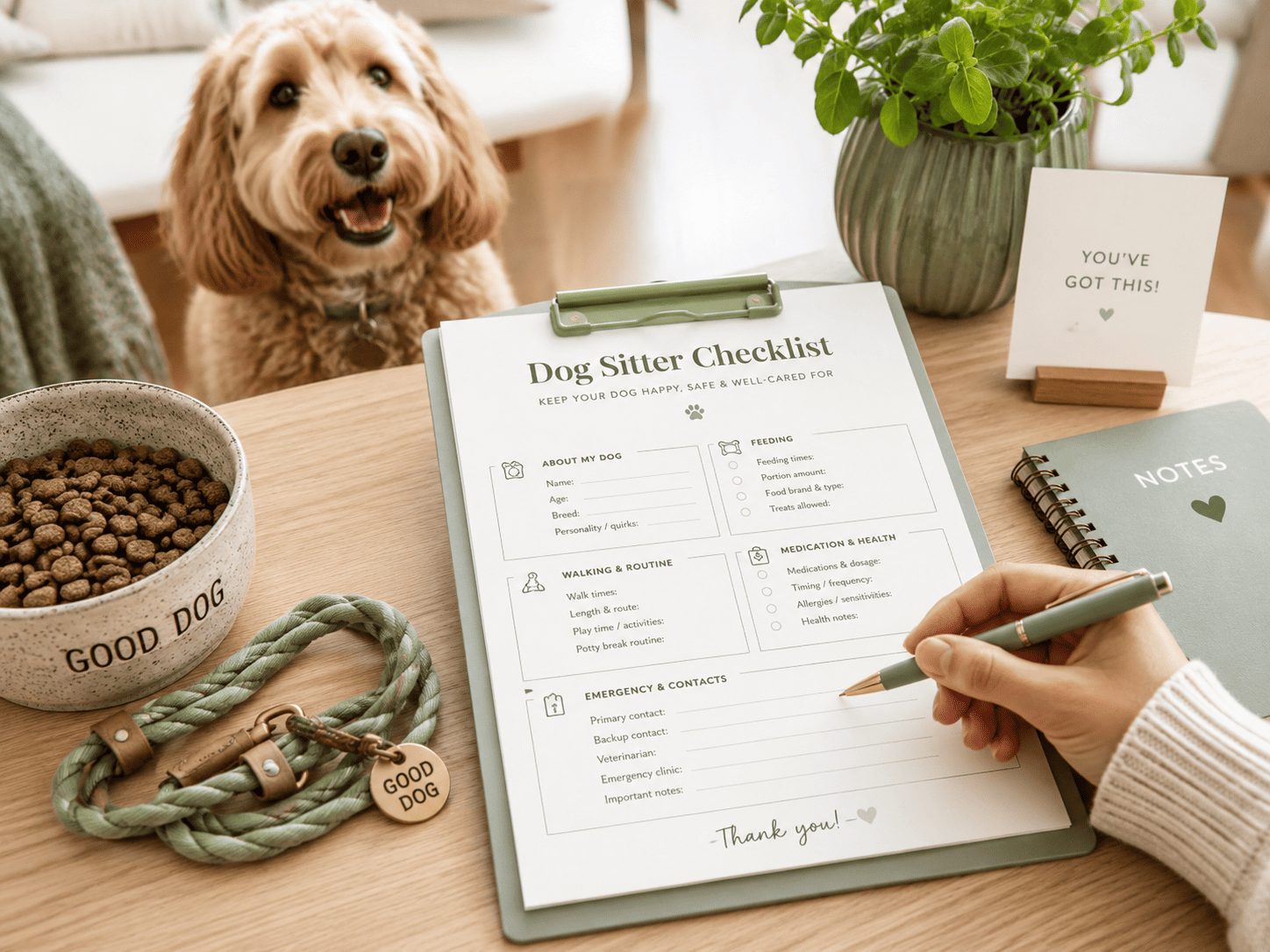
What to leave for a dog sitter includes the supplies they will use, the information they need and a way to get help when plans change. Pack by task: meals, walks, rest, prescribed care and veterinary contact.
Leave familiar equipment that fits your dog, not a new gadget the sitter has to learn at the door. Put each item where it will be used and show the sitter how the home, dog and equipment work together.
For a care pack covering pets beyond dogs, see what to leave for a pet sitter.
What to leave for a dog sitter: the supply checklist
Lay out the everyday items first. Check that the supply covers the booking and agree a replenishment plan if your return is delayed.
Meals and water
- The food your dog currently eats, in secure storage.
- The measuring tool or labelled portions used in the feeding plan.
- Clean bowls and any familiar feeding equipment.
- Allowed rewards, with their place in the daily food allowance.
- Instructions for food storage, preparation and bowl cleaning.
- A way to buy or obtain more of the same food if needed.
Walks and toilet outings
- The fitted harness or collar and lead the dog normally uses.
- ID tag with checked contact details.
- Waste bags and the disposal location.
- A towel for wet walks and any familiar coat used when needed.
- The usual route and a quieter backup route.
- Clear limits for outdoor access, greetings and off-lead activity.
Rest and household access
- Familiar bedding in the normal resting place.
- Barriers needed for doors, other pets or restricted rooms.
- A small selection of safe, familiar toys.
- Cleaning supplies stored beyond the dog's reach.
- Working keys and private security instructions.
Prescribed care and transport
- Current labelled medicines, stored as their directions require.
- The veterinary instructions and equipment supplied for administration.
- A completion sheet if the sitter has accepted prescribed-care tasks.
- Regular practice and emergency clinic contact information.
- The transport equipment and assistance needed if veterinary care is required.
Ask the clinic about prescription supply and repeat arrangements before travelling. A sitter should not be left with an empty pack and an assumption that replacement will be immediate.
Set up task stations the sitter can find
Choose one clear place for meal preparation and one for walking equipment. Keep medication secure even if the written care sheet is visible beside the feeding area.
| Task station | Leave there | Check before departure |
|---|---|---|
| Meal preparation | Current food, measuring tool, clean bowl and portion reference | The sitter can prepare the correct meal without searching |
| Back-door outings | Named lead, harness, waste bags and towel | Equipment is intact and the door can be secured |
| Rest area | Bed, water access and the usual household boundaries | Visitors or other pets cannot block the dog's retreat |
| Care information | Contacts, current directions and transport location | Readable offline and tied to the correct dog |
Remove confusing duplicates from the active area. If three similar scoops or two old harnesses are left together, a detailed note may still lead to the wrong choice.
Give a short information packet, not just a bag
Include the dog's identity, owner and agreed backup contacts, feeding plan, walking boundaries, handling needs and current health information affecting care. Tell the sitter how to contact you when travel or time zones change your availability.
“Walking kit: the harness labelled PIP hangs on the rear-door hook. Keep the lead attached outdoors. Use the orchard path; if it is busy, take the quiet lane instead. Do not arrange greetings with unfamiliar dogs.”
For wording you can adapt, see what to write in pet sitter instructions. Keep the physical checklist focused on what the sitter can find and use.
State what happens if the usual activity cannot happen
Adult dogs usually need daily walks alongside sniffing and play, with the plan adjusted for their health and circumstances. Leave your dog's normal pattern and any veterinary restrictions. A substitute indoor activity may help during a disruption, but essential toilet access and care still need covering.
Tell the sitter which handling or grooming tasks they should avoid. “Do not clean inside his ears; call me if you notice a change” is clearer than leaving a bottle beside the brush without an instruction.
Check access and equipment on a practice visit
- Let the sitter use the key and follow the entry sequence.
- Show where the dog waits while an outside door opens.
- Demonstrate fitting and removing the usual walking equipment.
- Walk a manageable part of the familiar route together.
- Prepare a meal using the supplies you will leave.
- Locate the carrier or vehicle restraint and veterinary contact.
- Resolve any task the sitter cannot safely perform.
Do not use the visit to force the dog through an uncomfortable interaction. If handling, medication or behaviour needs exceed the sitter's ability, arrange capable support before leaving.
Leave an emergency route and a delay plan
Contact a vet or emergency clinic immediately for breathing difficulty, collapse, suspected poisoning, seizures, severe bleeding, repeated retching without producing vomit, or straining to pass urine. For suspected heatstroke, move the pet out of heat and begin cooling immediately while arranging urgent veterinary care.
Agree that urgent veterinary contact does not wait for your reply. Confirm the practice's consent and payment process, how transport will work and which backup can help locally.
| Problem | Leave ready |
|---|---|
| Owner cannot reply | Agreed backup contact and the clinic's urgent-care route |
| Owner returns late | Who extends care, who confirms it and how supplies are replenished |
| Sitter cannot attend | Another capable person with agreed access |
| Equipment breaks | A checked replacement where available, or a safe alternative arranged with the owner |
| Dog escapes | Recent photo, identification details and local reporting contacts |
Do not assume a neighbour will provide backup merely because you have their number. Ask them and make sure they can carry out the role you name.
Worked example: Pip's walking kit is missing a safe option
Arlo leaves a lead and writes “usual field walk” for Pip. During the practice visit, the sitter learns the field sometimes contains livestock and the alternative route is unfamiliar.
Arlo walks the quieter lane with the sitter and writes it as the backup. He labels the fitted harness, replaces worn waste-bag storage and explains where Pip waits while the gate is opened.
Departure note: “Breakfast and the first outing are complete. The next meal follows Pip's care sheet. Walking equipment is on the rear-door hook. If the orchard route is unsuitable, use the lane we practised. Call the agreed backup if my return changes.”
The sitter now has the supplies, the route and the last completed tasks. They do not need to improvise an off-lead outing because the first route is unavailable.
Do the final supply check and avoid these mistakes
- Open the food cupboard and verify the correct product and remaining supply.
- Check walking equipment for wear and current fit.
- Count the keys you are handing over and test access.
- Keep labels readable and prescribed care connected to the current source.
- Leave transport equipment accessible, not behind luggage.
- Write the tasks completed before departure.
- Confirm the start of care and the next agreed check-in.
Common mistakes: leaving supplies in several hidden cupboards, buying unfamiliar equipment just before the booking, giving a blanket off-lead permission and assuming food availability covers a late return. Fix the task and the backup arrangement together.
Frequently Asked Questions
Should I pre-portion my dog's food?
It can make meals simpler if storage remains safe for that food. Label each portion clearly and explain the current feeding plan, including rewards and any preparation needed.
Should the sitter use my dog's usual harness?
Leave equipment that fits and is in good condition, then show how to use it. Avoid introducing a new setup the sitter and dog have not practised together.
What if the sitter cannot give a prescribed medicine?
Discuss this with the prescribing practice before agreeing the booking. Arrange another capable carer or care setting; extra written detail cannot replace the necessary skill.
How much spare food should I leave?
Cover the planned stay and agree what happens if it extends. The useful reserve depends on your return arrangements and access to replacement food, rather than a fixed amount for every booking.
Resources & Links
These sources help match the supplies you leave with the dog’s temporary care and veterinary arrangements.
- RSPCA: Exploring Pet Sitting Options — Check the information, supplies and agreed care a temporary dog carer needs.
- RSPCA: Company for Dogs — Plan company and social needs alongside walking equipment and the daily routine.
- PDSA: Emergency Care for Pets — Prepare clinic access and transport before leaving emergency information with the sitter.
Prepare your dog’s temporary care information with the Pet Sitter Instructions Pack. Get the Pet Sitter Instructions Pack →
Printable and fillable PDF templates for pet owners — feeding schedules, health records, training trackers and more.