
How to Choose a Boarding Kennel or Cattery: A Visit Checklist
Check accommodation, staff, daily care and emergency arrangements before booking. Includes ten questions, a visit checklist, comparison terms and a trial example.
In short
Check accommodation, staff, daily care and emergency arrangements before booking. Includes ten questions, a visit checklist, comparison terms and a trial example.
Knowing how to choose a boarding kennel means checking where your dog will live and how staff will care for it when you are away. Start with your dog’s needs, then compare accommodation, staffing, handling and emergency arrangements.
A clean reception and reassuring photographs tell only part of the story. Ask to see the accommodation your dog would use, discuss an ordinary care day and get important agreements in writing before booking.
How to choose a boarding kennel for your dog’s needs
- Company: does your dog enjoy other dogs or need individual care?
- Handling: can unfamiliar people fit its lead, clean around it and provide prescribed care?
- Rest: what helps it settle, and what sounds worry it?
- Food: which food, meal routine and dietary restrictions must continue?
- Health: what mobility limits, medical conditions or current instructions matter?
- Security: does it try to escape, open latches or slip equipment?
Tell the kennel about these points before asking for availability. A service that cannot safely administer the current prescribed care or provide separate exercise is the wrong match, even if its online reviews are excellent.
Discuss boarding with the vet when health or severe distress may make the arrangement difficult. Home visits or a carefully chosen home boarder may be alternatives, each with its own checks.
Visit the accommodation and follow the route
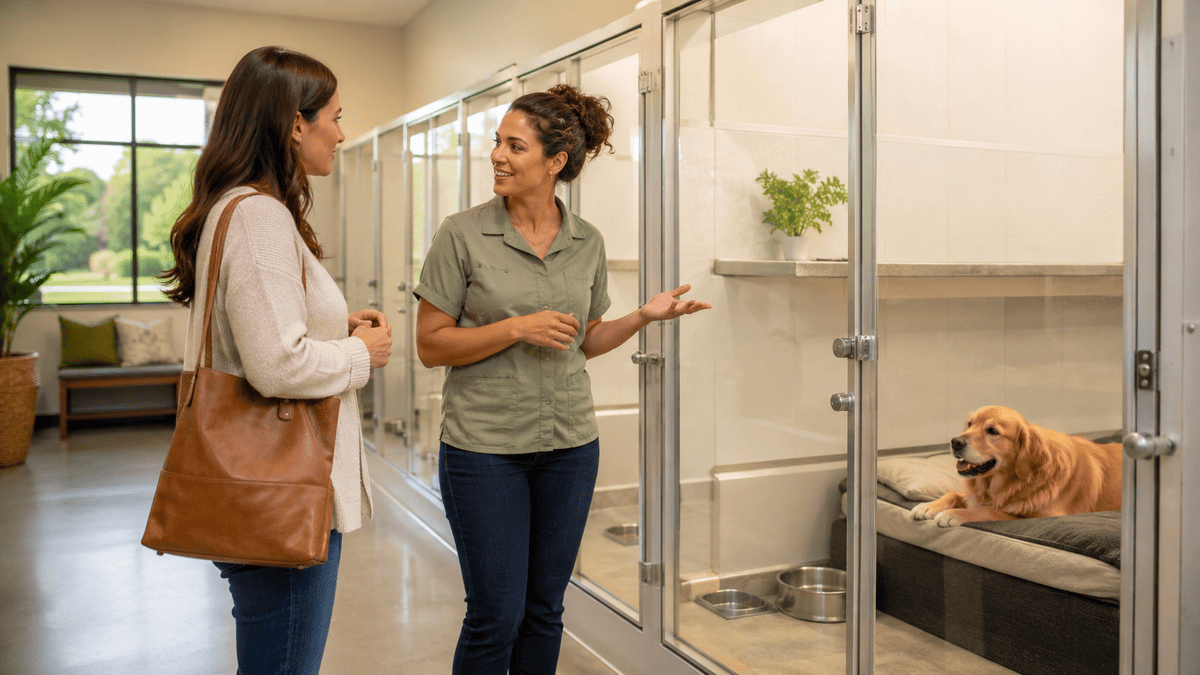
Arrange a visit at an agreed time that protects resident animals’ care and security. Ask which areas you can see and why any area is restricted. If you cannot visit, request current, detailed information and consider whether it provides enough confidence to book.
- Start at the arrival entrance: how is a dog transferred without escape?
- Look at the allocated sleeping area, bed and access to water.
- Check space to stand, turn, stretch and move away from the sleeping area.
- Ask about ventilation, heating, cooling and how conditions are checked.
- Look at separation between dogs and the routes used for exercise.
- Ask how waste, spilled food and soiled bedding are dealt with.
- Check doors, fencing, latches and double-entry arrangements.
Some noise is expected, but ask what staff do when a dog is persistently unsettled. Pacing or hiding should prompt questions about the animal and its care, not an instant conclusion from a brief visit.
Ask ten questions about the daily service
- Who will handle my dog, and what training do they have?
- What happens from morning feeding to the final evening check?
- How are exercise, toilet opportunities and quiet rest provided?
- Are dogs mixed, and can my dog remain separate?
- What staff coverage is present overnight?
- How do you recognise and respond to a dog that is not coping?
- How is prescribed care given and its completion checked?
- Which clinic is used for illness, and how is transport arranged?
- What happens if I cannot collect on time?
- Which items and documents must I provide?
Ask for the answer that applies to your booking. “We give individual attention” should lead to an explanation of who provides it, when and how the service adapts if your dog is struggling.
Compare the terms that affect care
| Decision | What to compare | What to confirm |
|---|---|---|
| Individual or shared exercise | Handling plan and group-selection process | Whether mixing requires your agreement |
| Food supplied or brought from home | Diet continuity and storage arrangements | Named food, meals and permitted extras |
| Prescribed care | Staff capability and any additional charge | Written instructions and missed-care contact procedure |
| Overnight supervision | On-site presence and checking arrangements | Response if a dog becomes unwell at night |
| Booking changes | Cancellation, extension and collection terms | Backup collector and extended-care costs |
In England, commercial dog boarding is subject to local-authority licensing; other places use different systems. Ask the relevant council or authority about current requirements and verify the facility’s status through it. A licence is one check, alongside the service’s fit for your dog.
Admission policies can specify vaccine evidence, timing, parasite arrangements and health exclusions. Get the current policy and discuss it with your practice; do not choose a treatment schedule yourself to fit a booking.
Use a trial when it will answer a useful question
A short familiarisation visit or trial stay can help staff learn about your dog before a longer booking. Ask what the trial involves, what feedback you will receive and what happens if the dog is distressed.
Judge eating, resting, toileting and comfortable handling, not just whether the dog stayed for the booked period. A successful trial does not guarantee every later stay will be identical, but it can reveal a service problem while there is time to make another arrangement.
For a cattery at the same facility, check quiet cat accommodation, hiding and elevated resting options, and separation from dogs. Do not assume that good dog care tells you how cats are housed.
Prepare drop-off and the backup arrangement
- Provide the vaccine evidence and other documents the kennel has accepted.
- Bring labelled food and the agreed feeding instructions.
- Keep prescribed products in their original labelled packaging with current directions.
- Supply your contact, a reachable backup and the usual vet’s details.
- Agree veterinary consent, transport and payment arrangements with the kennel and practice.
- Confirm who may collect, what identification is needed and what happens after a delay.
- Bring only bedding and toys the facility agrees are safe for your dog’s use.
For the concise care information, see what to write in pet sitter instructions. Keep keys, travel details and other private access information out of documents sent beyond the agreed recipient.
A quieter kennel wins over extra activities
In an illustrative example, Nessa compares two kennels for older dog Ralph. One offers busy shared play; the other can provide individual walks, a quieter sleeping area and the handling Ralph accepts.
Nessa chooses the second after checking its licence, service terms and prescribed-care capability. During the trial, she asks staff about meals and rest rather than requesting only a cheerful play photo.
Booking agreement: Ralph remains separate from group play. Use the supplied food and current clinic directions. Contact Nessa or backup Theo about concerns; follow the agreed veterinary contact and transport arrangement if urgent care is needed.
Frequently Asked Questions
Is the cheapest kennel a bad choice?
Price alone cannot tell you. Compare the care included, extra charges, staff capability and fit for your dog before deciding.
Should someone be on site overnight?
Ask exactly what coverage and emergency response the facility provides, then decide whether it meets your dog’s needs and local requirements.
Can I send my dog’s usual blanket?
Often, but ask first. Bedding must suit the facility’s cleaning arrangements and your dog’s safety, especially if the dog chews fabric.
What if my return journey is delayed?
Use the agreed extension and backup-collection plan. Confirm both before departure rather than leaving the kennel to find an unapproved collector.
Resources & Links
These sources help compare kennel welfare, practical care and alternatives.
- RSPCA: Boarding Kennels and Daycare — Review welfare, accommodation and service checks before booking.
- Blue Cross: Boarding Advice and Alternatives — Compare boarding with other care arrangements and prepare for a stay.
- PDSA: Holiday Care — Prepare individual needs, documents and practical care information.
Prepare care instructions with the Pet Sitter Instructions Pack and keep clinical documents in the Pet Health Record Binder. Get the Pet Sitter Instructions Pack → Get the Pet Health Record Binder →
Printable and fillable PDF templates for pet owners — feeding schedules, health records, training trackers and more.