
What to Bring to a Vet Appointment: Complete Pet Owner Checklist
Pack the right records, medicine labels, questions and secure transport. Includes visit-type comparisons, a call-ahead script and a leaving-clinic checklist.
In short
Pack the right records, medicine labels, questions and secure transport. Includes visit-type comparisons, a call-ahead script and a leaving-clinic checklist.
Knowing what to bring to a vet appointment helps you use the consultation for decisions instead of searching your phone for an old prescription. Pack the pet securely, the relevant records and a short list of questions.
Call the practice beforehand about samples, preparation and arrival needs. If the reason for the visit has become urgent, tell the team rather than waiting for the original booking.
What to bring to a vet appointment: the packing checklist
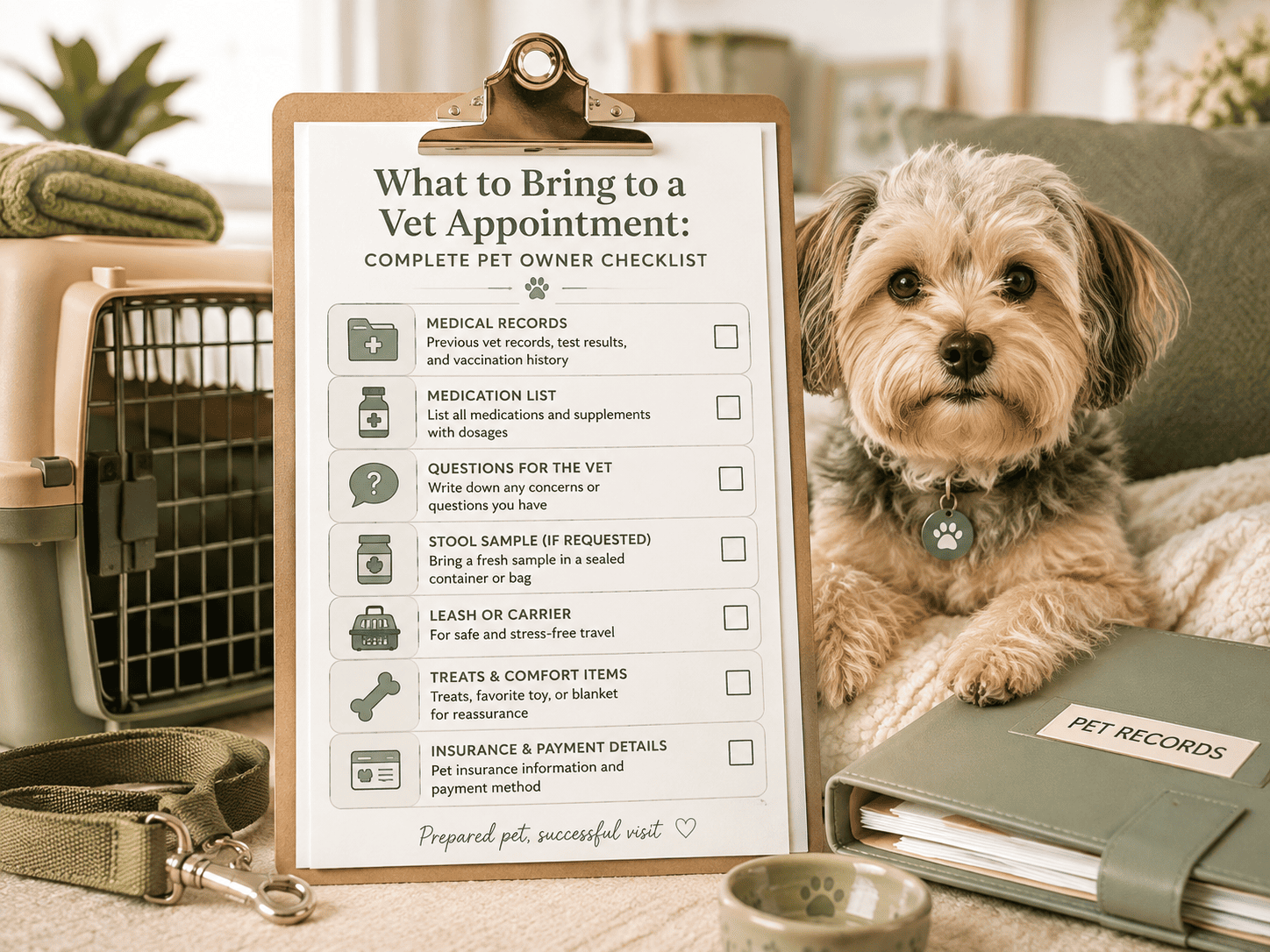
- The pet in secure transport: a fitted lead and restraint for a dog, or a secure carrier for a cat or other animal as advised by the practice.
- Booking and patient details: appointment time, pet name, clinic and any patient reference.
- The reason for attending: a short description of the main concern and when it began.
- Relevant clinical records: recent summaries, test results, referrals or vaccination evidence for the purpose of this visit.
- Current medicine information: original labelled containers or clear label photographs, plus supplements and products used.
- Useful photos or videos: selected clips of intermittent changes, accessible without hunting through hundreds of files.
- Requested samples: only collected, stored and delivered according to the clinic’s directions.
- Your questions: the decisions you need help making, including practical care or affordability concerns.
- Payment and insurance details: the information the practice requests for its process.
- A way to record answers: paper or a phone note, with space for follow-up.
For an animal being seen for the first time, ask whether the practice needs records sent directly from the previous clinic. Bring your personal copies too, but check that transfer has happened before assuming the clinician has the full history.
Confirm preparation and arrival with the practice
Some visits need preparation; many do not. Ask whether food, water or medicines should change before this particular appointment. Do not fast an animal or withhold prescribed care because another owner did so for a different procedure.
“We are booked for [reason] with [pet]. Do we need any preparation or a sample? What should I bring, how should it be collected or stored, and where should we wait on arrival? Please note that [handling, access or travel concern].”
Tell the team if your dog struggles around other animals, your cat is very frightened, or you need help moving safely from the car. Ask about a quieter waiting arrangement if needed. Mention bite history honestly so the team can plan safe handling.
- Check the location, especially if a referral uses a different building.
- Ask how to send records or recordings before the consultation.
- Confirm any interpreter, mobility or communication support.
- Plan enough travel time to arrive without rushing the pet.
- Keep the practice number accessible in case travel is disrupted.
Prepare a brief account the vet can use
Start with the main change, then its sequence. Describe what you saw: “left the stairs and lay by the bottom step” is clearer than assuming why it happened. Include appetite, drinking, toileting and activity changes when relevant.
| Prompt | What to write | Example |
|---|---|---|
| First noticed | Date or the best honest time estimate | “First saw hesitation at the stairs on Tuesday evening” |
| Progression | What changed afterwards | “Used the downstairs bed on Wednesday; avoided stairs today” |
| Other changes | Relevant everyday observations | “Ate breakfast; took longer to stand after resting” |
| Care already given | Product and source of instruction | “Current medicine label photographed; completion times in attached log” |
| Main question | The help you need | “What movement is safe while this is investigated?” |
For a longer history, use a symptom timeline before the visit. Put a short summary at the front, with fuller entries available if requested.
Contact a vet or emergency clinic immediately for breathing difficulty, collapse, suspected poisoning, seizures, severe bleeding, repeated retching without producing vomit, or straining to pass urine. For suspected heatstroke, move the pet out of heat and begin cooling immediately while arranging urgent veterinary care.
Bring the right evidence for the appointment type
| Visit | Most useful additions | Confirm beforehand |
|---|---|---|
| Vaccination or routine review | Previous certificate, current products and questions about changes | Which records are needed if care happened elsewhere |
| New symptom | Timeline, selected footage and current medicine labels | Urgency, requested samples and transfer of previous results |
| Follow-up | Discharge directions and what happened since treatment | Whether pending results are available and any preparation |
| Referral | Referral details, relevant history and current treatment sources | Receiving location, records transfer and estimated costs |
| Travel paperwork | Identification and vaccination originals required for the route | Document requirements with the clinic and official travel authority |
Samples are an ask-first task. The team can explain whether a sample will help, the container needed and how quickly it should reach them. Avoid collecting from the wrong animal in a multi-pet home or transporting an unlabelled container.
Make the consultation questions specific
Lead with your biggest concern before discussing a long list of small questions. If two household members attend, agree who will explain the history and who will note answers. Tell the vet about any part of home care you cannot safely perform.
- What are the options, and what are their benefits and risks for this pet?
- What does the estimate include, and what could change it?
- Which result or decision is still pending?
- What should we do at home, and can you show the task?
- Which change should prompt a call, and which contact should we use?
- When and how will the next review or result contact happen?
Ask for plain wording when a term is unfamiliar. Repeat the home task back in your own words so the team can correct a misunderstanding before you leave.
Check the packet before going home
In an illustrative visit, Priya brings dog Dune’s medicine label, a short stair video and a dated summary. During the consultation, she explains that lifting Dune into the car is difficult and asks the team to demonstrate the safe arrangement they recommend.
Priya leaves with written instructions, the next contact plan and an estimate for proposed further work. She keeps a pending-result note because one report is not ready. The appointment is not treated as finished simply because the bill is paid.
- Check the patient name on every new document and label.
- Confirm which directions replace earlier ones.
- Save the practice and out-of-hours contact routes.
- Write who will contact whom about results.
- Book the agreed follow-up or note the booking task.
- Share the new instructions with anyone helping at home.
Frequently Asked Questions
Should I bring every record I own?
Bring the documents relevant to the visit, with the wider history accessible. A new or referral practice may need the clinical record transferred directly.
Can I show a phone video during the consultation?
Ask the practice how it prefers to receive recordings. Choose a brief, clear clip and explain when it was taken; never provoke a symptom to film it.
Should my pet eat before the appointment?
Ask the practice about this visit. Preparation can vary, so do not apply a fasting instruction from an unrelated procedure.
What if I forgot the vaccination certificate?
Call the practice and explain where it was issued. It can tell you whether a clinical record or another copy is needed before proceeding.
Resources & Links
These sources help prepare consultation questions, relevant observations and practice-access arrangements.
- Blue Cross: Choosing a Vet Practice — Check communication, services and access needs before attending a practice.
- PDSA: Home Health Checks — Describe relevant everyday changes to bring to the consultation.
- AVMA: Resources for Pet Owners — Find owner information to support questions about care and veterinary visits.
Keep relevant health information ready for visits with the Pet Health Record Binder. Get the Pet Health Record Binder →
Printable and fillable PDF templates for pet owners — feeding schedules, health records, training trackers and more.