
Pet Emergency Plan: What Happens If You Cannot Get Home?
Arrange willing helpers, private access and clinic-confirmed care arrangements. Includes scripts, a rehearsal checklist and an unavailable-owner example.
In short
Arrange willing helpers, private access and clinic-confirmed care arrangements. Includes scripts, a rehearsal checklist and an unavailable-owner example.
A pet emergency plan needs to work when you cannot get home, answer your phone or explain the routine. The essential arrangement is a willing helper who can reach the pets, enter safely and take responsibility.
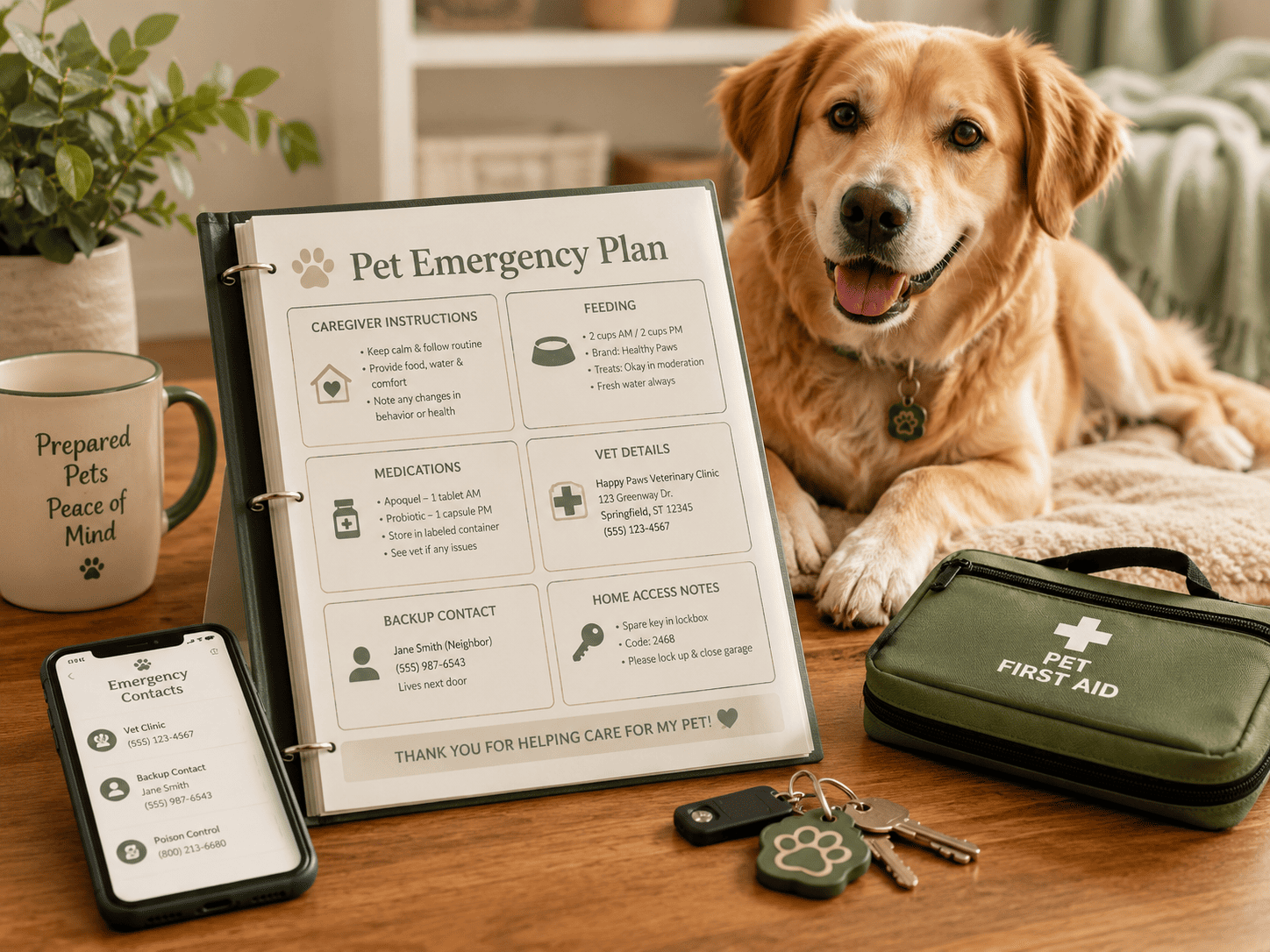
Prepare a primary contact, a backup, private access instructions and a short care packet. Then test the whole chain while you are available to fix it.
Make a pet emergency plan for an unavailable owner
- Name the trigger. Examples include an unexpected hospital stay, travel disruption or a message that you cannot return as planned.
- Ask a primary helper. Confirm that they accept the role and can provide the care your pets need.
- Ask a backup. Check what happens if the first person is unavailable.
- Arrange private access. Provide a tested key or agreed route without publishing household security details.
- Agree the handover. Decide how someone confirms they have reached the pets and taken over.
- Check veterinary arrangements. Ask the clinic about consent, contacts and payment when you cannot be reached.
- Leave a notification route. A wallet or phone note can point to the agreed helper; it cannot guarantee that somebody will find or act on it.
Write the plan for ordinary care as well as urgent treatment. A helper may first need to let a dog out, check that a cat is present, provide water or arrange another visit.
Choose helpers who can do the tasks
Availability and ability matter more than a familiar name. Ask about access, transport, handling and prescribed tasks before assigning the role. A nearby friend may be able to check the pets but need another person to drive or provide longer-term care.
| Role | Confirm | Backup question |
|---|---|---|
| First responder | Can enter, identify the animals and check immediate needs | Who can go if this person is away? |
| Daily care | Can cover meals, toileting, company and agreed tasks | Who covers the next visit or overnight period? |
| Transport | Has secure equipment and a workable clinic route | What happens if the vehicle is unavailable? |
| Communication | Updates contacts and records who has accepted care | Who maintains the chain if the first contact cannot? |
One person can hold several roles, but write them explicitly. Do not assume someone who agreed to collect a dog has also agreed to board the dog indefinitely.
“If I cannot get home or communicate, would you be willing to check [pets] and arrange their next care? The tasks are [list]. Access is arranged privately. Please tell me which parts you can cover and who we should use as backup.”
Prepare an access and care packet
- Pet inventory: names, species, identifying descriptions and usual locations.
- Safe entry: the private access route, doors to keep closed and any escape or handling risks.
- First tasks: water, toilet access, checking presence and the next meal.
- Food: product, portion from the current plan, preparation and labelled location.
- Prescribed care: current written instructions, original labelled products and a clinic contact if a helper cannot perform the task.
- Equipment: carriers, fitted walking gear and secure transport supplies.
- Contacts: primary helper, backup, regular vet and emergency clinic.
- Ongoing cover: who can arrange visits, boarding or another agreed carer.
Keep public notification separate from this packet. A wallet note can say pets need care and give an agreed contact number. It should not disclose key locations, alarm codes or an empty-home timetable.
Store current instructions where the helper expects to find them. If they have a private digital copy, check that it opens from their device without your login or a code sent only to your unavailable phone.
Confirm veterinary consent and payment in advance
Ask the practice how a helper should request care for your animal when you are unreachable. The clinic can explain what it needs about authorisation, contact attempts, decisions and payment. Requirements and legal effect vary, so a sentence on your own card should not be treated as universal authority.
“I am preparing backup care if I cannot communicate. What information or authorisation should you hold, who may bring my pet in, and how do you handle treatment decisions and payment in that situation?”
Keep the practice’s answer with the plan. Tell the helper where to find it and what remains unresolved. Include an accessible payment arrangement only through a private, agreed route; avoid publishing financial details.
Contact a vet or emergency clinic immediately for breathing difficulty, collapse, suspected poisoning, seizures, severe bleeding, repeated retching without producing vomit, or straining to pass urine. For suspected heatstroke, move the pet out of heat and begin cooling immediately while arranging urgent veterinary care.
Test the chain with a rehearsal
- Tell the helper this is a planned test and send the agreed notification.
- Have them locate and open the care packet.
- Test the access arrangement with you present.
- Ask them to identify every pet and find the next care task.
- Find the transport equipment and clinic contact route.
- Ask what they would do if the primary helper could not continue.
- Agree the confirmation message and repair any gap.
“I have reached the pets and accepted care until [agreed handover]. [Named pets] have been checked. Next task is [task]. [Backup] has accepted the following period. I will contact [person] about any change.”
A message delivered to a phone is not an accepted handover. Keep contacting the agreed alternatives until someone confirms responsibility. Avoid vague group messages in which everyone assumes another person has gone.
A backup takes over during an unexpected hospital stay
In an illustrative household, Celia is unexpectedly admitted to hospital. Her nominated first helper, Karim, is out of town. Celia’s sister contacts the listed backup, Jo, who confirms she can enter and check dog Hazel and cat Rue.
Jo finds the private care packet and checks both animals before sending the confirmation. She can cover the next visits but cannot stay longer, so she contacts the pre-agreed longer-term carer. The handover specifies when that person takes over and where the current instructions are.
| Gap discovered | Response |
|---|---|
| Primary helper unavailable | Backup accepts the first care period |
| Owner cannot answer care questions | Use the current packet and clinic-confirmed arrangements |
| Backup cannot provide ongoing cover | Named longer-term helper confirms the next period |
| One task needs additional skill | Contact the clinic and arrange help before improvising |
For a compact list of people and numbers, use a pet emergency contact sheet. The care plan still needs tested access and a confirmed takeover.
Frequently Asked Questions
Is a wallet card enough on its own?
It can alert someone to pets at home and name a contact. The helper still needs to have agreed, know how to enter and have current instructions.
What if my backup moves away?
Choose another willing person and update every notification and private packet. Test the new arrangement before relying on it.
Should I put access codes on a public pet profile?
No. Share access privately with trusted carers through the agreed route. Public identification should not expose household security.
How often should I test the plan?
Recheck it after changes to contacts, home access, pets or care needs. Also choose a periodic household check you will remember, rather than assuming an old agreement remains workable.
Resources & Links
These sources help prepare contacts, care information and practical support when ordinary arrangements are disrupted.
- CDC: Pet Safety in Emergencies — Prepare pet information, care contacts and practical backup arrangements.
- FDA: Pet Preparedness Before Disaster — Check identification, prescribed-care information and supplies for disrupted care.
- PDSA: Emergency Care for Pets — Confirm the veterinary contact route a backup carer may need.
Prepare backup care information with the Pet Emergency and Care Info Kit and a compact contact reminder with the Pet Emergency Card. Get the Pet Emergency and Care Info Kit → Get the Pet Emergency Card →
Printable and fillable PDF templates for pet owners — feeding schedules, health records, training trackers and more.