
Lost Pet Information Sheet: What Details Help Bring a Pet Home Faster
Choose recognisable photos, markings, confirmed location and a monitored contact. Includes copyable notices, private-evidence checks and a sighting example.
In short
Choose recognisable photos, markings, confirmed location and a monitored contact. Includes copyable notices, private-evidence checks and a sighting example.
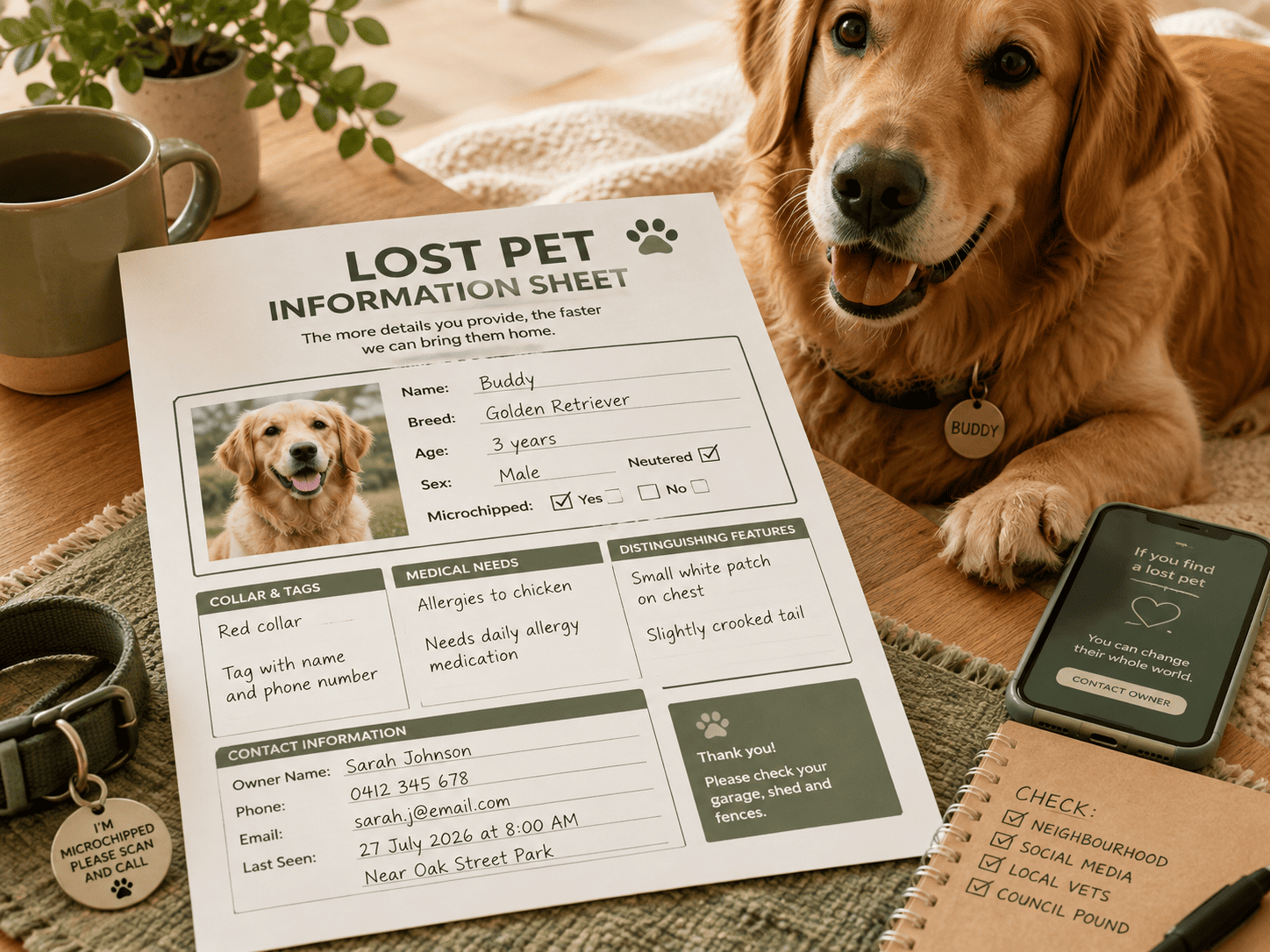
The lost pet information sheet details that help a finder are the ones they can recognise and act on: a clear photo, distinctive features, where and when the pet was last confirmed, and a working contact route.
Give the public a readable notice and keep ownership evidence privately for services handling a reunion. Accurate, specific wording helps more than a long biography.
Choose lost pet information sheet details a finder can use
| Detail | Useful wording | Why it helps |
|---|---|---|
| Species and size | “Adult small black-and-white cat” or a clear dog description | Someone can judge relevance without guessing breed |
| Coat and markings | “White chest, white left front paw, black patch beside nose” | Distinctive visible features help compare a sighting |
| Photo | Recent face and body images showing those features | Provides a quick visual match |
| Last confirmed place | Recognisable area, street or landmark | Gives a starting location without exposing private access |
| Last confirmed time | Date and time, or a clearly stated estimate | Helps separate relevant reports from older sightings |
| Contact | A monitored phone number or chosen contact route | Lets a finder reach someone who can respond |
| Handling caution | “May hide; please do not chase or corner” | Discourages an unsafe attempt to catch the animal |
Breed can be included when useful, but visible description matters if the finder does not know breed names. Write size in familiar terms rather than relying entirely on weight, which a passer-by cannot measure.
Use photographs and descriptions that survive a quick glance
- Choose a recent, well-lit image showing the pet rather than a distant background.
- Include a whole-body view if markings or body shape matter.
- Use a face image when facial markings are distinctive.
- Describe important features in words as well as photographs.
- Note collar or harness details only if worn when last seen.
- Keep the key contact and location readable on a small phone screen.
A collar can come off and a coat can look different when wet or dirty. Give several useful identity features instead of making one removable item the only test. Avoid filters that alter colour or hide markings.
Replace vague wording
| Vague | More helpful |
|---|---|
| “Brown dog” | “Medium brindle dog, white chest patch and dark muzzle” |
| “Friendly cat” | “Usually approaches people at home; may hide or flee outdoors” |
| “Missing near us” | “Last confirmed near [recognisable landmark], [date/time]” |
| “Call my usual number” | A printed number checked character by character |
Do not claim that a normally social pet will accept handling when frightened. Ask people to report the location and contact you; trained services can advise about safe containment when needed.
Separate the public notice from private reunion evidence
The public notice needs a way to identify and report the animal. A shelter, vet, registry or responsible local service may need additional evidence to connect the pet with its owner. Keep that material available without publishing it all.
| Public notice | Private evidence file |
|---|---|
| Selected recent photographs | Further photographs showing identity over time |
| Visible description and chosen contact | Full registry record and ownership documents |
| Last confirmed location and time | Detailed search notes and household information |
| Useful safety wording | Clinical records relevant to service or veterinary care |
Keep the full microchip number and registry details in the private file. Contact the registry to check your details and its missing-pet process. A chip helps identify an animal when scanned; it does not transmit the animal’s location.
Check ID tag details and microchip registration whenever your phone number or address changes. Updating one contact layer does not automatically update the others.
Write a notice and a finder message you can copy
Missing [species/name]. Description: [size, coat and distinctive features]. Last confirmed: [place], [date/time]. Wearing when last seen: [collar/harness, if known]. If seen, please call [contact]. Please do not chase or corner. If safe, send a photo and the exact location and time.
Add only information that affects recognition, reporting or safety. A long medical history can overwhelm the notice; urgent care needs can be shared with the service handling the pet. Keep home entry information off the notice.
“Thank you for contacting me. Where and when did you see the animal? Is the pet still there, and can you send a photo safely? Please avoid approaching if it may bolt or bite. I will coordinate the next step with the relevant local service.”
Use a backup contact who has agreed and can relay details. If the first phone is unavailable, a clearly monitored second route is better than a number nobody checks.
A distinctive detail improves a possible sighting
In an illustrative example, Owen’s cat Mabel is described as “black and white”. A neighbour reports another black-and-white cat. Owen’s revised description adds Mabel’s white left front paw and a small black patch beside her nose, with clear photographs.
The neighbour sends a photo taken safely from a distance. Owen compares the visible markings and asks for the time and location. The photo is not clear enough to settle the identity, so he follows up through local search contacts without rewriting the notice’s last confirmed location.
| Information received | Next action |
|---|---|
| Clear matching photo and current location | Coordinate a safe response; avoid inviting a chase |
| Possible match without a photo | Ask for time, exact place and visible identifying features |
| Old sighting forwarded by someone else | Find the original observer and event date |
| Claim requiring money or a verification code | Do not send codes or pay an unverified claimant; seek identifying evidence and service support |
The last confirmed location belongs on the notice; possible reports belong in the search notes until checked. Keep any update dated so volunteers know which version to use.
Check the details before sharing and after reunion
- Read the phone number aloud while comparing it with the working contact.
- Check the photographs show the listed features.
- Confirm the location wording makes sense to somebody outside your household.
- Remove unnecessary personal and security information.
- Ask local services how to report the missing animal and send evidence.
- After reunion, notify those services and update or remove notices.
Reporting routes differ by place and species. Local councils, shelters, vets and registries may have different roles; check who handles the animal in your area rather than assuming one organisation covers every pet.
For preparing the blank sheet before it is needed, see a lost pet information sheet. Keep the finder-facing notice concise when an event occurs.
Frequently Asked Questions
Should I publish the microchip number?
Keep it available privately for the registry and services verifying identity. A finder usually needs your chosen contact route and a visible description first.
What if my pet was not wearing a collar?
Describe coat, size and distinctive features clearly. Do not add a remembered collar from another occasion as if it was worn when last seen.
Should a possible sighting replace the last-seen location?
Keep the last confirmed location on the notice and record the report separately while it is checked. Date any confirmed update.
Which details can I leave out of the public notice?
Leave out access codes, full private records and unrelated household information. Keep recognition, a monitored contact, confirmed location and useful safety wording prominent.
Resources & Links
These sources help connect a readable notice with local reporting and identification checks.
- PDSA: Lost and Found Pets — Check reporting and search actions to support a finder-facing notice.
- Blue Cross: Missing and Stray Dogs — Find dog-specific service and reporting considerations for a possible sighting.
- AVMA: Microchipping FAQs — Understand scanned identification and registry contacts when preparing private evidence.
Keep lost-pet and backup-care information ready with the Pet Emergency and Care Info Kit. Get the Pet Emergency and Care Info Kit →
Printable and fillable PDF templates for pet owners — feeding schedules, health records, training trackers and more.