
How to Choose a Dog Walker: Questions to Ask Before You Hand Over a Key
Compare walking arrangements, ask ten service questions and observe a trial. Includes written terms, access checks, red flags and an individual-walk example.
In short
Compare walking arrangements, ask ten service questions and observe a trial. Includes written terms, access checks, red flags and an individual-walk example.
How to choose a dog walker comes down to a specific arrangement: who walks your dog, with which dogs, using what equipment, on which routes, and what happens if something goes wrong.
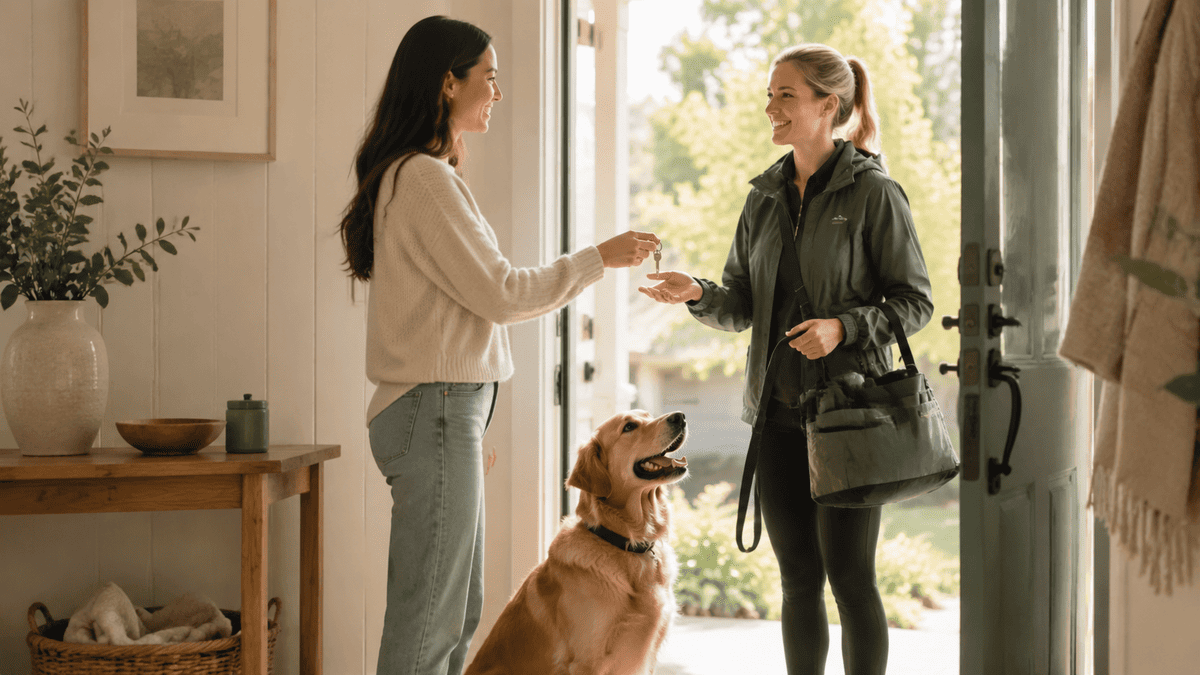
Start with your dog’s needs, then ask for evidence and observe a trial. A friendly introduction helps, but clear handling, transport and backup plans matter after you have handed over the key.
How to choose a dog walker for your dog’s needs
- Health and movement: tell the walker about current veterinary restrictions and any tasks they must avoid.
- Interactions: explain reactions to dogs, cyclists, children, traffic or livestock with concrete examples.
- Handling: demonstrate the walking equipment and mention discomfort or escape history.
- Company: decide whether your dog is likely to cope with a group or needs individual attention.
- Schedule: specify the care period, including collection and return rather than only advertised walking time.
- Home access: identify the agreed private route and which doors must stay closed.
Do not hide a bite or chasing incident to secure a booking. The walker needs accurate information to judge whether the service is safe for your dog and others.
Ask these questions before meeting
- Who will physically walk my dog, and can that person change?
- How are group dogs selected, introduced and reassessed?
- What is the maximum group this particular walker handles under your policy?
- Where do you walk, and how do routes change for weather or restrictions?
- What are your lead and off-lead arrangements?
- How do you respond when a dog is frightened, fixates or refuses to continue?
- How are dogs transported and separated or secured in the vehicle?
- What training and first-aid preparation does the walker have?
- What insurance applies to the service, and can I see current evidence?
- What happens after an injury, escaped dog, missed visit or walker illness?
Ask for the current service terms and references you can contact with permission. Read what the insurance covers and whether the insured activity matches the offered service. A certificate’s presence alone does not explain every exclusion.
Local rules can affect commercial use of parks, group limits, leads and related services such as home boarding. Check the relevant council or land manager for your area; do not assume one licensing rule applies to every dog-walking business.
Many UK councils, especially in England and Wales, limit the number of dogs one person may walk in public spaces through Public Spaces Protection Orders, commonly to four to six; check the council’s current local rules and ask the walker about their own limit.
Compare individual, group and home-visit arrangements
| Arrangement | May help when | Check carefully |
|---|---|---|
| Individual walk | The dog needs a tailored route, pace or distance from other dogs | Who covers it if the usual walker is absent |
| Matched group | The dog is comfortable with the selected companions and handling | Introductions, transport, group management and changing membership |
| Home visit | The immediate need is toileting, company or vet-limited care | Which tasks are included and whether the visit meets the dog’s needs |
| Combined service | Collection, a walk and another care task are required | Time spent travelling and whether the extra task is agreed |
Do not choose a group because the advert describes all dogs as friendly. Ask how this dog is assessed in this group. A previous pleasant meeting does not guarantee every future pairing works.
Observe a trial and check the equipment
Arrange a trial before regular care, ideally observing the parts relevant to your concerns. Let the walker meet the dog calmly. Watch whether they respect distance and respond to the dog’s behaviour rather than forcing a greeting.
- Can the walker fit and check the harness or collar without guessing?
- Does the dog have room to move without constant lead pressure?
- Does the walker notice approaching triggers and choose space early?
- Can they explain how they would end a difficult interaction?
- Is collection secure, including gates, doors and vehicle loading?
- Does the advertised arrangement match what happens during the trial?
Ask about anything unclear while you are present. If the walker uses frightening handling, punishment or an arrangement outside the agreement, stop the trial and reconsider the service. You need a plan that fits the dog, not a promise that discomfort will disappear with enough pressure.
Put routes, permissions and backup care in writing
Dog: [name]. Walker: [person]. Agreed service: [collection, walking and return tasks]. Equipment: [named items and fit check]. Lead arrangement: [rule]. Interactions to avoid: [details]. Current restrictions: [vet instruction reference]. Update after return: [method]. Delay or cancellation contact: [person]. Backup accepted by: [name]. Veterinary contacts and clinic arrangements: [private reference].
Discuss off-lead requests explicitly, including recall, escape risk, permitted locations and the walker’s policy. Owner permission does not remove local restrictions or make an unsafe situation safe.
Share keys and access information privately, with a return or revocation plan. Ask how key loss, replacement walkers and access records are handled. For broader care wording, use pet sitter instruction fields and keep only the tasks this walker accepts.
Confirm the practice’s arrangements for care if you are unreachable, including consent and payment. The walker should know whom to call and where to take the dog rather than relying on a vague instruction to “use any vet”.
Contact a vet or emergency clinic immediately for breathing difficulty, collapse, suspected poisoning, seizures, severe bleeding, repeated retching without producing vomit, or straining to pass urine. For suspected heatstroke, move the pet out of heat and begin cooling immediately while arranging urgent veterinary care.
Reject arrangements that leave important questions unanswered
- No named walker: ask who takes the dog and how substitutions are approved.
- No usable service terms: resolve collection, cancellation and responsibility before regular bookings.
- Pressure to hand over access: complete the assessment and private access agreement first.
- No transport explanation: do not accept an unseen loading or restraint arrangement.
- No response to discomfort: choose a service that adapts rather than dismisses the dog’s behaviour.
A confident sales answer is less useful than a clear demonstration and written arrangement. If a gap remains after reasonable questions, look for another service before giving the provider responsibility for the dog.
A trial changes the booking
In an illustrative example, Amira is booking care for dog Kit, who enjoys quiet walks but becomes tense around fast-moving dogs. A walker initially offers a group slot. During the assessment, Kit repeatedly tries to move away from a lively companion.
Amira and the walker agree to an individual route while considering further professional help if needed. The written arrangement avoids the busy field, identifies Kit’s fitted harness and names the backup person. The return update records the route and any problem encountered.
Amira’s decision is based on the observed match and the walker’s response. She does not accept “he will get used to it” as a substitute for a manageable plan.
Frequently Asked Questions
Should every dog join a group walk?
No. Health, comfort, interactions and the specific group matter. An individual walk or home visit may fit better.
Can I ask to meet the replacement walker?
Yes. Agree who may take over and how introductions and instructions will be handled before a substitution is needed.
What should a return update include?
Confirmation of collection and return, the agreed tasks, any change and anything needing your attention. Photos can accompany this but do not replace it.
Is insurance legally required everywhere?
Requirements vary by jurisdiction and service. Check local rules and the provider’s written cover rather than relying on a universal claim.
Resources & Links
These sources help prepare selection questions, service responsibilities and emergency contact arrangements.
- RSPCA: Pet Sitting Options — Check selection, introductions and care information for a temporary service provider.
- PDSA: Holiday Care — Consider what the agreed service and backup arrangement need to cover.
- PDSA: Emergency Care for Pets — Prepare the clinic contact route the walker may need during an urgent event.
Prepare agreed care information with the Pet Sitter Instructions Pack and wider dog care with the Complete Dog Owner Binder. Get the Pet Sitter Instructions Pack → Get the Complete Dog Owner Binder →
Printable and fillable PDF templates for pet owners — feeding schedules, health records, training trackers and more.