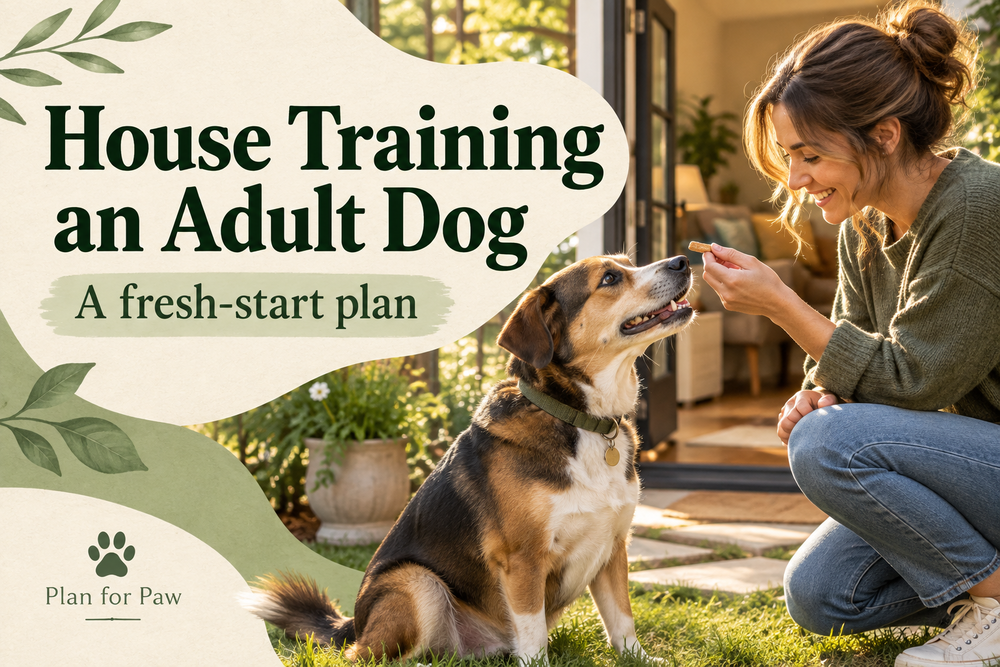
House Training an Adult Dog: A Fresh-Start Plan
Rescue dogs, dogs from kennels and dogs who were never fully trained can all learn — usually faster than a puppy. Here is a fresh-start house training plan for adult dogs.
In short
Rescue dogs, dogs from kennels and dogs who were never fully trained can all learn — usually faster than a puppy. Here is a fresh-start house training plan for adult dogs.
Adult dogs who are not house trained are more common than people think. Dogs from kennels or farms may never have lived in a house; others were never fully trained; some have lost their routine after a move. The good news is that adult dogs have much better bladder control than puppies, so they usually learn quickly once the routine is clear.
Step 1: Rule Out Medical Causes
If a previously clean dog starts having accidents, or a new dog is going very frequently, straining or drinking a lot, see your vet first. Urinary infections and other conditions can look exactly like a training problem.
Step 2: Treat It Like a Fresh Start
For the next two weeks, assume your dog knows nothing. That means taking them out far more often than seems necessary and preventing accidents rather than reacting to them.
A Two-Week Schedule
- First thing in the morning
- After every meal — usually within 15–30 minutes
- After waking from a nap
- After play or excitement
- Every two to three hours in between at first
- Last thing at night
Go to the same spot each time, stand quietly and wait. Use a cue word as your dog goes, and reward with a treat and praise the moment they finish — outside, not when you get back indoors.
Daily Dog Care Tracker
Logging every toilet trip for two weeks shows you your dog's real pattern. The Daily Dog Care Tracker has printable daily sheets for meals, water, walks and toilet trips — so you can get ahead of accidents.
Get the Daily Dog Care Tracker →Supervise or Contain
Accidents happen when nobody is watching. When you cannot supervise, use a crate (if your dog is comfortable with one), a small room with a baby gate or a lead attached to you. Gradually give more freedom as the clean days add up.
Handling Accidents
- If you catch your dog in the act, calmly interrupt and go straight outside
- Never punish an accident — it teaches your dog to hide when they need to go, which makes training harder
- Clean with an enzyme cleaner. Ordinary cleaners leave a smell your dog can still detect, which draws them back to the same spot
Dogs Who Will Not Go on a Lead
Some dogs from kennels or farms have only ever toileted off lead or on a particular surface. A long line gives more space and privacy. Try different surfaces and be patient — standing still and boring is better than walking around.
Marking
Leg-lifting on furniture is often marking rather than a full toilet. Neutering may reduce it in some dogs — ask your vet. Supervision, enzyme cleaning and rewarding outdoor toileting all still apply.
How Long Does It Take?
Many adult dogs make big progress within one to two weeks of a consistent routine. Dogs with a long history of toileting indoors may take longer. Patterns in your log will show you whether things are improving.
Two ways to track progress
Want a daily toilet and meal log? Choose the Daily Dog Care Tracker. Want training, health records and routine in one place? Choose the Complete Dog Owner Binder.
Get the Complete Dog Owner Binder →Frequently Asked Questions
Can you house train a 5-year-old dog?
Yes. Age is not a barrier. Adult dogs often learn faster than puppies because they can physically hold on for longer.
My rescue dog was house trained but has accidents in my home. Why?
A new home is a new environment. Many dogs need a short refresher with a clear routine. Stress can also play a part — see our rescue dog decompression guide.
Should I use puppy pads for an adult dog?
Generally, if your goal is outdoor toileting, pads can slow things down. They can help for dogs with mobility issues or long gaps between trips — ask your vet or trainer.
Printable and fillable PDF templates for pet owners — feeding schedules, health records, training trackers and more.