Puppy Potty Training Tracker: How to Notice Patterns Faster
Record toilet opportunities, outcomes and accident context to find supervision gaps, coordinate carers and recognise changes that need veterinary advice.
In short
Record toilet opportunities, outcomes and accident context to find supervision gaps, coordinate carers and recognise changes that need veterinary advice.
A puppy potty training tracker can show where a toilet opportunity was missed, but it cannot tell you a puppy's medical condition or guarantee when they will go. Use it to connect events, access and outcomes without turning accidents into a score of the puppy's effort.
The most useful page records unsuccessful trips as well as successful ones. It also explains what happened beforehand, so you can change a practical gap rather than guessing at a universal holding time.
Choose fields that answer a toileting question
Begin with the puppy's name and the date. Add the event before the opportunity, the place offered, the outcome and the carer. Record actual times if they help you understand the sequence; these are observations, not prescribed intervals.
Leave space for accidents and uncertainty. A page containing only outdoor successes cannot reveal whether there were indoor accidents between entries or whether another person provided an unrecorded outing.
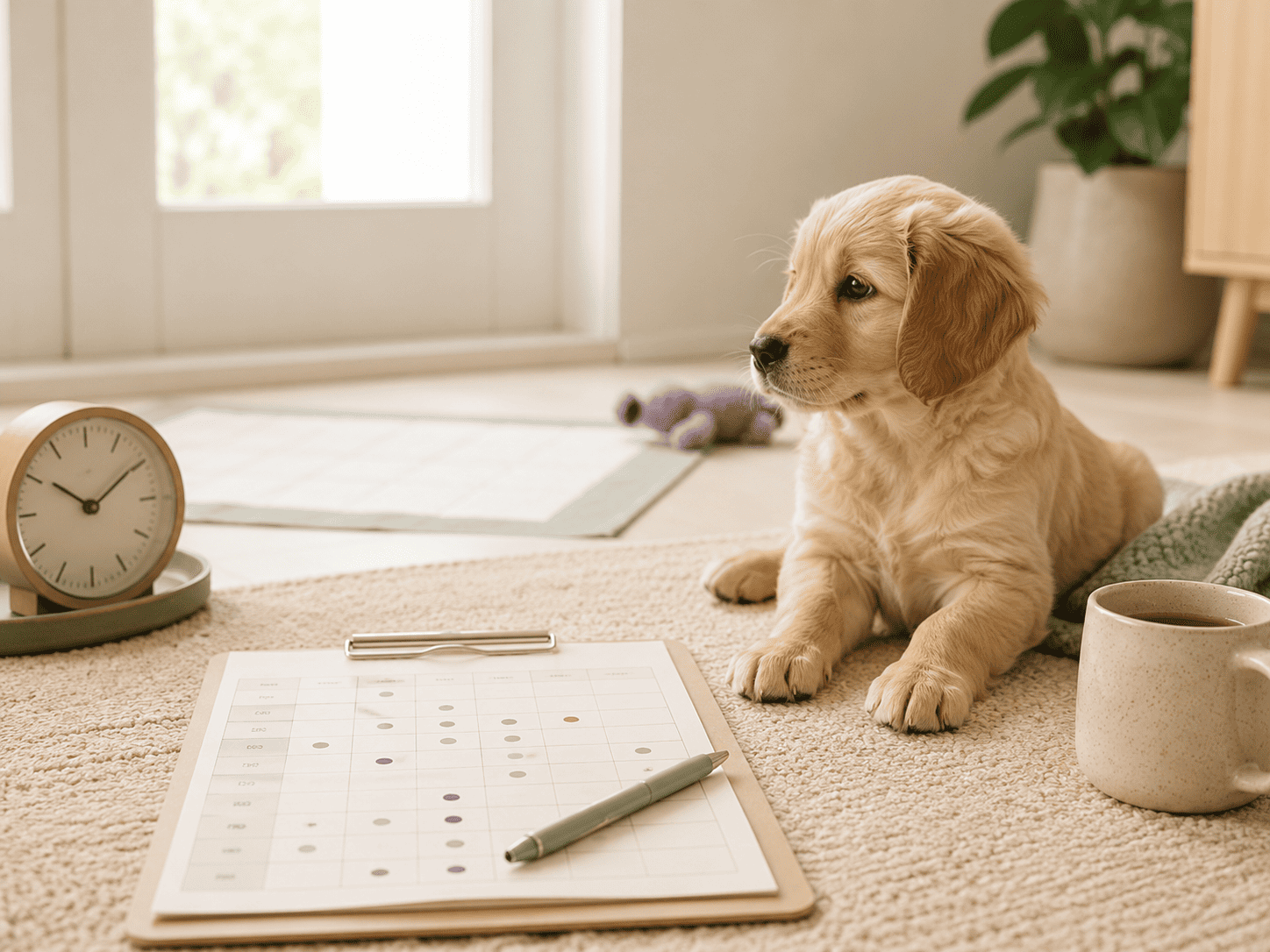
| Field | Useful entry | Purpose |
|---|---|---|
| Previous event | Woke, finished meal, played or changed carer | Shows the context before the opportunity |
| Opportunity | Place offered and who supervised | Separates access from outcome |
| Result | Urinated, passed stool, both, nothing observed or uncertain | Avoids treating an outing as guaranteed completion |
| Accident | Location and circumstances noticed | Helps identify a preventable access or supervision gap |
| Next arrangement | Who covers supervision and the next opportunity | Closes the handover rather than merely recording history |
If a printable uses the word “potty”, you can keep it in the tracker name while writing clear outcome labels. Everyone sharing the page should understand exactly what each mark means.
Use the puppy potty training tracker during ordinary care
Offer appropriate toilet opportunities around waking, meals, activity and the puppy's signals. Accompany the puppy where needed so you know what happened. A door opened towards a garden is not the same as an observed toilet trip.
- Notice the event or signal prompting the opportunity.
- Provide safe access to the agreed toilet area.
- Observe without rushing or frightening the puppy.
- Reward appropriate toileting using suitable praise and rewards.
- Record the outcome after the event.
- Resume supervision and confirm the next responsible carer.
If nothing happens, record that honestly and keep needs and supervision in mind. It does not prove the trip was too early, too late or a failure. Distraction, discomfort and incomplete observation are possible limitations to discuss where relevant.
Never punish an accident or frighten the puppy after finding one. Quietly manage the situation and use a pet-appropriate cleaning method, following the product instructions. The tracker is for improving care, not documenting reasons to reprimand.
Record accidents without inventing their cause
Write where the accident was found, when it was noticed and whether anyone saw it occur. Separate the discovery time from the event time when you do not know both. Otherwise a later discovery can create a false pattern in the log.
Include access circumstances: a door was closed, the carer changed, play had just ended or the puppy was not supervised. These details can point towards a practical adjustment, but they do not establish the cause of every accident.
Do not label an evening accident as proof that the gap after dinner was too long. Look at the actual entries and the puppy's health. A sudden unexplained change, pain or unusual effort needs veterinary advice rather than another round of schedule enforcement.
Straining to urinate requires immediate veterinary contact. Do not use an improving success count to dismiss that sign, and do not wait to complete a full day's tracking before asking for help.
Look for an access gap, then change one thing
Review events rather than hunting for a single ideal interval. Ask whether a toilet opportunity follows waking and activity, whether the route is accessible and whether someone owns supervision during busy transitions.
If accidents cluster around a household handover, fix the transfer first. A new reminder on the same unattended page will not provide a carer. If outside distraction interrupts the opportunity, consider a quieter suitable setting instead of expecting the puppy to ignore everything.
Make one manageable adjustment and observe what happens next. Keep the description modest: “Fewer accidents observed after this change” is not a promise that the puppy is fully trained or can now be left without care.
Review entry: “The evening game ended when both adults began cooking. Tomorrow one adult will cover the toilet opportunity and supervision at that transition. We will record the actual result rather than assume it worked.”
Ask the vet or an appropriate reward-based professional for help if the pattern remains unclear. The page is useful evidence of circumstances; it should not replace assessment where a health or persistent training difficulty needs attention.
Make the record workable for more than one carer
Keep a shared paper page near the usual care area or a digital record everyone can reliably access. Use one agreed place for completion. Separate private veterinary documents from the ordinary outing log.
At each transfer, say what was last observed and who will cover the next period. If an entry is missing, ask the previous carer rather than assuming an outing never happened. When the answer remains unknown, mark the gap instead of filling it from expectation.
Avoid imposing a maximum holding time derived from age or a previous day's success. Provide care for the puppy in front of you, with individual advice where needed. Do not restrict water to make the record show fewer accidents.
Keep the tracker narrow. You can reference a meal event without copying the entire feeding history, training programme and sleep record into the same table. The page should make toileting clearer, not become an exhausting account of every minute.
Example: a transition after play
Ben and Asha notice accidents after an evening game. Their earlier notes only counted successful garden trips, so they add the previous event and accident context to the tracker.
The new entries show that supervision becomes unclear when both start preparing dinner. They assign Asha to provide a quiet toilet opportunity after the game while Ben begins cooking. Neither adult blames the puppy or treats the proposed outing as automatically successful.
They compare subsequent observations and keep the handover explicit. If unusual effort or a sudden change appears, the veterinary contact plan takes priority over testing another household adjustment.
Common mistakes when logging toilet training
- Counting only successful trips. It hides the opportunities and accidents needed to understand the pattern. Record no-result outings and indoor events as well.
- Writing a cause where only a result is known. A discovered accident does not prove the puppy waited too long. Record the facts and distinguish the review question from a conclusion.
- Treating a sudden change as disobedience. Health or access problems may be involved. Seek veterinary advice for concerning signs and keep training reward-based.
Frequently Asked Questions
What does an outing with no result tell me?
It confirms an opportunity was offered and nothing was observed. Keep the context, continue appropriate supervision and review the overall sequence without assigning a cause from that entry alone.
Should I log accidents I discover later?
Yes. Mark when you found them and say the actual event time is unknown. That preserves useful information without creating a misleading timestamp.
When can I stop using the tracker?
Reduce logging when it no longer answers a useful question, while keeping appropriate care and supervision. Return to observation if a problem changes, and seek veterinary advice for new health signs.
Can the log prove my puppy can hold on longer?
No single success establishes a safe maximum interval. Use the record to improve opportunities and handovers, rather than testing how long the puppy can manage without access.
Resources & Links
Use these puppy-training sources to support kind teaching while the tracker records your household's observations.
- PDSA: Toilet training your puppy — Provides toilet-learning guidance to use alongside your event and outcome log.
- PDSA: Basic training for puppies — Explains positive teaching principles without treating the tracker as a reason to punish.
The Puppy Training Tracker is for puppy owners organising training observations, including the events and outcomes behind toilet learning. Get the Puppy Training Tracker →
Printable and fillable PDF templates for pet owners — feeding schedules, health records, training trackers and more.