
Complete Dog Owner Binder: What to Keep in Your Dog Care Binder
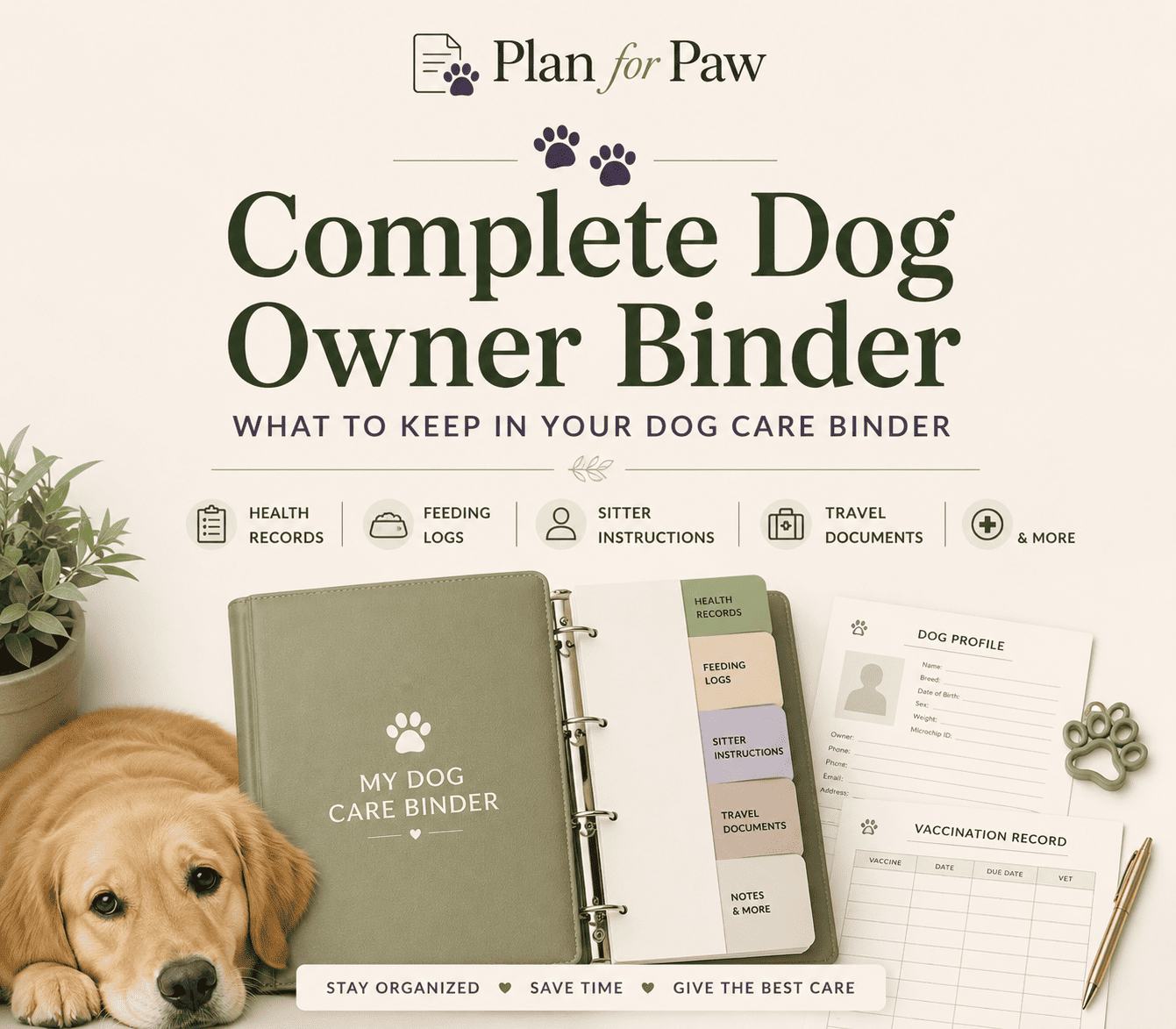
Choose dog binder sections for daily care, health evidence, training, handovers and spending, then test whether another carer can find the right page.
In short
Choose dog binder sections for daily care, health evidence, training, handovers and spending, then test whether another carer can find the right page.
A complete dog owner binder should connect everyday care with the records behind it. If the walker needs the lead rule, they should not have to search insurance invoices; if the vet needs a visit summary, it should not be mixed into yesterday's meal checklist.
Choose sections by the jobs your household actually does. This layout keeps the useful coverage of a dog binder while making the front of it practical for a person who has never opened it before.
Put the dog profile and urgent contacts first
Begin with the dog's name, identifying features, recent photograph and date of birth or estimated age. Include chip and registry details copied from reliable records. Put the current veterinary contacts and consenting backup person beside the profile.
Keep emergency information at the front, with a plainly labelled tab. Do not describe it as essential front-page information and then instruct readers to hide it at the back. A separate portable copy can help a carer who does not carry the whole binder.
- Identity and contact sheet.
- Index naming the actual sections.
- Current routine and its review date.
- Location of authoritative veterinary directions.
- Any unresolved care question and the person following it up.
Use written labels as well as colours. A colour-coded section loses its meaning on a monochrome photocopy, and a new reader may not know that blue means health. Put the dog's name on loose pages that could travel separately.
Give each binder section a defined purpose
The binder needs enough coverage to answer different questions without making you write the same event repeatedly. Keep a care action in its completion record and link to the relevant evidence when necessary.
| Section | Question it answers | Useful contents |
|---|---|---|
| Routine | What does this dog need now? | Established feeding, toilet access, activity and responsibilities |
| Daily log | What was completed or observed? | Actual meals, outings, care actions and exceptions |
| Health | What did the veterinary team say? | Current directions, visit summaries and certificates |
| Training | What are we practising? | Reward-based exercises, context and comfortable progress |
| Handover | What does a walker or sitter need? | Relevant current instructions and confirmed cover |
| Spending | What was paid or remains outstanding? | Receipts, invoices, claims and planned costs |
Use these categories as a starting layout, not a requirement to fill every page. A dog without a current training programme does not need invented homework. A blank spending tracker can wait until you decide what budgeting question it should answer.
Make daily logs short enough to maintain
Record the person who performed an essential task and distinguish it from the planned task. The log should tell the next carer whether the usual meal happened and whether food remained. “Breakfast planned” cannot serve as the completion entry.
For walks, keep context that matters to this dog: route, conditions, comfort and unusual events. There is no need to attach a universal performance target. A calmer outing during difficult conditions may be the appropriate choice rather than a failed goal.
Write behaviour as an observation. “Moved behind the owner when the visitor entered” is clearer than “was naughty with guests”. If a new health or behaviour concern appears, seek appropriate advice rather than using the binder to diagnose it.
For prescribed care, retain the veterinary team's written directions and use one agreed completion log. If a carer is uncertain what happened, the record should show that uncertainty and the question should go to the responsible veterinary team.
Keep training notes separate from clinical decisions
A training page can describe the cue, setting, reward and response. Include what made the exercise easier or harder so another household member can practise consistently. Record comfortable progress rather than demanding the same result in every environment.
Use reward-based methods and stop an exercise that creates fear or unsafe interactions. The binder is a place to organise an agreed programme, not a reason to continue until the dog stops protesting. Consult an appropriate professional when the situation needs more than routine practice.
Keep veterinary documents recognisable as veterinary documents. Preserve certificates and visit summaries, mark superseded instructions and separate owner questions from confirmed findings. A vaccination recommendation, a booked appointment and an administered vaccination belong under different labels.
Do not copy health instructions into several trackers unless you can reliably keep every copy current. Point a task sheet to the authoritative document, then record completion in the agreed place.
Prepare a walker packet and a sitter packet
A walker may need equipment details, escape prevention, the agreed route and behaviour notes. A sitter needs a wider care plan, supplies, veterinary contacts and a return arrangement. Select information by the role instead of handing everyone the whole archive.
Keep household credentials outside ordinary binder copies. Demonstrate keys and equipment during a practice visit, and confirm that the backup person can actually enter. The handover should state which task was last completed and who owns the next one.
Walker cover note: “Use the harness shown during our trial visit. The agreed route avoids the busy school entrance. Record any change in comfort and contact me if the outing cannot be completed safely.”
When you issue a temporary packet, date it and explain when the arrangement ends. On return, reconcile outstanding care before archiving the trip's notes. Old holiday exceptions should not become permanent instructions by accident.
Example: a binder for a dog with several carers
Otis has an owner, a weekday walker and a relative who sometimes covers evenings. The owner places identity and contacts first, then the current routine. The walker receives only the relevant outing sheet and contact information.
The daily record names the person who provided each outing and meal. When the relative covers an evening, they read the completed entries before starting. A vet invoice remains in the spending section, linked to the clinic document in the health section.
The owner tests the layout by asking the relative to find the next meal instructions and the most recent visit summary. A confusing divider is renamed rather than adding a second copy in another tab. That fixes retrieval without creating competing records.
Common mistakes when building a dog binder
- Printing every available template immediately. Unused sheets make important pages harder to find. Start with real tasks and add a page when it answers a specific question.
- Keeping several active feeding sheets. Carers may follow different versions. Select the current instruction, remove obsolete active copies and tell affected people what changed.
- Putting emergency contacts behind financial records. A helper may search the wrong section under pressure. Place urgent contacts at the front and label the index plainly.
Frequently Asked Questions
Do I need separate binders for two dogs?
Separate binders or clearly named sections can work. Choose the arrangement that keeps identities unambiguous, including on loose logs and copies sent to someone else.
Should the binder include every walk photograph?
Keep photographs that answer a real identification or care question. Ordinary updates can remain outside the binder; the care record should not become difficult to search through decorative material.
Can I use digital files for the archive?
Yes. Name and index the files so the paper action pages point to the right documents. Check that the person who needs a file has appropriate access and can open it.
When should I reorganise the sections?
Reorganise when a new care arrangement exposes a retrieval problem. Watch how a helper uses the binder and change the confusing label or location rather than expanding every section.
Resources & Links
These guides help you select useful healthcare information and urgent contacts for the dog binder.
- Blue Cross: Basic healthcare in dogs — Covers ordinary dog healthcare topics that help you choose relevant care and appointment pages.
- PDSA: Getting emergency vet care — Explains the urgent contact arrangements to place on the binder's front sheet.
The Complete Dog Owner Binder is for dog owners bringing daily care, supporting records and carer information into an organised system. Get the Complete Dog Owner Binder →
Printable and fillable PDF templates for pet owners — feeding schedules, health records, training trackers and more.