
Complete Cat Owner Binder: What to Keep in Your Cat Care Binder
Organise each cat's profile, feeding observations, litter care and clinical records while keeping shared-household uncertainty clear for carers and vets.
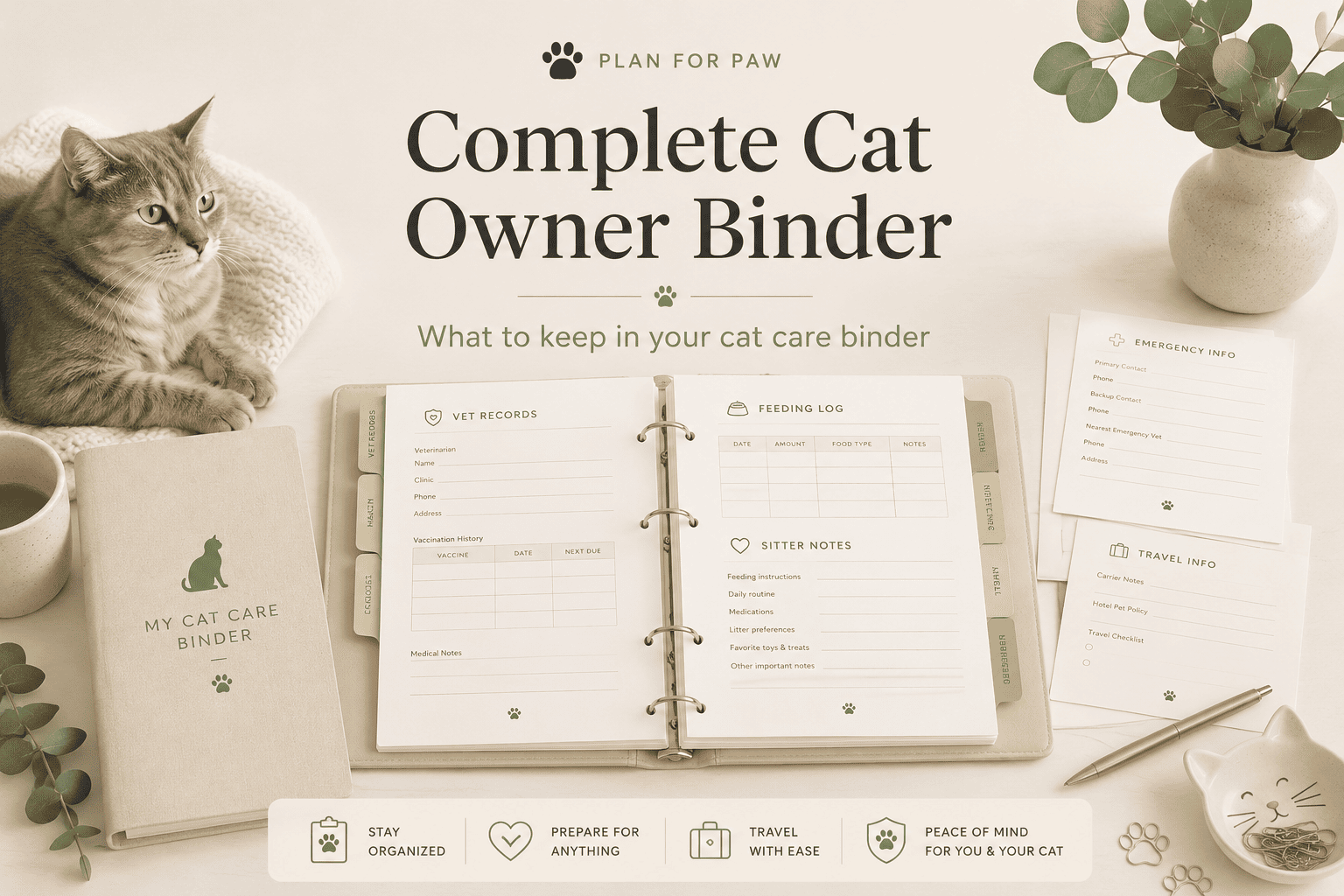
In short
Organise each cat's profile, feeding observations, litter care and clinical records while keeping shared-household uncertainty clear for carers and vets.
A complete cat owner binder should make it easy to answer questions about a particular cat. Shared bowls, shared trays and similar markings can otherwise turn a household observation into an inaccurate individual record.
Organise the binder around identity, feeding, litter care, veterinary evidence and sitter use. Keep the cat's ordinary preferences visible without treating them as explanations for every new health concern.
Start with a recognisable profile for each cat
Use a current photograph and distinguishing features alongside the cat's name. Include age or estimated age, chip registry details and the established indoor or outdoor access arrangement. This helps a visitor identify the right cat without approaching or lifting them.
Place owner, backup and veterinary contacts at the front. Add the carrier's location and point to any current written veterinary directions. Emergency information belongs where a carer will first look, not hidden behind old receipts.
- Cat's name and visible identifying marks.
- Recent photographs suitable for a private care packet.
- Registry details checked against reliable documents.
- Current access arrangement and rooms that must stay secure.
- Regular and emergency veterinary contacts.
- Location of carrier, active instructions and spare supplies.
Keep shared household information in a clearly labelled section, but put the cat's name on individual care pages. A profile that says “all cats” cannot resolve a question about which animal missed a meal.
Arrange feeding records around observed intake
The feeding section should state the established food, serving method, storage and feeding location. Preserve any current veterinary feeding instructions as the authoritative source. Do not add assumed supplements or improvisations because a printable contains an optional field.
Separate “served” from “eaten”. If several cats could access the bowl, note that individual intake was not established. Ask the vet how to obtain useful observations where health makes that distinction important.
| Feeding record | Useful wording | Unsupported conclusion to avoid |
|---|---|---|
| Meal served separately | Named cat, usual food and observed result | The cat must be healthy because it ate |
| Shared bowl checked | Food left; individual intake unknown | Every cat ate the same amount |
| Water replenished | Bowl checked and refreshed | Total drinking measured without observation |
| Appetite change | What differed and who noticed it | A guessed diagnosis or a fixed wait before calling |
Keep a concerning change visible until it has been followed up. The binder should support a call to the practice, not become a reason to watch an unwell cat indefinitely while collecting more entries.
Map litter resources and record uncertainty
List tray locations, the usual litter, cleaning supplies and the established cleaning arrangement. A simple room description can be easier for a sitter to use than a decorative floor plan. Include trays in less obvious rooms and spare materials.
Describe observable changes such as repeated attempts, unusual effort or waste outside the tray. Do not convert a shared tray observation into a diagnosis for whichever cat is nearest. If you cannot identify the cat, state that clearly when contacting the practice.
Straining to urinate requires immediate veterinary contact. Put that instruction alongside the emergency details rather than leaving it in an old appointment note. A carer should not wait for the owner to answer before obtaining urgent advice.
Keep routine cleaning records distinct from health observations. “Tray cleaned” shows a task happened; it does not establish that each cat used it normally. That distinction is especially important when several people share litter duties.
Keep clinical documents and prescribed care coherent
File visit summaries, vaccination evidence and results by cat and document date. Preserve originals where needed and keep the clinic's findings separate from your questions. Mark recommendations and pending appointments as plans rather than completed events.
Use the veterinary team's current written directions for any prescribed care. A completion page can reference those directions without repeating a treatment recipe. Arrange suitable support if the household cannot perform an essential task safely.
When an instruction changes, confirm what it replaces and remove the obsolete active copy. Tell carers who received an earlier version. Keep ended instructions in the history if useful, with their status plainly marked.
Retain unanswered questions where they can be seen. For example, a result requested from the clinic should remain labelled pending until it is received or the practice explains the next step. An empty result field is not a normal finding.
Give the sitter a cat-specific packet
Include the cat's hiding places, comfortable interaction preferences and normal response to this visitor. Show how presence can be checked without forcing the cat out. Describe door and window rules, food preparation, litter work and the carrier.
Use a dated care packet with only information needed for the visit. Keep access codes private and agree backup attendance. The sitter needs to know how to report an unlocated cat or concerning change, not just how to send an attractive photograph.
Sitter note: “Hazel usually rests on the wardrobe shelf and has a white front paw. Confirm her presence without pulling her down. If you cannot locate her, contact me and follow the agreed safe checks rather than assuming she is elsewhere.”
Demonstrate equipment while the cat is comfortable. Do not write generic restraint or treatment methods into the binder. When handling is difficult, discuss an appropriate arrangement with the veterinary team before it becomes an urgent task for an unfamiliar person.
Example: shared household, separate cat records
Hazel and Pepper share a home, but their meals are served in separate places. Each feeding entry names the cat and describes what the carer actually saw. A common supplies page tells the sitter where food and litter are stored.
The owner keeps tray cleaning as a household task and records individual toileting only when observed. An unusual shared-tray finding is labelled with that limitation. The practice receives the observation without an unsupported claim about which cat produced it.
During a trial handover, the sitter finds Hazel's profile easily but misses the carrier note. The owner moves that note into the front index and checks retrieval again. The clinical archive and expense records remain separate from the packet used during visits.
Common mistakes with cat binders
- Using household totals as individual observations. Shared access hides which cat ate or toileted. Record the limitation and use an appropriate individual observation arrangement when needed.
- Explaining every change as a cat being particular. Familiar preferences do not rule out illness. Describe the new change and ask the veterinary team how urgently to act.
- Sharing the full archive with every sitter. It adds private material and makes key instructions harder to find. Send a current cat-specific packet and retain supporting evidence separately.
Frequently Asked Questions
Where should behaviour preferences go?
Put ordinary handling, play and hiding preferences in the care and sitter sections. Keep professional advice or clinical findings identified by source so preferences are not mistaken for treatment instructions.
Can one litter log serve several cats?
It can record household cleaning and shared observations. Label individual identity as unknown unless actually established; do not divide the entries between cats by guesswork.
What should a carrier page contain?
State the carrier location, closures and demonstrated safe handling arrangement. Include relevant veterinary contacts and ask for professional help where essential handling cannot be carried out safely.
How do I keep a sitter's old copy from being reused?
Issue a dated replacement and explicitly say it supersedes the previous packet. Ask the sitter to discard the obsolete active copy, while keeping past visit notes separately if useful.
Resources & Links
Use these feline and veterinary guides to support the care pages you keep in the cat binder.
- PDSA: Creating a cat-friendly home — Explains feeding, resting and litter resources to identify in your household and sitter sections.
- PDSA: Health checks at home — Shows comfortable checks and changes worth describing to the practice alongside your cat's records.
The Complete Cat Owner Binder is for households organising cat care, veterinary documents and information for visiting carers. Get the Complete Cat Owner Binder →
Printable and fillable PDF templates for pet owners — feeding schedules, health records, training trackers and more.