
How to Introduce a New Pet to Your Home Without the Chaos
Introduce resident and new pets through controlled meetings, separate resources and escape routes. Use dog-and-cat steps, stop decisions and a worked example.
In short
Introduce resident and new pets through controlled meetings, separate resources and escape routes. Use dog-and-cat steps, stop decisions and a worked example.
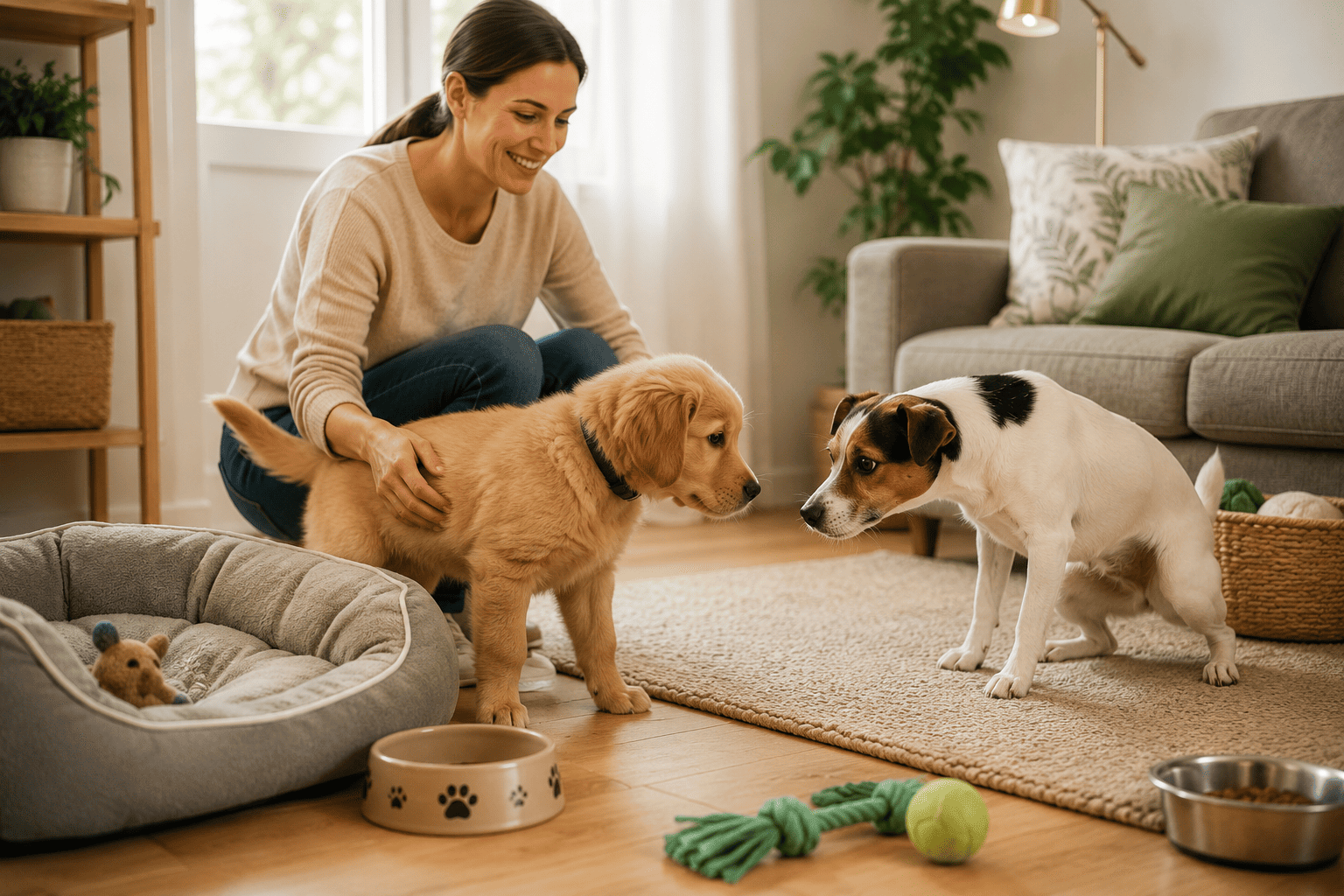
To introduce a new pet to your home, you need a way to protect the newcomer and any resident animals from an encounter they cannot escape. A successful meeting gives each animal space and ends before chasing, cornering or tension builds.
Prepare separation, decide who controls each animal and choose the next encounter by how both respond. Quiet coexistence can be a useful goal; pets do not have to share beds or play together.
Introduce a new pet to your home: prepare controlled access
Make separate care work before allowing contact. Each area needs food, water, a resting place and the relevant toilet arrangement. Test the doors and barriers against jumping, squeezing and accidental opening.
- Choose where each animal stays when no adult can supervise.
- Keep the resident pet's familiar resources available.
- Assign one person to each animal during a managed encounter.
- Plan an easy route back to separate areas.
- Remove shared food, chews and other resources that may create conflict.
- Tell visitors which doors stay closed and which meetings are currently permitted.
A gate may be enough for one pairing and unsafe for another. Use a closed door when you cannot prevent contact through or over the barrier. Ask for professional help before encounters involving known aggression, intense chasing or vulnerable animals.
Choose the meeting method for the animals involved
| Pairing | Useful starting arrangement | Important limit |
|---|---|---|
| Dog and dog | Quiet space with two handlers and room for parallel movement | A brief calm walk does not settle home resource sharing |
| Cat and cat | Separate base areas, scent familiarisation and protected visual access | No forced face-to-face contact in a carrier |
| Dog and cat | Secure separation, a controlled dog and cat retreat routes | Prevent chasing rather than expecting the cat to stop it |
| Small animal and dog or cat | Protected species-specific housing and separate spaces | Do not use direct access as a test of friendliness |
For arrival space and the first household settling routine, see settling a new pet into your home. Keep the secure base available throughout later meetings.
Manage a dog-to-dog encounter without a doorway rush
- Choose a quiet, secure location agreed with the rescue, breeder or behaviour professional.
- Have a separate handler for each dog and begin with enough distance for relaxed movement.
- Walk in the same direction without requiring nose-to-nose greetings.
- Keep room to move away if either dog stiffens, fixates or repeatedly avoids contact.
- Allow a manageable closer encounter only while both remain comfortable.
- End calmly and return to the planned separate arrangements.
Avoid tight leads pulling dogs together or a crowd surrounding the greeting. At home, manage the entrance separately so excitement does not build in a narrow space. Feed separately and protect rest while you learn how they use shared areas.
Ask for help if either dog guards access, repeatedly pursues the other or cannot disengage. Do not stage another meeting simply to see whether they will settle the disagreement themselves.
Let cats become familiar without forced contact
Settle the new cat in a protected room and keep the resident cat's routine available. When both are comfortable, offer familiar scent items without pushing them towards the cat. Leave room to approach or walk away.
Introduce visual access through a secure arrangement only after the cats can manage the earlier separation comfortably. Start with distance and a short encounter. Stop when staring, crouching, avoidance or attempts to reach the other cat make the situation harder.
Later shared space needs multiple routes and places to retreat. Keep resources distributed, including a general starting point of one litter tray per cat plus one extra in separate locations. Do not make one cat pass the other to reach every tray or meal.
A cat watching quietly from a corner may still feel trapped. Look for the ability to move normally, turn away and resume ordinary activity before making the encounter more demanding.
Prevent chasing in dog-and-cat meetings
Begin with scent familiarisation and secure separation. During a controlled visual encounter, keep the dog under reliable physical control and give the cat a route away that the dog cannot follow. A cat held in your arms cannot choose distance safely.
- Prepare the cat's protected area and escape routes first.
- Use distance where the dog can remain calm and respond to the handler.
- Reward the dog for turning attention away from the cat.
- Let the cat choose whether to remain visible.
- Finish before staring, pulling or pursuit takes over.
If the dog repeatedly fixates or lunges, increase separation and seek individual support. Never release the dog to see how the cat reacts. Preserve separate areas whenever supervision is unavailable, including overnight.
For a detailed stage-by-stage plan for this pairing, see how to introduce a cat and dog.
Decide whether to repeat, make it easier or stop
| What you see | Next decision | Practical change |
|---|---|---|
| Both can turn away and continue ordinary activity | Repeat at the same easy level | Keep the same distance and control before expanding |
| One freezes, hides or watches continuously | Reduce the pressure | Increase distance or return to non-visual separation |
| Chasing, lunging or cornering begins | End access safely | Restore separation and seek professional guidance |
| Comfort changes around food or rest | Protect those resources | Feed separately and provide undisturbed resting areas |
Progress has no shared deadline. A pairing may need sustained management, and some animals cannot safely share unrestricted space. Ask a vet and qualified behaviour professional when you cannot keep both comfortable and protected.
Worked example: a cat controls the pace
Bea's new cat, Iona, stays in a quiet room while the resident dog uses the rest of the home. After comfortable scent exposure, Bea arranges visual access with the dog on a lead and Iona free to leave the view.
The dog looks away for a reward, but Iona crouches and retreats. Bea closes the view and returns to the quieter arrangement. She does not carry Iona closer to complete the meeting, and the next attempt begins farther apart.
Household instruction
“Keep Iona's room closed. One adult handles the dog during planned meetings. The cat is never carried towards the dog. If either animal cannot turn away comfortably, we end the view and return to separate spaces.”
Common introduction mistakes to avoid
- Using a carrier as a forced greeting cage: let the newcomer retain a protected base and choice.
- Removing separation after one quiet meeting: check ordinary home situations before expanding access.
- Expecting pets to share food: protect meals and valuable items.
- Leaving children to manage encounters: adults supervise and arrange safe separation.
- Ignoring discomfort because nobody fought: notice avoidance, fixation and blocked movement.
Frequently Asked Questions
How long do introductions take?
It varies by pairing. RSPCA notes that cat introductions can take a week to several months. Use comfortable responses to choose the next step rather than expecting shared access by a fixed date.
Should I hold my cat while the dog sniffs?
No. Give the cat a protected choice to approach or retreat, and control the dog. Holding the cat removes that choice and can expose you to scratches or bites.
Can I leave pets together after a calm first meeting?
Keep separation whenever you cannot supervise until the individual pairing can be managed safely. A first meeting does not reveal every reaction to food, doorways, toys or rest.
What if the pets never become friends?
Comfortable, safe coexistence may be enough. Maintain separate resources and resting options. If ongoing tension makes that impossible, seek professional help and review the living arrangement.
Resources & Links
These sources support gradual meetings and separate access to essential resources.
- PDSA: Introducing Cats and Dogs — Plan separation, controlled contact and escape routes in a mixed-species home.
- RSPCA: Keeping Cats Together — Check the gradual introduction process and allow time for each cat to settle.
- RSPCA: Company for Dogs — Consider compatibility and social contact when arranging dog meetings.
Printable and fillable PDF templates for pet owners — feeding schedules, health records, training trackers and more.