How to Give a Cat or Dog a Pill Without a Struggle
Getting a pet to take medication is one of the most common daily challenges for pet owners. Here are the methods that actually work — for dogs and cats — and what to do when nothing else does.
In short
Getting a pet to take medication is one of the most common daily challenges for pet owners. Here are the methods that actually work — for dogs and cats — and what to do when nothing else does.
If you have ever spent ten minutes coaxing a cat to take a tablet only to find it spat out, hidden under the sofa two hours later, you are not alone. Medicating pets is a universal challenge, and yet most owners are given a box of tablets and sent home with minimal guidance on how to actually get them in. Here are the methods that work.
For Dogs: Start with Food
Most dogs are easier to medicate than cats because food motivation is typically higher. The approach that works for the majority of dogs:
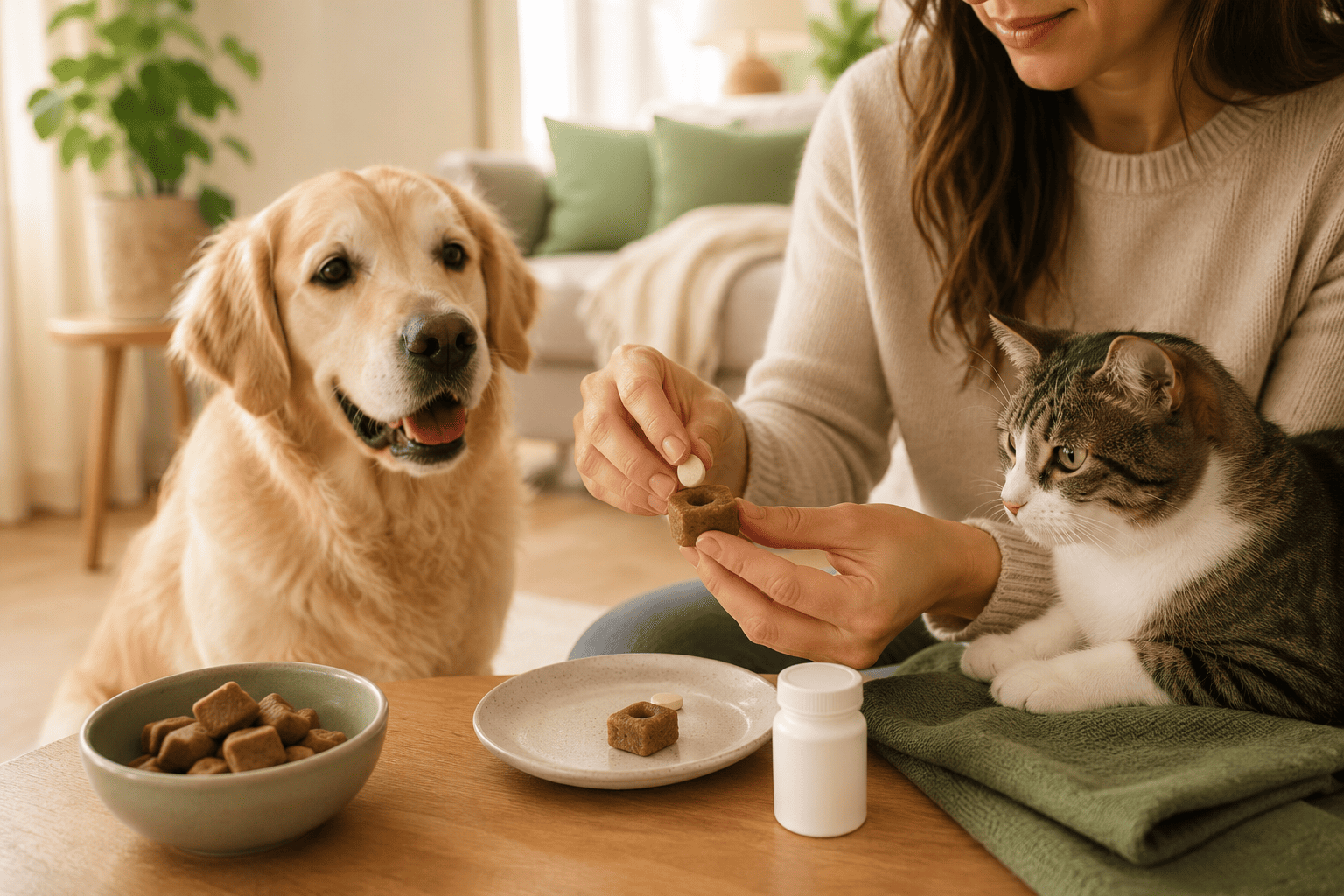
- Pill pocket or soft treat: Wrap the tablet in a small piece of soft treat — cream cheese, peanut butter (xylitol-free), a small piece of cooked chicken, or a purpose-made pill pocket treat. Give the dog a plain piece of the same treat first, then the one with the pill, then another plain piece. The anticipation of the final treat encourages fast swallowing of the middle piece.
- The "three treat trick": Toss the first plain treat so they catch it. Toss the pill treat. Toss the third plain treat immediately — the speed of the sequence encourages swallowing without checking.
- Hollow treat or food toy: Press the tablet into a piece of banana, a grape-sized ball of wet food, or a Kong filled with paste. Works best for dogs who gulp rather than chew.
Direct Pilling a Dog
If food hiding fails (some dogs are expert at eating around the tablet), direct pilling is the alternative.
- Hold the tablet between your thumb and index finger with your dominant hand.
- Cup your other hand over the muzzle from above, fingers either side of the canine teeth, and gently tilt the head back.
- Use your pilling hand's middle finger to open the lower jaw.
- Place the tablet as far back on the tongue as possible — past the middle of the tongue, toward the throat.
- Close the mouth and hold it gently closed with the nose pointing slightly upward. Stroke the throat or blow gently on the nose to encourage swallowing.
- Follow immediately with a small syringe of water or a treat to help the tablet go down.
For Cats: It Is Harder
Cats are more resistant than dogs for two reasons: they are less food-motivated on demand, and they are better at detecting something wrong in their food. Still, several methods work reliably.
Method 1: Pill in Food (Not Always Reliable)
Crush the tablet (check with your vet that the medication can be crushed — not all can) and mix into a small amount of strong-smelling wet food. The amount of food should be small enough to be eaten in full — mixing into a full meal risks the cat eating around the medication or leaving some.
Method 2: Pill Pocket or Treat
Pill pockets designed for cats are soft, mouldable, and come in meat flavours. Warm the treat between your fingers before moulding around the tablet — the warmth increases smell and palatability. Give two plain treats first, then the pill treat.
Method 3: Direct Pilling a Cat
- Wrap the cat in a towel (the "burrito" method) to prevent scratching.
- Hold the cat's head from above, with your thumb and forefinger on either side of the cheekbones.
- Tilt the head back until the nose points at the ceiling — the jaw will drop slightly.
- Use your other hand's index finger to press down the lower jaw.
- Drop or place the tablet as far back on the tongue as possible.
- Close the mouth immediately and keep the head tilted. Blow gently on the nose. Look for a lick — this confirms swallowing.
- Follow with a small syringe of water (1–2 ml) to prevent the tablet sitting in the oesophagus, which can cause irritation in cats.
Method 4: Pill Giver (Pooter)
A pill giver is a long plastic syringe with a soft tip that holds the tablet. It places the pill further back than a finger can reach, making spitting more difficult. Ask your vet to show you the technique once before using it at home. They are particularly useful for cats that bite when you put your finger in their mouth.
When Standard Methods Fail: Alternatives
- Liquid medication: Many tablets can be compounded into a liquid formulation by a compounding pharmacy. For cats who resist all other methods, a flavoured liquid (chicken or fish) that can be syringed into the side of the mouth is often more successful.
- Transdermal gels: Some medications are available as gels that are rubbed into the inner ear flap and absorbed through the skin. Ask your vet whether this is available for your cat's specific medication.
- Long-acting injections: For some conditions, a monthly or quarterly injection given at the clinic eliminates the daily tablet problem entirely.
Tracking Medications
If multiple people in your household may give medication, or if your pet is on several different medications at different times, a simple medication log prevents accidental double-dosing and gaps in treatment. Note the medication name, dose, time given, and whether the pet took it fully. This is also invaluable information for your vet at check-ups.
Pet Health Record Binder
Includes a medication tracker, vet visit log, vaccination record and allergy notes — so nothing gets missed and every vet visit starts with complete information.
Get the Pet Health Record Binder →Frequently Asked Questions
Can I crush tablets for my pet?
Some can be crushed, others cannot — including extended-release formulas, enteric-coated tablets, and some medications that taste so bitter when crushed that pets will refuse all food they are mixed into. Always check with your vet or pharmacist before crushing.
My cat always spits out tablets. Is there another option?
Ask your vet about compounding the medication into a flavoured liquid or transdermal gel. For long-term medications, this can save significant daily stress for both of you.
How long after a meal should I give medication?
Some medications must be given with food, others without — check the label. If the instruction is "with food", give the medication during a meal or within 30 minutes of eating, not hours later.
Printable and fillable PDF templates for pet owners — feeding schedules, health records, training trackers and more.